Bychkov conducts Mahler's First Symphony
An excellent, if not game-changing, recording.
A symphony should be like the world, it should encompass everything.
So said Mahler himself, and his ambitious First Symphony sets out to do exactly that.
We have previously looked at Bychkov's Fourth and Fifth Symphonies on Pentatone, and we should not forget a live Mahler Fifth with the Czech Philharmonic at the Barbican ....
Now to the First. Here's a brief promo video from Pentatone:
If anything this is even finer overall, but comes with the occasional caveat. Again, the sheer orchestral excellence is impressive from the off. The way the strings control the sustained octave prior to the woodwinds' Wie ein Naturlaut” is extraordinary (the last time I heard control like that was the Bavarian Radio Symphony and Kubelík back in the early 1980s!). The trumpets, a distantly remembered military, are a perfect unit; the horns' linearity is perfectly balanced.
I wonder if just a touch more freshness to the Wunderhorn theme ("Ging heut' Morgen über's Feld") would have sealed the deal in the first movement proper, Incidentally, if you want to explore some of Mahler's Wunderhorn songs, this post will point you in the right direction (Boulez et al).
The level of detail combined with the evocation of a properly Mahlerisch soundworld is extraordinary, the return of the opening carrying huge weight. Then there's the lovely, creamy horns for their statement of the theme that will later crown the movement:
The second movement continues the Nature element in its very rusticity, itself pitted against a gentler Trio (the latter here faster than one might expect). The Trio does sound a tad rushed - a little more space would have sealed the deal.
The third movement is the famous minor-mode "Frère Jacques," launched from near-silence on the timpani and by one of the finest double-bass solos I have heard. It initiates a performance that has total grasp of Mahler's layering technique (it is a round, after all). The funeral procession is mobile and yet unstoppable; No-one can beat the swing Bernstein's contrasting episode, though:
This movement, if anything, is Bychkov's's Achilles Heel - it feels as if it needs just a touch more space to breathe throughout.
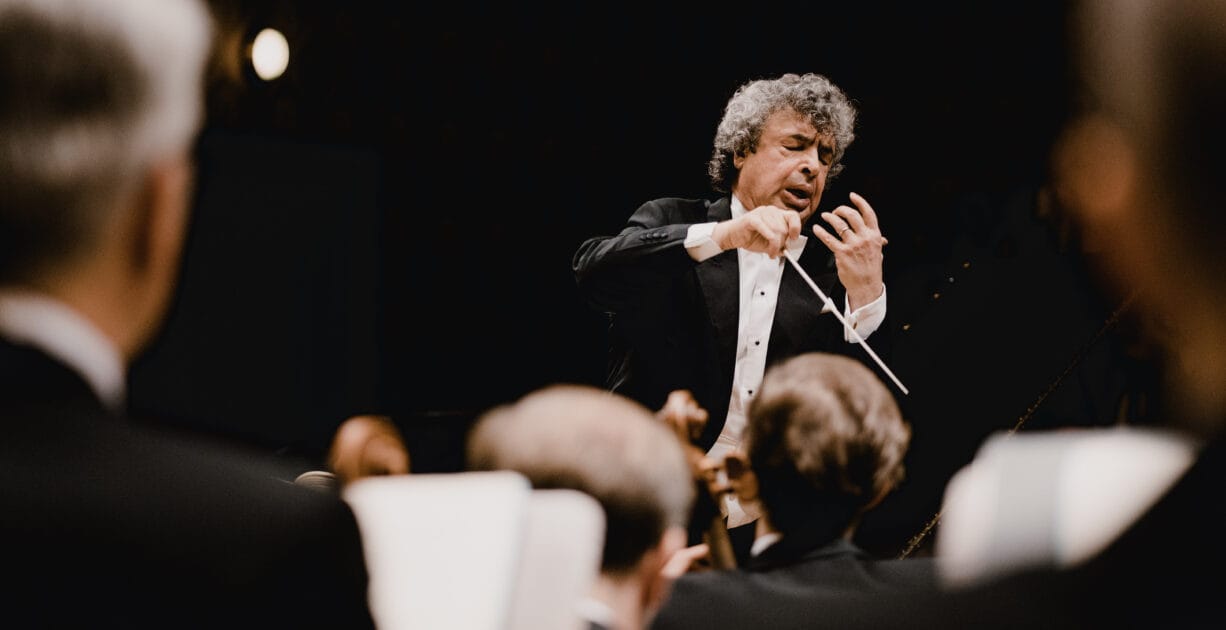
The Pentatone recording (2021, Rudolfinum, Prague) is exemplary, as one might expect form this source. If you want road test it, try the opening of the finale, a proper explosion (as it should be). "Stürmisch" is the marking, and so it is:
... and it is here in the last movement that Bychkov really comes into his own. There are stretches in the finale that test the finest conductors: the music needs to be continually on the simmer when it's not boiling over: let it sag, you're lost. Bychkov understands this perfectly, and how it works, pianissimi stretching back in power right back to the symphony's opening. The approach to the final peroration is superbly calibrated:
An excellent, if not game-changing, recording. It is available at Amazon here; the Bernstein/Concertgrbouw is here; the Kubelík is a snip here.