
Divisions and Visions: the London Piano Festival returns!
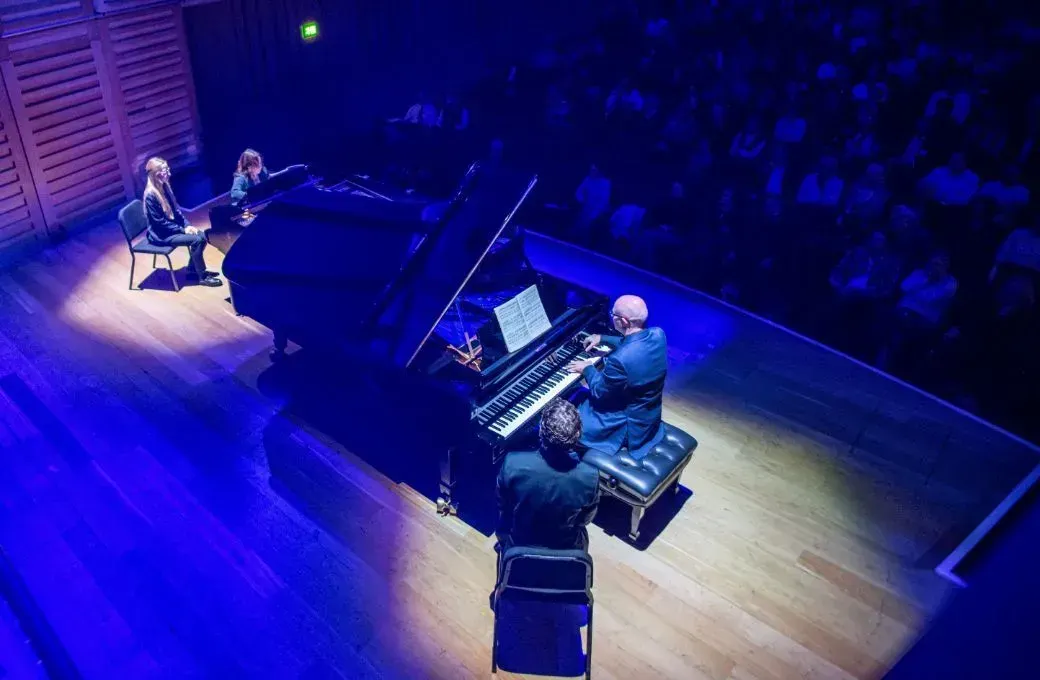
London Piano Festival (1): Opening Night, Divisions & Visions Donald McLeod in conversation with George Benjamin; Charles Owen, Katya Apekisheva (pianos). King’s Place, 29.10.2026
Benjamin Two or Four (2010). Divisions (2024/5).
Messiaen Visions de l’Amen (1943).
The London Piano Festival returns to King’s Place curated by co-directors (and performers here) Charles Owen and Katya Apekisheva with Philip Jones as Chair. This year, there is a Steinway exhibition in the foyer, which also hosts Young Artist Platform performances at the weekend.
This was a brave way to start, with music with the ink metaphorically still wet on one of George Benjamin’s pieces, and some austere Messiaen. Opening nights of previous festivals have certainly been fuller, but I cannot remember a more stimulating and musically successful opening concert (and I have been attending since inception).
Charles Owen and Katya Apekisheva opened the evening with a performance of George Benjamin’s Two or Four of 2010 and exists in two near-identical halves, but the first is for two hands, the second for four. As Benjamin says, it is a ‘tiny’ piece, beginning with two hands (Apekisheva), then moving to four. This was a supremely expressive, musical performance that complemented the music’s own world, a sense of Modernist flow, with the second pianist adding richness
Benjamin’s chat with Donald McLeod was an ideal mix of introduction and detail - something to satiate all levels of experience. Inevitably, Benjamin’s time with Olivier Messiaen in Paris was a major part of the discussion, but there was real insight into Benjamin the man as well as composer, too (he was something of a Wunderkind, after all). Benjamin rightly pointed out, too, that people did not write for piano duet (four hands/two pianos) much any more as the originating functionality (arrangements of symphonies for domestic performance for example), now rendered unnecessary thanks to our instant access.
First performed in May 2025 by Pierre-Laurent Aimard and the composer in Paris, Divisions is a more substantial work (around a quarter of an hour). With Charles Owen on Primo and Katya Apekisheva on Secondo, the immediate impression was a piano invocation of gamelan. Mild dissonance felt maximally expressive, as did the pianists’ sheer variety of timbral resource: at one point, the Primo’s martellato is pitted against a lusher Secondo backdrop. There are, undoubtedly, echoes of Messiaen here in its sense of monumentalism of the the piano’s bass end (Apekisheva); this, in a piece that also dynamically extends down to what must be at least ppp. But it was the sense of scintillating dance that was so exciting - a terrific, informative and musically engaging first half.
Messiaen’s Visions de l’amen is one of the great two-piano works, an edifice written for the composer himself to play with his then-student, Yvonne Loriod (who was to become his second wife): Messiaen took the ‘melodic’ Secondo, with Loriod on the more complex Primo. The basis of the work is the different definitions of the word ‘Amen: that of the Creator (movement 1), the Amen of obedience to Divine Will (movement 3), the Amen of longing for union with God (movement 4), and Amen of the eternal consummation (the seventh and last movement).
In accordance with the composer’s association with synaesthesia, different coloured lightings were used for each movement.
The layering of the first movement, ‘Amen de la création,’ was finely calibrated here. The important bass part of the second, ‘Amen des étoiles, de la planète à l’anneau’ (Amen of the stars, of the ringed planet) carried full weight from Apekisheva, the climax overwhelming - and with some Messiaen ‘jazz’ on the way, the whole screening towards its conclusion.
The agony of Jesus forms the subject matter of the third movement (purple, apparently). This is very gestural music until the lyrical theme appears, and they could have come across as more marked, more individuated. But how well Apekisheva voiced the chords here (the ‘Bien modéré’ is Secondo only), while chordal exchanges between Owen and Apekisheva were beautifully matched. And how those ultra-low bass notes tolled like bells.
The sweetest of Messiaen chords graces the ‘Amen du désire,’ delivered by Secondo with the quietest of adornments from the primo. ‘Messiaen is as loving and generous with his instructions as he is with the mystic sensuality of his chords: ‘Très lent, avec amour’ as the general instruction, supplemented by ‘chanté, espressif et tendre’ for the choral main line. There was a sense that time stopped still in the perfumed wonder of it all. Again, superb voicing from Apekisheva.
Owen and Apekisheva’s reading was shot through with lyricism: assertive though the opening of ‘Amen des anges, de saints, du chant des oiseaux’ is (it is also marked ‘chantant’; it is also, apparently, green). There had to be some birds somewhere! - here, it is in this movement’s middle section, a swathe of heavenly acciaccaturas. Perhaps I would have welcomed an even harder touch and primal secondo delivery in the ‘Amen du Jugement’; this lost some tension, surprisingly, less ‘inside’ the pianists interpretatively. But the final ‘Amen de la consummation’ was full spectrum, a panoply of pianistic wonder and, for all its volume, texturally clear throughout. The many repetitions of the ‘Creation’ theme here had a sense of inevitability, a slow momentum that was unstoppable, the concluding fffff bell-encrusted statement properly climactic.
A daring and yet rewarding start to the 2026 London Piano Festival. The Saturday night Gala is an all-Mozart affair: watch this space!