Lyatoshynky String Quartets
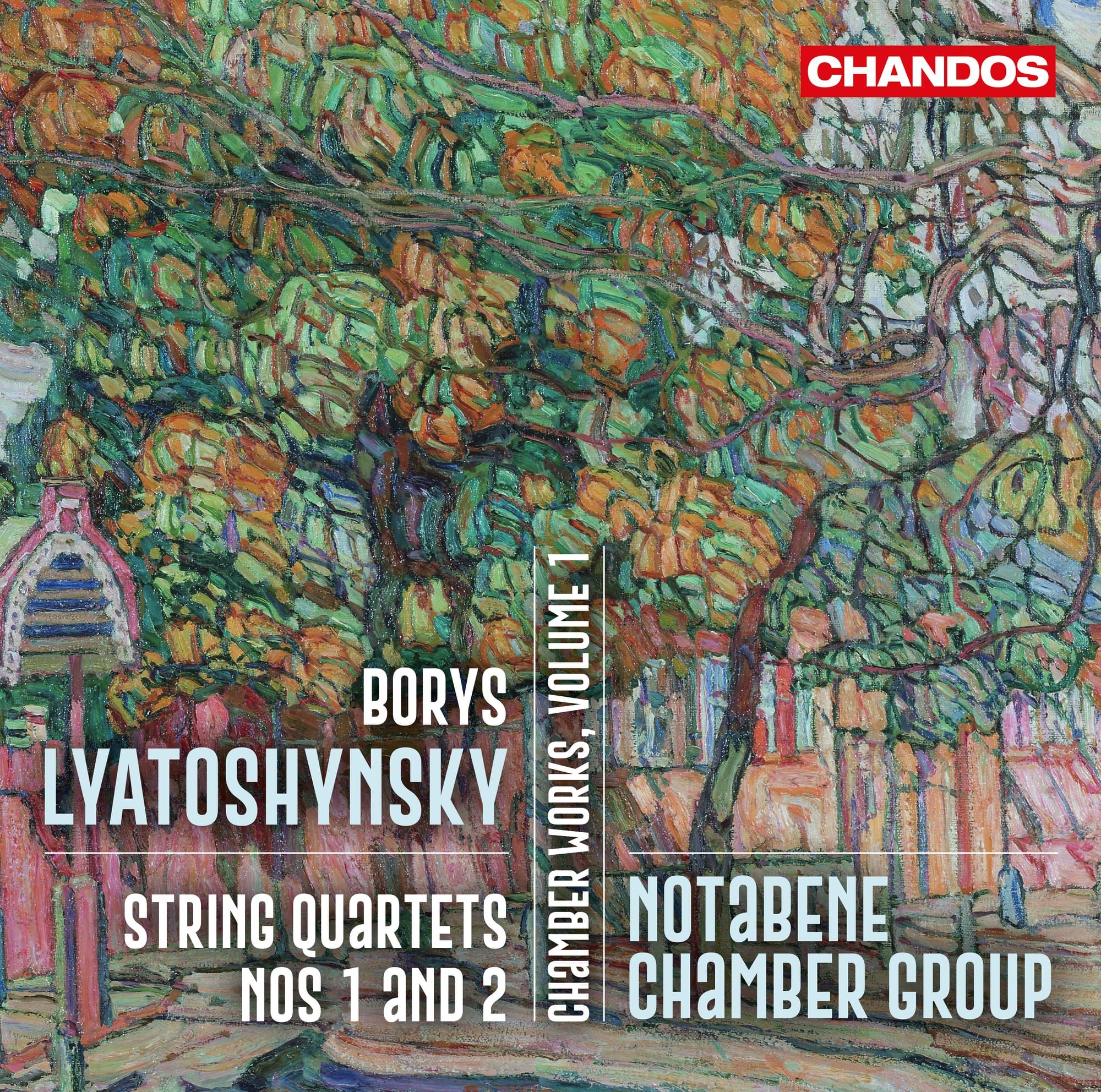
“Lyatoshynsky Chamber Music, Volume 1” bodes well here. We've already considered a disc of his symphonies on cpo here (Nos. 4 and 5), and this Third Symphony live with the LPO and Vladimir Jurowski here. It is good, though to enter into the ore intimate realm of chamber music,
Released October 23, this nicely expands our knowledge of one of the leading Ukrainian composers of the twentieth century (and Professor of Music at Kyiv Conservatory). It particularly expands our knowledge as the first String Quartet was written in 1915, whilst a student of Reinhold Glière, whose music we really must cover soon (he's best known for the symphony, “Ilya Muromets” and a Harp Concerto, Op. 74: the symphony burst into our collective consciousness in the UK via the RPO and Harold Faberman on an old Unicorn-Kanchana on a gatefold double LP - I remember pining after it when I saw the ad in Gramophone!).
The four players of the NotaBene Chamber Group (Andrii Pavlov, Maksym Grinchenko, violin; Ihor Zavorodnii, viols; Artem Poludennyi, cello) perform exquisitely together. There is a grand lyric impulse throughout, including the first movement, while folk music informs the phrase shapes. Here's that first movement:
The briefer second movement has a jauntiness about it, and is far from facile: this is a remarkable work whose expertise completely belies its student origin. The melodic impulse is marked here, those folkloric themes given full force, and yet decorated with spiky commentary. There's also the most delicious pianissimo textural tapestry towards the end:
The slow movement is almost a Ukrainian equivalent of a late Beethoven Quartet solo movement. The melodic shapes are once ore derived from folk music, but held within a sophisticated cradle. The contrasting Allegretto section of this movement is a jaunty ray of light. Tempos are perfectly chosen by the NotaBene ensemble: a perfect Allegretto contrasts with a perfect Lento ma non troppo, which means a return to the movement's main theme in triumph makes full impact. It's a truly inspirational moment:
The finale is certainly the prescribed “energico” here, but contains great lyric contrasts. It rise sto a marked climax, too, just after five minutes in, but it is Lyatosynsky's ability to create a kaleidoscope that is so impressive.
For a student work, this piece enjoyed notable success, and deserved success at that - the Leontovych Quartet (part of the Leontovych Music Society) took it into its repertoire.
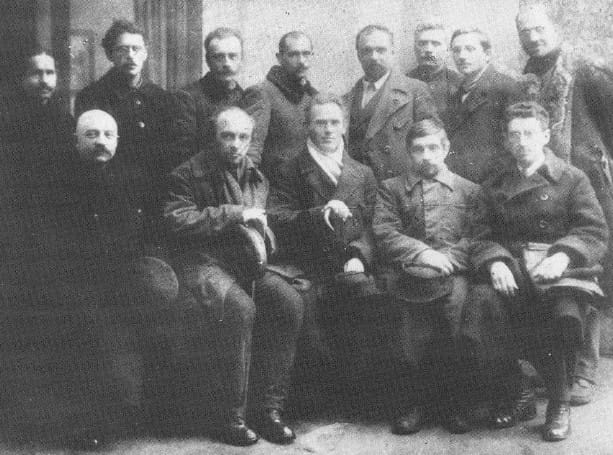
The Second Quartet, Op. 4 dates from 1922. ,Aged 27, Lyatoshynsky had more of an individual voice by that time. There are connecting threads between the first and second quartets, though, including the use of Russian and Ukrainian folk music. It is heard here in its 1926 revision .
Immediately the harmonies are different, as are the long-limbed themes. Polyphony is a real part of the equation, too (listen to the arrival of the second subject in the first movement). The lyricism is a statement of Lyatoshynsky's love for his wife - at times, there are hints of Schoenberg's Verklärte Nacht here. Listen to the opening carefully - it transforms into the most luminous ending for the first movement:
There is no doubting the folkish basis of the second movement, an “Intermezzo”. Some of the writing is so delicate, almost shimmering, as Lyatoshynsky has all four players up high:
This, surely, has to be one of the most purely magical movements for string quartets ever written, and the Notabene group excel in their control - the music's often tissue-thin textures leave nowhere to hide for the performers. As Iryna Tukova says in her accompanying notes, this is the world of Eastern fairy tale.
The Scherzo (brief at less than four minutes) and finale seem to morph into each other even as the spectral nature of the third movement looks back to the supernatural world of the second.. The textures of the finale are almost thicket-like at times; at others, they look back and reframe the etheric sounds of earlier in the quartet:
Founded in Kyiv in 2015, the NotaBene Chamber Group is a collective of musicians of the new generation, whose repertoire focuses on classical and contemporary music. Lyatoshynsky is obviously at the heart of their activities and it is diffcult to imagine these works better served. While the symphonies are relatively well represented in the catalogues, the quartets have received far shorter shrift. There is an alternative No, 2 from the Tchalik Quartet on Alkonost Classics which is another fine account (coupled there with Ravel's Quartet in F, Op. 35 and Lyatoshynsky's Third Quartet.
Here's a link to the Tchalik Quartet's complete disc; below the first movement so you can get a feel for their performance, a little more objectivist perhaps, and yet no less valid:
There's also the Lysenko Quartet's version of No. 2, the YouTube of which carries scrolling score:
As a taster for what is (probably) the next release, here's a live performance of Lyatoshynsky's Third Quartet, Op. 21, by the Notabene Chamber Group, recorded in the Mirror Hall of the Lviv Opera House, 2023:
This fabulous disc is available at Amazon here. Streaming below.