
MOURN: FIGURE and Alkanna Graeca at Stone Nest
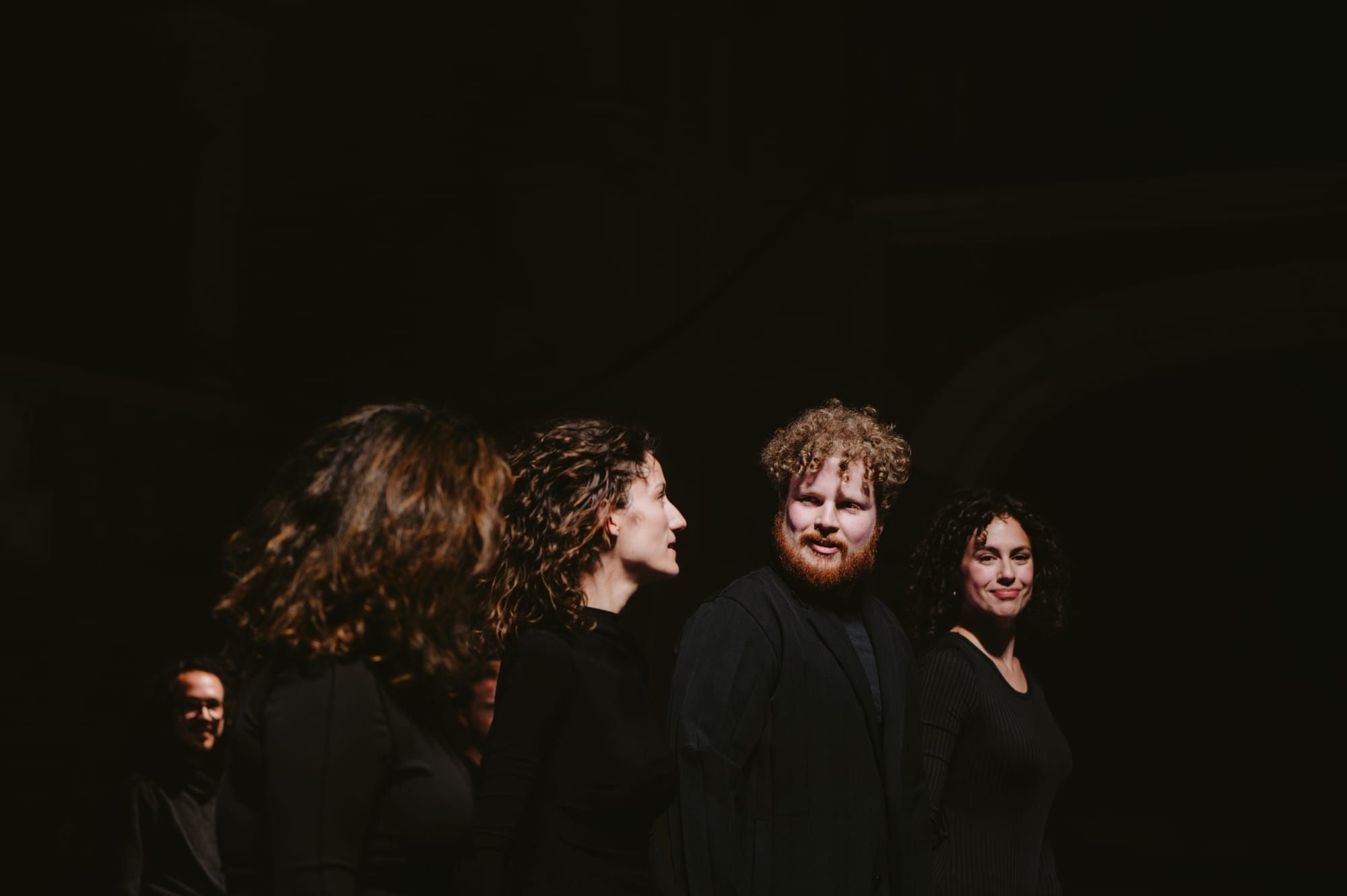
The London venue Stone Nest seems to be a hub for innovation: in March 2024, I attended a performance of Our Mother, starring Emma Kirkby and with the same ensemble as here, FIGURE. That was impressive, for sure, but MOURN, an examination of grief through multiple lenses, cut even deeper.
From Renaissance Italy to the timeless folk musics to ancient Balkan grief ceremony, MOURN seemed to act as a prism, taking the concept of death and exploding its ramifications for those left behind out in a multiplicity of direction. A vital part of this was the lighting (Edward Saunders), which in combination with the space caused the starkest of contrasts - light shining brightly in the prevailing darkness - as well as the inviting in a sense of ritual.
The music came from the Western canon and further afield, to the Croatian area of Slovenia: ancient locales are specified, quite rightly (Epirus is a historical region now across Albania and Greece; Thrace is a historical region now across Bulgaria, Greece, and Turkey).
It was right that the rawness of Mirangula (from Georgia) launched the evening, performed at the high arch above the stage, its onward tread perhaps implying a bastardised Winterreise, its unisons stark, that rawness remembered much later in the evening in Mor’ Deropolitissa (from Epirus). Alkanna Graeca is a remarkable, flexible ensemble, the three members of which excelled throughout.
Here's a performance of Mirangula by the Kolkheti Ensemble:
The switch to Lully (a Passacaille from Armide) offered at once contrast but also a reminder that grief and mourning affect all nations; as well as the astonishing power of Lully's music.
The Albanian Janines c’i pane syte offers examples of individual and collective grief; heard in scaled-down format, Gesualdo’s O vos omnes melds the fragile individual and the collective perfectly. And through all of this inter-regional shifting was a thread of pain - unrelenting pain with only brief glimpses of hope (as grief itself often manifests, of course),
The shifts of harmonic bases were not the only aspect that moved from region to region - melodically, the sheer melismatic fluidity of some of the music came across as extended lines of pain: Skaros (from Epirus) is a case in point, and in an interesting parallel, there was a similar effect from Barbara Strozzi’s Lagrime mie within a different harmonic framework, all set against the harmonic pain of Monteverdi’s Lamento della ninfa (from the Eighth Book of Madrigals). All three singers of Alkanna Graeca are exceptional, but perhaps a special word is due for the sheer passion and pain that Dunja Botic holds within her voice.(try this, if you don\t believe me).
It is difficult to decide (perhaps we should not have to, or even try to) which form of mourning is deeper. Whichever, were real rarities here: an aria from the third act of Cesti’s 1669 opera L’argia is as fragile as they come (Disserratevi abissi: “Throw open your gates, abysses, I have come to weep”), its emotions echoed by the more gentle words of the Thracian song, Giati m’ den kelaidis (Why don’t you sing, little bird, the way you sang before?) and the mobile rhythms yet highly disturbed vocals of Vini uara uara i’l of the Vlach people.
Handel’s lovely, tender “Lascia ch’io pianga” needs no introduction, but it is with regional music the evening ended, a Balkan (Croatoslovenian) lullaby, Drijema mi se, drijema (the text translates to “I am taking a nap”), one of the most beautiful lullabies I have ever heard. Sleep is, of course, a “little death,” celebrated memorably by some Elizabethan and Jacobean poets, but far older as an idea: in Greek myth, Hypnos (sleep) and Thanatos (death) were twin brothers, and both Ovid and Virgil reference connections. Perhaps the protagonist cried themselves to sleep in the Handel?
With instrumental contributions consistently fine throughout, this was a stunning, infinitely touching evening. The bright lights and traffic noise of Cambridge Circus afterwards seemed an unwanted interruption (as well as a reminder of the superb sound insulation of Stone Nest!).
Works performed: Mirangula (Georgia); Lully “Passacaille” from Armide; Janines c’i pane syte (Albania); O vos omnes (Gesualdo); Skaros (Epirus); Lamento della ninfa (Monteverdi); L’Argia: Disserratevi abissi (Cesti); Giati pouli m’den kelaidis (Thrace); Lagrima mie (Strozzi); Vini uara uara (Vlach people, from Southeast Europe); Lemonanthous es stollsa, Mor’ Derpolisissa (both from Epirus); Rinaldo: Lascia ch’io pianga (Handel); Drijema mi se, drijema (Croatoslovenia).
Musicians: Alkanna Graeca (Alexandra Schilles, Irini Arabatzi, Dunja Batic, vocalists), Naomi Burrell, James Toll (violins); Sergio Buchell (lute); Konstantinos Glynos (kanun); Andrea di Biase (double-bass)’ Frederick Waxman (chamber organ/ music director/creative producer).
Stone Nest, London, 8 October 2026