Das verratene Meer: Henze's sea opera
If Tristan and Being Beauteous are good introductions to Henze generally, Das verratene Meer is a perfect way in to his operas.
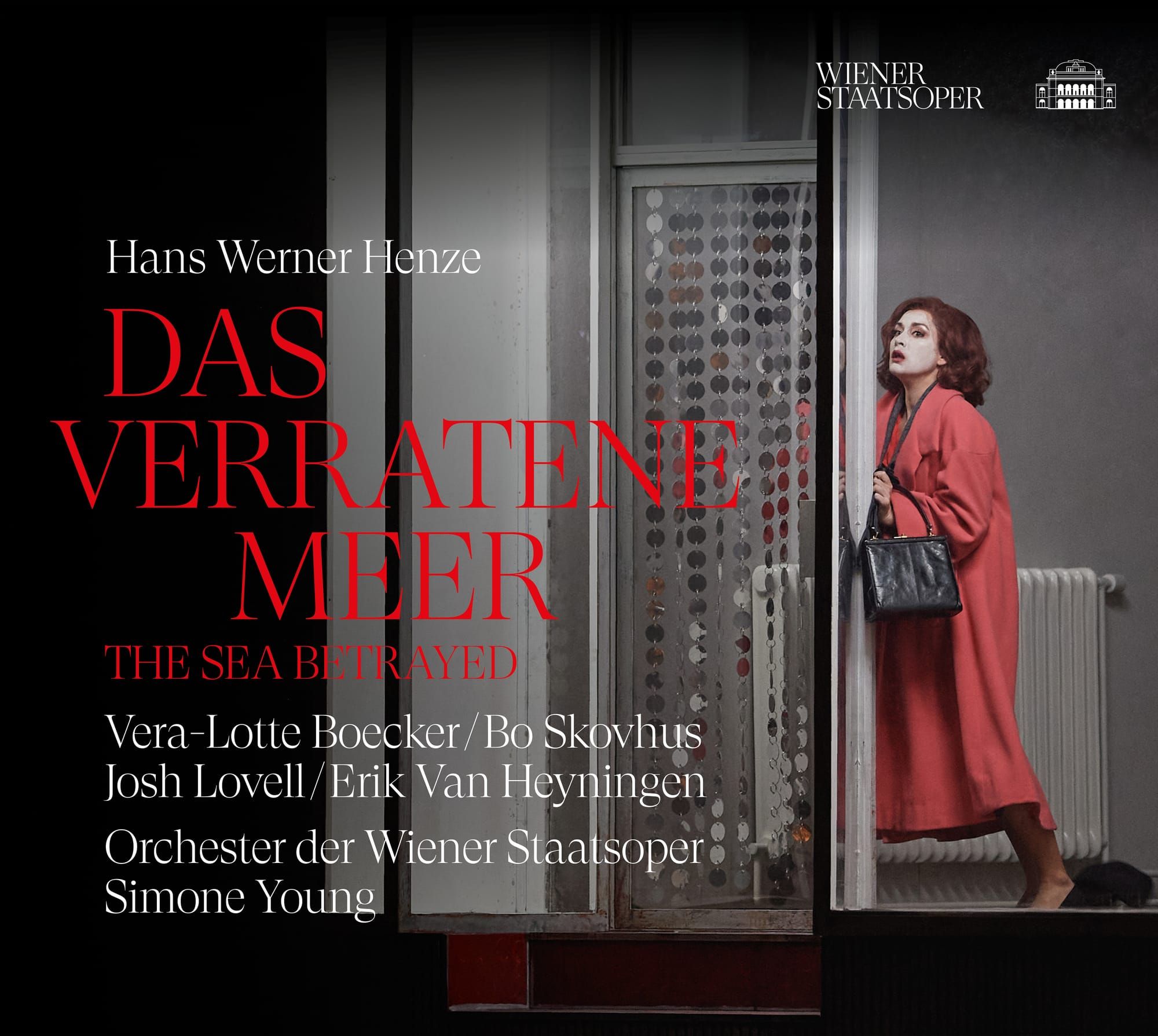
This is a major release, which widens our appreciation of the operas of Hans Werner Henze and reminds us, simultaneously, of his stature. At Classical Explorer, we have previously looked ay a Naxos disc that included Nachtstüccke und Arien, and a dual post on Tristan and another of his operas, Der Prinz von Homberg. There's another Tristan courtesy of Igor Levit here.
Given Henze's importance, it is good to expand our experience of him here, with a CD recording from the Vienna State Opera of his ninth opera, Das verratene Meer (The Sea Betrayed). The performance is white-hot and has a sense of knowing, of direction, and of pure drama even without video that is utterly convincing, thanks to the conducting of Simone Young. A cast including Bo Skovhus (as Ryuji Tskazaki) offers real strength.
This performance is of the third version of the opera: the premiere was at the Deutsche Oper, Berlin in 1990; there was subsequently a Japanese version, first heard as a concert performance in 2004 in Suntory Hall, Tokyo. - although there is a subdivision of this second version, the score edited by conductor Gerd Albrecht for his 2006 Salzburg Festival performance. Then there is this, the third version - the so-called "Viennese" version as it was presented at the Wiener Staatsoper, an amalgam of original and Japanese versions (retaining the orchestral interludes of the original).
The opera Das verratene Meer (the Sea Betrayed) is based on the novel, The Sailor Who Fell From Grace From The Sea (Gogo no Eik) by Yukio Mishima (1925 - 1970). There are some changes: the gang of four boys is sung by adults, for example.
The tale is rather gruesome and takes in the novelist's typical" suffocating scenario of hopelessness in which the struggle for normality is doomed to failure," as the Naxos promo notes put it. The orchestra in Hanze's vision takes on teh voice of teh "angry, betrayed sea" - via a series of interludes.
Of the music, Henze himself said,
I find myself increasingly occupied with matters of the human soul, its sublimation and spiritual abyss. Certainly my opera “The Ocean Betrayed” betrays this preoccupation. This music has been to Hades and back, with Monteverdi and myself.
We begin in Summer, and to hear how the orchestra is a vital force in the drama, here's the very first, Part Onem Scene 1:
The drama concerns a Japanese naval officer and a young, beautiful widow. , Madame Musako, whose son Noboru is vehemently opposed to the union, Noboru is also a member of a deadly cult. The text is suffused with French references.
For me, the primary influence is Berg - there is a lyricism here that links directly back, while some of Ryuji's lines seem close in spirit to that character so associated with Skovhus, Wozzeck. Try this:
Fun fact: Henze took advice from his pupil Detlev Glanert (see here for a review of Semyon Bychkov's performance of Glanert's Prague Symphony), who had grown up around the sea, around how to compose a sea storm - that it is the seventh (or ninth) wave that is the largest (after which there is a pause, so make for the lifeboats then!).
Embedded in Henze's score are Baroque dances - musette, sarabande. At times, Henze writes for a "Japanese orchestra" (soft, delicate). At others the music is decidedly more visceral, like the scene devoted to the gang of youths, scene 5:
This climaxes in the "Credo" of the schoolboys (a version, dramatically, of Iago's Credo from Otello?):
The real danger is life itself; the beating of our hearts is dangerous; the wind in the trees, the dirt on our shoes. It's dangerous to wake up in teh morning and watch the clouds in the sky.
CD 1, Part 1, is set in Summer; Part 2 (CD 2), Winter. Within these seasons, Henze gives us myriad colours which under Young's baton shine, shimmer, or punch us in the stomach: try the poundings of Scene 6 above. The second part begins from a place of hope: "Das neue Jahr soll glücklich für uns werden" (The New Year will be lucky for us) sings Fusako.
There is no doubting the mix of Japanese ritual and European Modernism here, in the 'Verwandlungsmusik' between scenes 9 and 10:
The singing is as confident as the orchestral playing, with Canadian tenor Josh Lovell a strong Noboru and Vera-Lotte Boecker a superb Fusako Kuroda. The gang members are unnamed in the opera except for Noboru (who is "Number 3"); the other four are sung by (in numerical order!) Erik Van Heyningen, Kangmin Iustin Kim, Stefan Astakhov, and Marin Häßler.
One track that demonstrates how all of this comes together, fine singing and a superb sense of drama from Henze, is scene 12, quite an extended tract (14"33) - Henze often in less-is-more mode:
This opera is Henze at his most powerful and cogent, and tight - there is not a note wasted here (frankly, not always the case with Henze).
This is a must-hear - and I notice that there will be a performance of this opera in Hamburg in January 2027 of the Japanese version, which comes with the following arresting stage image. Singers will be from the Tokyo Nikkei Opera, and the MDR (Mitteldeutscher Rundfunk - Central German Radio) Orchestra will be conducted by Alejo Pérez:

If Tristan and Being Beauteous are good introductions to Henze generally, Das verratene Meer is a perfect way in to his operas.
Here's the Amazon listing, at £19.99, but at the time of writing there is only one left in stock!

 Libretto: Hans-Ulrich Treichel