
To Gothenburg: Alfvén and Rautavaara
A wonderful idea to pair Alfvén and Rautavaara. This SACD is bathed in glorious sound
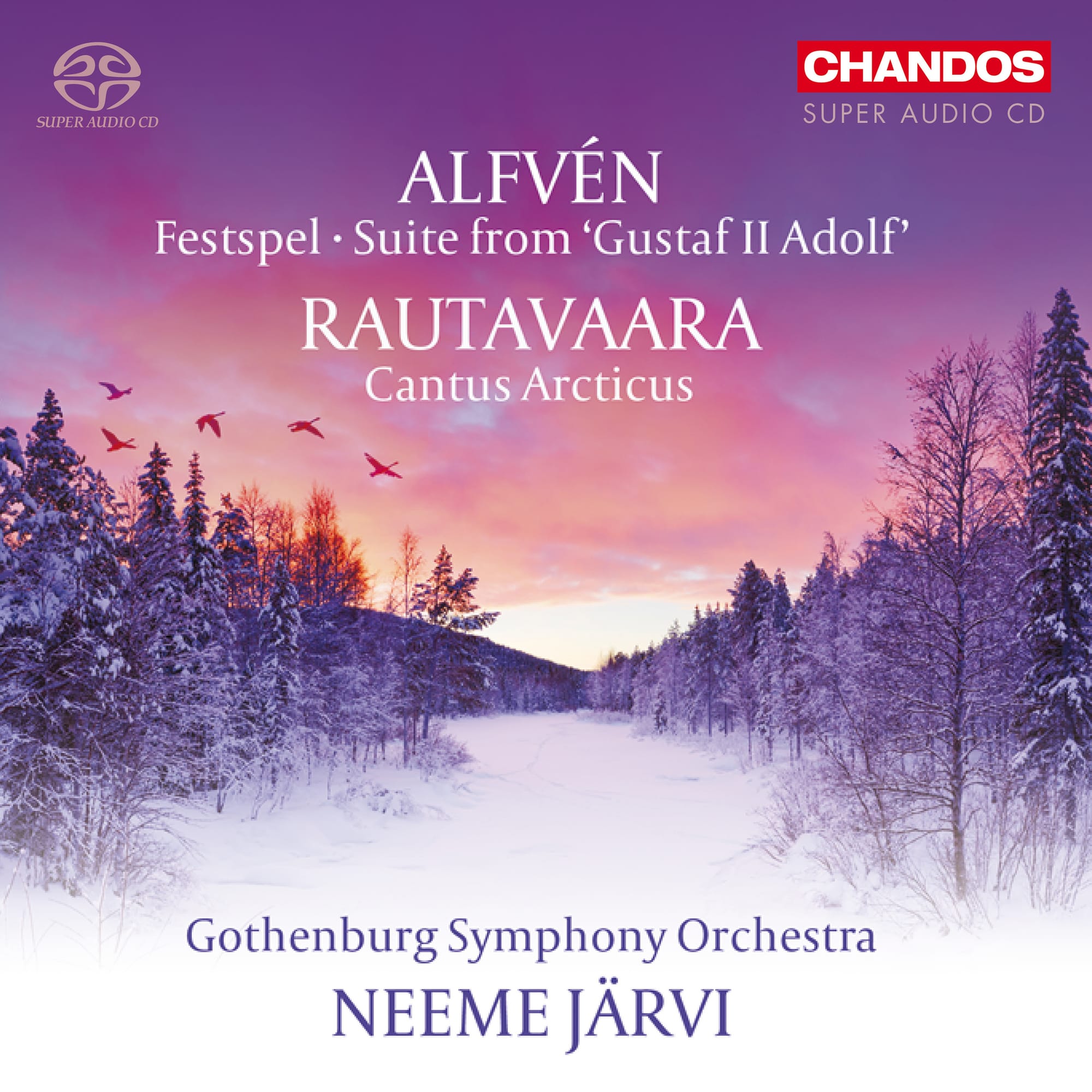
The indefatigable Neeme Jävi (I wonder what his record disc total is?) leads the Gothenburg Symphony Orchestra in his fabulously recorded disc, a coupling of composers one might not immediately consider juxtaposing, too: the Swedish composer Hugo Alfvén (1872-1960) and the Finnish Einojuhani Rauavaaara (1928-2016).
And what a beautiful congas there is between the bright-light optimism of Alfvén's Festspel (Festival Play), Op. 25 (1907) and Rautavaara's Cantus arcticus, Op. 61 (1971), bobbly that composer's most famous work.
We have of course explored Alfvén's music before: his First Symphony, and his Symphony No. 4 "From the Outermost Skerries," both on Naxos. Here we have the outgoing Festspel (Festival Play), Op. 25 of 1907, commissioned to inaugurate the new art nouveau building for Kunglinga Dramatiska Teatern (the Royal Dramatic Theatre) in Stockholm. Frankly, as a polonaise of dramatically outgoing intent, it would not b out of place in a New Year's Day concert for Vienna. The Gothenburg orchestra is outstanding, the recording capturing their cut-steel ensemble and sheer joy perfectly:
The shift to the sheer beauty of the first movement of Rautavaara's Cantus arcticus, Op. 61 (1972) is stark. Nordic stillness writ large (and quietly), the first movement seems to be the cover illustration in sound:
There is not enough Rautavaara on Classical Explorer so far, only a couple of Sérénades peformed by Hilary Hahn here. His most famous wok, Cantus arcticus was commissioned by the University of Oulu, in northern Finland, to honour its first formal doctoral graduation ceremony, in 1972. Rautavaara took his inspiration from the natural environment of the region, incorporating two-channel tape recordings of bird song . There ae a couple of other notable recordings of this, on Naxos and (unsurprisingly) BIS; This one though is magnificent, captured in sunning sound. Here's the second overmen of this "Concerto for birds and orchestra".
Whereas the Alfvén Festspel was painted in bight who light, Rautavaara's music glows from within. The first movement is marked, "The Bog (think of autumn and Tchaikovsky)" and the birdsong is taken from cranes south of Oulu. Counerpointing this ae almost Wagneian brass progressions. There appears to be no direct Tchaikovsky quotation, bu the string layout (divisi) and the gentle melancholy certainly seem to create a link:
The second movement, "Melancholy," begins with birds (along a shoreline). Strings are to the fore here, before "Swans migrating," perhaps a reference to Whooper swans and their influence on the finale of Sibelius' Fifth Symphony. Rautavaaea creates a milieu of birds both recorded and orchestral (the flute section has a lot to do, unsurprisingly). The radiant strings recall Sibelius, too. long melodies that seem to stretch on forever, ceding to a lyrical trumpet sounding against the woodwind milieu:
This is music of extraordinary beauty and imagination. The taped birds are used as an integral part of both soundscape and structure. A glorious perfomance and recording of a glorious piece.
Alfvén might seem like a retrogressive stop, but in fact the first movement of the the Gustav II Adolf Suite, Op. 46, "Vision" coins some remarkably mid-period Wagnerian harmonies that sort of align the two (think Lohengrin). This is music to a play by Ludvig Nordström (1882-1942). The source material for the first movement is the famous chorale "Ein feste Berg is unser Gott," to which Alfvén provides a fantasy:
In stark contrast, come the resolute fugatos of the second movement, "Intermezzo":
A sense of pageant suffuses "In Emperor Ferdinand's Royal Chapel" (Ferdinand is Gustav's adversary in the play). There is a fabulously expressive cello solo, too, and back to Wagnerian skies hee, especially the slowly ascending violins that close the movement:
Thee follows a most fetching senecio of neo-Baoque dances, a noble Sarabande, a boisterous, bassoon-staturated Bourrée sounding for all teh world wha sounds like a hornpipe and closing with lately Minu, full of lovely compass. But surely most impressive of all is the Romanicism of the penultimate movement, "Elegy": it reflects Gustav Adolf's ruminations the night before battle. Frequently excerpted, it is a little masterpiece:
The finale is a depiction of battle (no missing it!) which also uses a chorale as source material, this time "Be not dismayed, thou little flock," sung by the Swedish troops as they moved into battle. This is pictorial, almost cinematic writing, music that Järvi père excels at:
A wonderful idea to pair Alfvén and Rautavaara. This SACD is bathed in glorious sound; and it carries a real frisson, too, as it was all delivered in one live performance at Gothenburg's Concert Hall on October 11, 2024 (I 8is so technically perfect, you really would never know). Producer Lars Nilsson and Engineer Michael Dahlvid should also take a bow.
rThe disc is available at Amazon here, iDagio here. Remaining streaming below.