Sir Adrian Boult's Moeran on SOMM
We need to hear more music by Amglo-Irish composer Ernest John (Smeed) Moeran (1894-1950). Arnold Bax referred to Moeran as “the last true Romantic”. His life was a toubled one: he was wounded in the war, he battled with alcololism and was in an unhappy marriage..
Moeran arrived at the Royal College of Music in 1913 but his stay was cut short by emlistment - he was wounded on the Western Front.
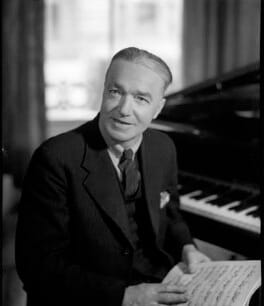
The Symphony in G-Minor (a second was left unfinished) was commissioned in 1925 by Sir Hamilton Harty - who was never to conduct the work, sadly - for the Hallé, and first performed by that orchestra under Malcolm Sargent on February 16, 1939, preceded by Beethoven's Coriolan Overtire and followed, in the second half, by Brahms' Violin Concerto with Bronislaw Huberman, no less. But a variety of circumstances meant the premiere was at Queen's Hall, London, on January 13, 1938 (Leslie Heward conducted the London Philharmonic Orchestra). The HMV first recording was a kind of mix of the above: the Hallé Orchestra conducted by Heward.
What we have here is a Prom performance, live from the Albert Hall on September 2, 1949, Lani Spahr's restoration enables much detail to come through, and the strings have little harsh edge.
The first movement is expansive, and decidedly unpredictable. English Pastoralism rubs shoulders with dissonant English Modernism (think Vaughan Williams in War mode, perhaps, but more frenetic). The lyrical way Moeran uses brass instruments is noteworthy. The booklet notes suggest an influence of Sibelius (indeed, Bax pointed out similarities between the last movement and Tapiola, but you can hear similarities in the string writing in the faster passages towards the end of the first movement, too):
Here's the Dutton transfer of the HMV recording, a tensile affair; Boult with the BBC orchestra is more overtly lyrical, including at the opening:
The Lento is aglow in this SOMM performance. The structure of the symphony is that the first, second and last movements are broadly equidurational, the final just a touch longer (12"55; 12'27; 13"40) while the scherzo, a vivace, is a mere 4"57. Hearing the Lento gain momentum in Boult's carefully tracked performance is glorious, mobile woodwind above a Sibelian, slow-moving bass. And again, frittiness meets lyricism interspersed with moments of grandeur:
The Vivace holds such beauty in its softer moments, and Boult teases out Moeran's subtleties of scoring (nicely revealed through the transfer). Worth noting that given this is the Albert Hall pre-space mushrooms, it is absolutely remarkable we do get to hear so much:
The finale has its fair measure of heroics. Is unpredictability is its strength; and there is no denying that Sibelian, gritty sense of expanse. But Moeran's melodies against that work in a way Sibelius never would, bringing us back to the England/Ireland axis. And while the finale proper is labelled “Allegro molto,” there is no sense of rush in Boult's performance, just integrity. There's also something Sibelius-like about the slashed chords at the end, with silences between them (think that composer's ending for his Fifth Symphony):
Here's Sibelius' Tapiola (Gothenburg Symphony Orchestra/Neeme Järvi). See what you think about any links!:
Adrian Boult also recorded the G-Minor Symphony with the New Philharmonia for Lyrita, a terrific performance well worth having, especially for the couplings (Sinfonietta, and Overture for a Masque):
... and so to the Violin Concerto, begin in 1937 in County Kerry, finished in Valentia Island in the extreme West of Ireland and originally intended for Max Harrison. Arthur Catterall (whom we featured on Classical Explorer in music by Mozart, Brahms & Franck on Biddulph) was the first soloist though: Proms again, July 8, 1942.
Again the structure of the piece is interesting: After an Allegro moderato (the longest movement, here at 11"34), a fast Rondo follows (Vivace). As with the Delius Concerto, It is the Lento that is placed last: both of these last between 9 and 10 minutes. The first movement is imbued with lyricism, and Sammons' tone is appropriately sweet. His lower, G-string register is lovely, too and comes across beautifully in Shani's transfer. There are quixotic changes within this movement, beautifully handled by both Sammons and Boult.
The Rondo begins in a blaze of energy (there is more than a touch of Scherzo about this); but it is the finale that is Moeran at his most powerful, and Sammons and Boult are magnificent. The music towards the end positively glows; applause is (briefly) retrained:
That performance was taken down at St Andrew's Hall, Norwich, and has a nice tight focus.
Of modern recordings, perhaps Lydia Mordlkovich on Chandos with the Ulster Orchestra and Vernon Handley has gained fairest currency.
The SOMM notes go on to provide notes for Moeran's Cello Concerto, which is not on the disc: this is an audio download accessed via QR code in the booklet (the duration of the physical CD is 74"45). It is also, handily, also on YouTube.
The is the first time I have seen a venue in Mile End - People's Palace. The performance dates from October 1946. Peers Coetmore, the soloist, was a heartfelt dedicatee, given her relationship with the composer. There is something Elgarian about the cello writing, but he Elgar of the Violin Concerto, not the Cello Concerto!. The music feels freshly-minted (Coetmore was to record this later, for Lyrita, but in terms of technical mastery as well as momentum, this is the one to have):
Coetmore plays with real nobility, nowhere more so than in the gloriously expansive themes of the slow movement: du Pré levels of intensity here:
On this slow movement, too, Boult ignites the music from the inside; it positively glows; the folkish melody of the finale is perfectly given in this performance, the true incarnation of the composer's indicator: "Allegro deciso, alla marcia":
The addition of the Cello Concerto is a fine idea: this becomes a super-length listening experience, and what an addition. Anyone that loves the Elgar Concerto will love the Moeran, of that there is no doubt.
The disc is available at Amazon here.