Beethoven's Razumovsky Quartets from Quatuor Elmire
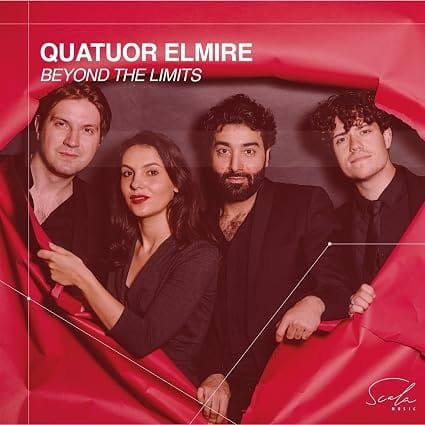
The Quatuor Elmire was part of the String Quartet finals at Geneva a few years back (see here); currently in residence at the Singer-Polignac Foundation and the Chapelle Musicale, Reine Elisabeth (the present release was recorded at the latter in 2024, for Scala Music).
The first movement of No. 1 (String Quartet No. 7 in F, Op. 59/1) sets out their stall: clean, always in tune, textures often lighter than one might expect, but there's still plenty of power:
The Scherzo. too, has a febrile aspect, full of live (it is Allegretto vivace e sempre scherzando). Lots of contrasts, too, and I like the dance-like element to the more lyrical sections, pitted against fury represented by four independent lines determinedly holding their own against each other:
The eleven-minute Adagio molto e mesto is a quartet-song that anticipates those of late Beethoven, A low/non-vibrato aspect gives the music a sort of nightmarish rawness that is most effective. It leads to a furious finale, full of angst - even in the quiet moments, the music boils underneath:
It is a powerful, lithe performance overall, very well recorded (quite close).
The Second Quartet has all of that freshness of line and sound, but now parked in the minor (E minor). The Elmire Quartet explores how Beethoven takes known gestures and expands them into newness. The first movement is one tensile thread; the Molto adagio is exactly that, stretching out into infinity - again, the late quartets seem a mere breath away:
The close of that movement is gloriously done; everything is tighter than in Geneva, with no drops of tension in either of the first two movement. The Allegretto is red-raw angry, the famous "Thème russe" (the one Mussorgsky also uses in Boris) almost sprightly (as it was in the competition) - one has to admire the virtuosity of the roulades around it:
The finale is perhaps not the prescribed Presto, but instead the quartet opts to show how the music can glow from within. The main theme is galloping (an Allegro molto, surely), and exchanges between the two violins are lovely:
The final quartet of Op. 59 is in C major, The opening Introduzione is held-breath magnificence, the first movement proper (an Allegro vivace) an explosion of major-mode tonality here. Semiquaver passages are delivered with such clarity from all four instrumentalists, as Beethoven tosses phrases from one player to the other:
The Andante con moto is a triumph. Again, that transparency, now with added luminosity, the whole carefully sculpted, nicely prolonged by the Menuetto grazioso:
The finale again is well-shaped, the the perfect blend of frenzied activity and climactic feel:
The booklet talks about Beethoven moving to a script of his own with these works, and about the Heiligenstadt Testament, which is reproduced in full (in French - the booklet is French-only).
Available from Amazon here; srreaming below.