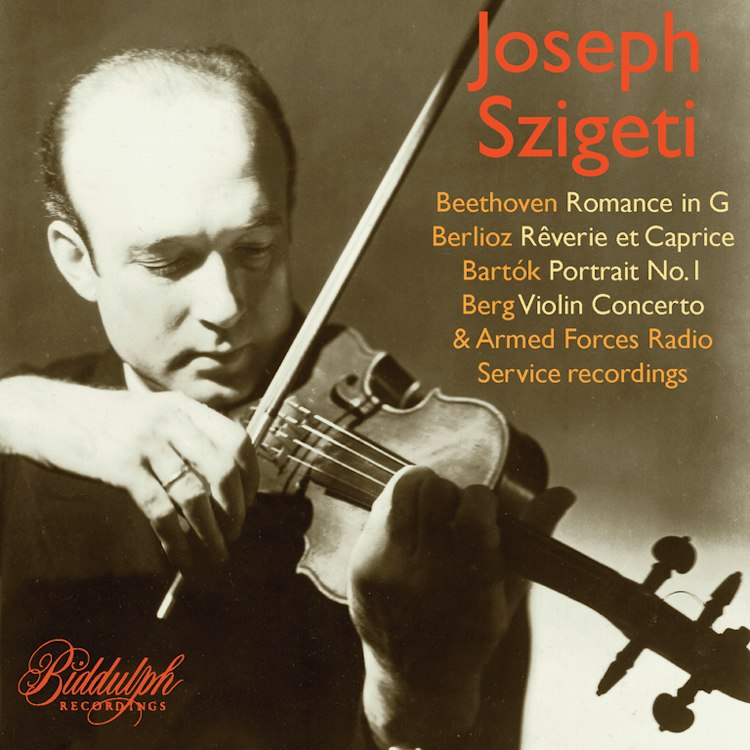
Szigeti: Armed Forces Radio Service Recordings &
What a treasure trove this is! Joseph Szigeti at the height of his powers ...
What a treasure trove this is! Joseph Szigeti at the height of his powers ...
The first track might well sound familiar to pianists: it's the finale from the Piano Sonata in D, D 850 arranged for violin and piano There are lots of performances with Emanuel Bay on YouTube, but this is just with "piano accompaniment" and with a different duration. It's a delight, what would be piano staccato now near-spiccato on violin. This is with "piano accompaniment" as opposed to named pianist; there is also this, with Andor Foldes, again on Biddulph. The first seven tracks were all released on the "Basic Music Library" (American Armed Forces Radio Service ). The arranger is Carl Friedberg (1872-1956), German-born American pianist briefly a student of Clara Schumann and who made his orchestral debut with the Vienna Philharmonic under one Gustav Mahler). and who taught such names as Malcolm Frager and the great if short-lived William Kapell:
"François" Schubert's L'abeille follows (‘The Bee’): it's by Dresden violinist Franz Anton Schubert The Younger (1808-78). But it is the swagger of Brahms' famous Hungarian Dance in G-Minor that impresses (along with some lovely tempo changes). The Bee below is from a TV programme, not this disc:
This is ideally complemented by a Dvořák Slavonic Dance (arranged by Kreisler) - warm0toned, and with some characterful playing by the anonymous pianist. It is "prolonged" by Tchaikovsky's Valse sentimentale, (Op. 651/2) in Grunes' transcription, but it's the Stravinsky Petrushka "Russian Dance" that intrigues (arranged Samuel Dushkin). Some lovely contrasts here, and such perfect tuning up top (and that high register is so well rendered here in Biddulph's transfer):
Szigeti's teacher Hubay offers The Zephyr and it is pure delight - again, the tuning up high (now stratospheric) is jaw-droppingly accurate, and there is real virtuosity here in the violin acrobatics.
The warm sound of an orchestra graces Berlioz's Réverie et Caprice, Op. 8/ H 88, recorded 26 August 1946 for Columbia at Abbey Road Studios, Lovers of the great opera Benvenuto Cellini might recognise this: violin takes over voice in a discarded aria (hence the "might"), Teresa's act I "Entre l'amour et le devoir". Berlioz's own transcription was originally for Alexandre Artôt. It's wonderful, perfectly "of" Berlioz. As in the Bartók which follows, the Philharmonia Orchestra is conducted by Constant Lambert:
.. and here's Patrizia Ciofi in the appendix to that great Berliozian John Nelson's recording of Benvenuto Cellini with the Orchestre National de France on Erato:
The Bartók Portrait No. 1 uses material from the First Violin Concerto, written for Stefi Geyer. There's an unreciprocated love here from composer to violinist, and the first theme is known as the "Stefi" theme. This Portrait was actually the last piece Szigeti performed in his home country of Hungary before emigrating to the USA - the composer was present on that occasion. This is a superb, wistful performance - and so much detail comes through in this transfer from the orchestra:
Szigeti and Bartók, of course, performed together, and I' just going to insert this here - the First Rhapsody with Bartók on the piano, on an LP that I actually owned in my teenage years! You can see the cover on the YouTube, with the label displayed as you play the piece:
The Bartók Portrait was recorded a couple of months earlier than the Berlioz, in June 1946, a performance of both sophistication and tenderness.
Amazingly, the Corelli here is four minutes longer than the Bartók: the "La Follia" Sonata transcribed for violin and orchestra by Belgian violinist Hubert Léonard (1818-80; the piece was published in 1877 by Schott). Authenticists should leave this be. .The WOR orchestra by the way is that of the New York radio station WOR (WOR doesn't stand for anything - it was the orchestra's randomly-assigned AM call sign issued by the IS maritime radio service):
The interest for the Beethoven Romans is not only Szigeti but also that the San Francisco orchestra is conducted by one Leonard Bernstein, who had debuted - sensationally - with the New York Philharmonic a year earlier. This is a stunning recording, and this 2024 transfer doe sit full justice. Szigeti is superb, not least in the exposed opening (something of a graveyard for violinists). :
.. and so to the real meat of the disc's Berg's Violin Concerto (sometime staking its nickname from the dedication, "Zum Andenken enes Engels"; to the memory of an angel). This performance took place on December 30, 1945 and is with the NBC SO and that great Bergian, Dmitri Mitropoulos (his Wozzeck is maximally approximate but unforgettable).
This performance aw actually the Berg Violin Concerto's first broadcast performance (the first official recording was Louis Krasner and the Cleveland Orchestra under Rodzinski. This new transfer of the Berg a corker: the way some of the folk-tunes dance (listen to the two clarinets, all a-waltz!). There was much opposition to the programming of this work, and perhaps that contributed to the electric atmosphere. There is some objectivity here that will appeal to many - when the horn states a folk theme with violin as "Nebenstimme" (subsidiary vocie), the players do rather power through at a moment where most relax. But just listen to the electricity of the opening of the work's second part (it is tracked as four here, Prelude/Scherzo; Allegro ma sempre rubato/Adagio):
Few violinists play the solo cadenza with such laser focus as Szigeti. This is a major achievement. The Adagio with its Bach chorale so poignantly delivered here, its slightly acid sound perfect, is remarkable:
Here's the Krasner/Rodzinski:
... and I so recommend you listen to Krasner also with one Anton von Webern conducting, with the BBC Symphony Orchestra. two out of the three members of the Second Viennese School!:
... and here's that 1951 Mitroupoulos recording, the YouTube showing yet another LP set that was in my teenage collection! (I remember the actual CBS box was over-size in comparison with the standard). Here's the opening, but follow this link and scroll to the murder of Marie - surely no more blood0curdling scream has been caught on record!):
Quite a lot to explore in this post, if you are so minded, then. Biddulph's service to the great violinists continues. It is available at Amazon here.