
René Benedetti's miraculous Paganini
A must for all violin lovers, and all Paganini lovers
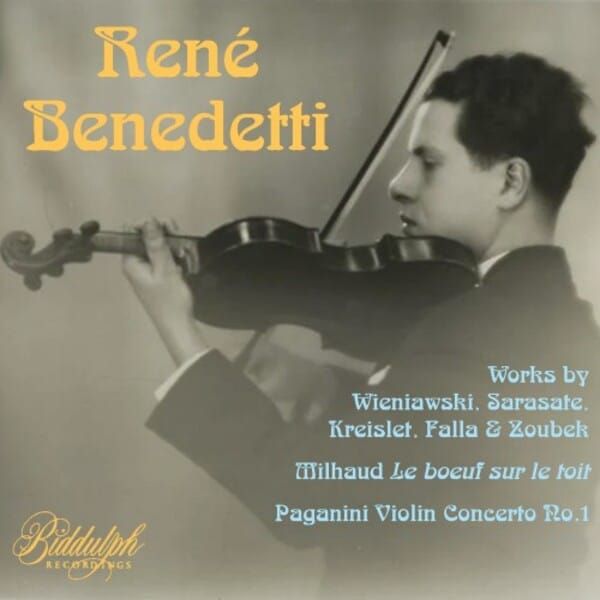
French virtuoso violinist René Benedetti was born in Toulon in 1901; the family moved to Paris when René' father opened a music shop in Montmartre. Benedetti was something of a prodigy: he had lessons at the Paris Conservatoire from Edouard Nadaud from the age of seven (ho taught there 1900-24), debuting in 1911 in a performance conducted by Gabriel Pierné (best known today as a composer). His friendship with the long-lived pianist-composer Jean Wiener (1896-1992) meant he came into contact with Les Six.
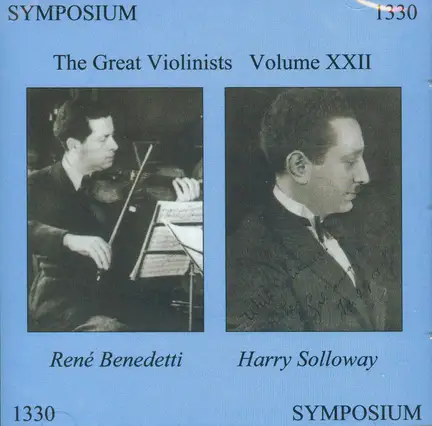
Benedetti also appeared on Volume 22 of Symposium's series, The Great Violinists, sharing disc space with Harry Solloway.
The major piece on the present Biddulph disc comes at the end, Paganini's Violin Concerto No. 1 in D, Op. 6 recorded in September 1941 with the Lamoureux Orchestra and Eugene Bigot. There is swashbuckling verve to Benedetti's opening, and complete contrast when the music turns lyrical. Benedetti wrote his own cadenzas (more difficult, apparently, than Saurer's). Benedetti's portamento is sparing and apt. He does play Paganini as to the manner born (it was his speciality); to be honest, I can't think of a finer Paganini 1, although if you want a modern one, Francesca Dego and Daniele Rustioni's on DG is a good one to go for (see Classical Explorer's post on the DG disc which finds the Paganini pitted against the Wolf-Ferrari Violin Concerto). Here's the first movement of the Benedetti, and that cadenza is remarkable! (it begins at 13"42):
The Adagio second movement begins with a bang, but it is Benedetti's way with the theme that is so impressive. The transfer maintains the warmth of his lower register, too. The famous finale has lovely freedom, a sense of the carefree that can only come with extreme technical prowess as precursor to interpretation. This is some of the most remarkable Paganini I have heard (including recordings by such as Ricci):
The other major work here is Milhaud's Le Boeuf sur le toit in an arrangement for violin and piano. Here, Benedetti is joined by pianist Jean Wiener. Benedetti's propensity for stopping, heard so strongly in the Paganini, is vividly on display here, in a performance of great rhythmic verse. Both Benedetti and Weiner understand Milhaud's musical language, and his use of bitonality, superbly. This arrangement was crafted by Honegger for these two performers; in the process, he labelled it a "Cinéma-fantaisie". Honegger inserts a wonderful cadenza:
It makes sense to balance Paganini at the end with Wieniawski at the beginning: the Souvenir de Moscou, especially as this is another Op. 6!. It contains the most remarkable solo violin passage where it sounds as if there's an ensemble playing, throwing the ensuing cantabile into high relief before the piano re-enters for a lovely "song". Benedetti's harmonics are remarkable towards the end:
A trio of works by Sarasate takes s to regions hispanic: Habanera, Malagieña, and Zapateado, from 1927/29. The pianist in these early tracks, "M. Faure" (Maurice Faure) sits very much in the passenger seat, but these pieces are after all designed as showpieces. And Benedetti's sense of style in these works is impeccable. It goes without saying that sparks fly: listen to the pizzicati in the Malagueña, and note now Benedetti feels zero need to slow in the face of such thickets of difficulty:
The programming of this disc is interesting in that, by presenting a group of three Spanish-inflected pieces, to move to Kreisler strangely emphasises the depth )you read that right) of the Caprice viennois, Op. 2. It is less saccharine when the big tune arrives, more poignant, and the introduction holds, dare I say it, in comparison to the Sarasate, really interesting harmonies:
There is the odd bit of detail in the piano that is worth hearing, and Raymond Glaspole's excellent transfer allows us to hear it:
Impressive though it is, I do find Benedetti's performance of Kreisler's Tambourin chinois too frenetic, although the contrasting, slower, section drips with character.
Kochanski's famous arrangement of the de Falla Siete Canciones Populares Españolas is represented here by four of them (there are six in Kochanski's full suite). These are arresting performances, and Faure comes into his own in the repeated notes of "Polo":
Yes, the piano sounds too distanced in the "Canción" for the material it has to carry, but given the recording date of June 13, 1928, I don't think we can complain too much. The closeness of the violin certainly gives us a front row seat for Benedetti's strummings in "Jota," though:
A Krteisler arrangement brings the Spanish/Kreisler elements together: the "Danse espagnole" from La vida breve, heady, yet somehow mysterious:
The real rarities are the pieces by Karel Zoubek (1902-59, a Czech compsoer who emigrated to Australia after the German invasion), a Sérénade à Elen (Serenáda Helené), as Tully Potter's excellent notes suggest, "in the tradition of Drdla" (Zoubek is perhaps a touch more sophisticated?) and Deux Minutes de Jazz (two minutes of jazz) - which does what it says on the tin:
A must for all violin lovers, and all Paganini lovers. As usual from this source, transfers are superb. This disc is available from Amazon here.