
Rautavaara & Martinů Third Piano Concertos on BIS
A superb release, from every angle
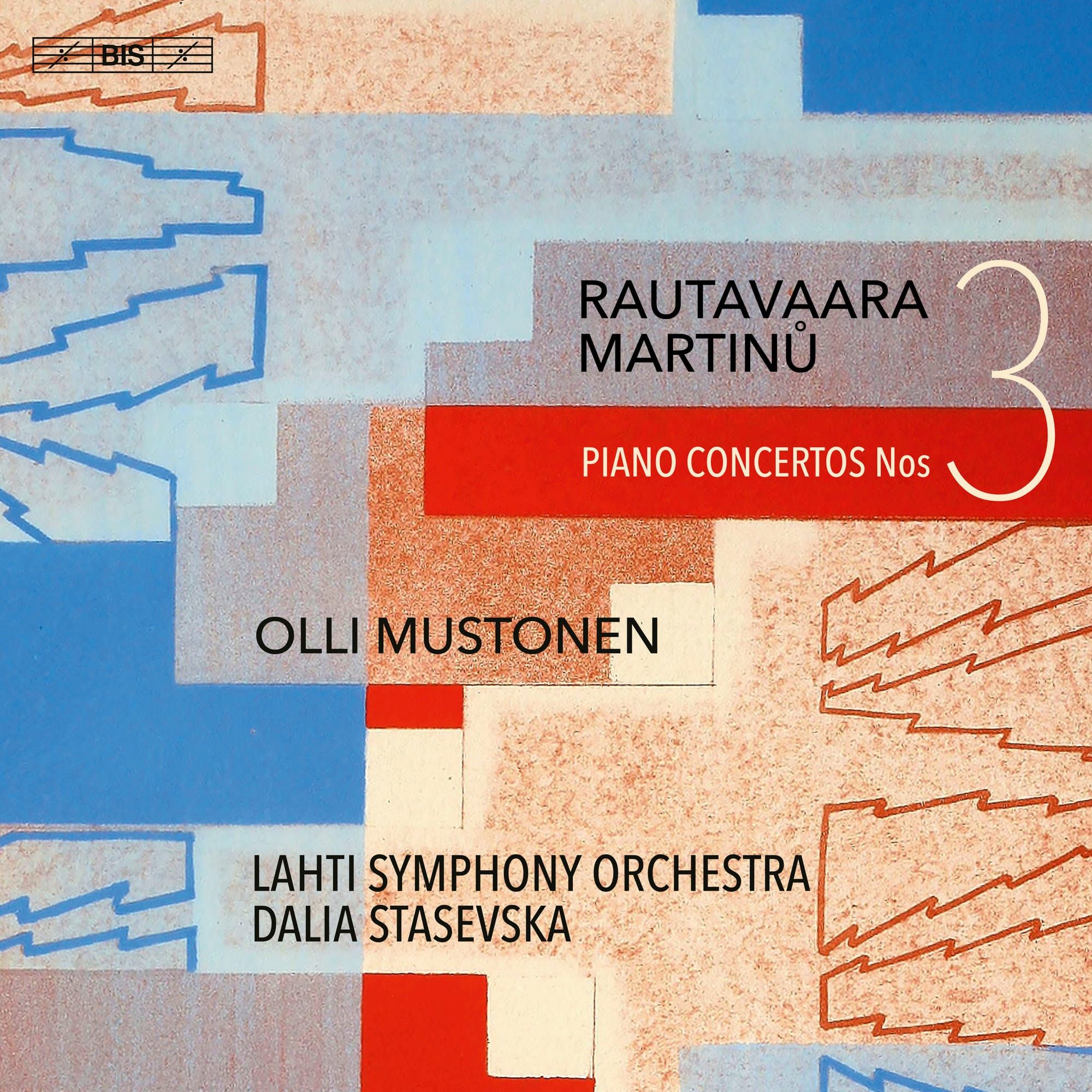
What a treat - a coupling as effective as it is rare. Who would have thought Einojuhani Rautavaara and Bohuslav Martinů make such wonderful disc fellows? And yet, they do!
Good to see Rautavaara again - we previously met his music via his most famous piece, Cantus Arcticus, on Chandos, plus the Deux Sérénades performed by Hilary Hahn on DG,
Explaining the heterogeneity of his musical language over the years, Rautavaara stated that, as a Finn, he stands
between East and West, between the tundra and Europe, between Lutheran and Orthodox faiths.
.. and that Finland is ...
... full of sumbols, of ancient metaphors, revered archetypes.
Premiered in 1999, his Piano Concerto No. 3 has gained something of a toehold in the repertoire. It is subtitled, ‘Gift of Dreams’, and indeed the first two movements are boradly of that ilk, before a more anxious finale 9pre-echoed, perhaps, in the more active part of the slow movement).
The concerto was actually commissioned by Vladimir Ashkenazy with the idea that it could be directed from the keyboard (not the case here): Ashkenazy premiered the piece with the Helsinki Philharmonic Orchestra on August 18, 1999 in Tampere, Finland.
The subtitle, “Gift of Dreams,” refers to a four-mote motif (F - E flat - D flat - E) that first appeared in Rautavaara's setting of Baudelaire for a cappella choir, “La mort des pauvres” (The Death of the Poor), the second of 4 Serenadia (1978), and heard here by the Talla Vox Ensemble under Pasi Hyokki on an Ondine disc of complete choral works for male voices by Rautavaara. The motif is heard to the words “Le don des rêves”; The Gift of Dreams:
There is a palpable Romantic sweep to the first movement, couched in Rautavaara's identifiably Nordic language: but this is a softer Nordic slant of the sun than, say, Sibelius, couched in a pervading lyricism (all within Rautavaara's own language - Rebecca Saunders also referenced Romantic-era tropes in a very different way in her Piano Concerto, The inspiration for the first movement was a specific dream: the composer by the sea, and in a pool near him was a school of dolphins, that he released:
The slow movement contains frozen beauty. Mustonen is such an eloquent interpreter of this music. It begins with the core motif and includes much piano monologue-musings. Rautavaara's harmonies are unutterably beautiful, but also consistent:
We've mentioned Rautavaara's harmonies: symmetry is a core element of the finale (Schoenberg was a great fan of this on an individual chord basis: think of a chord as a vertical unit - which it is - and instead of being rooted at the bass, the chord's centre of gravity is in the middle, with symmetrical intervals moving in either direction from that core). In Rautavaara's case, the idea of symmetry is a vital and consistent part of his output, particularly his piano output: see this article, for example, or this free pdf.
The "Energico" finale departs from the more placid dreams of the earlier movements: Mustonen is superb here, flying the flag of Rautavaara's lyric impulse in the face of hectic movement:
Again, the Romantic Piano Concerto forms something of a model for Martinů's Third Concerto (written for Rudolf Firkusný and premiered by that pianist and the Dallas Symphony under Walter Hendl in November 1949). Here is Firkusný in 1993, with Libor Pešek conducting the Czech Philharmonic (the YouTube video comes with a rolling score of solo piano part and piano reduction of the orchestra):
Booklet annotator Jean-Pascal Vachon is right to identify a Brahmsian influence to the first movement (some of the piano writing, too, is distinctly of that other composer); and also Stravinskian Neo-Classicism. Mustonen's touch is light, reflected in the playing of the Lahti SO under Dalia Stasevska. There is a dance element to some of this, and it's perfectly judged:
.The second movement seems to burst into a post-Romantic glow, pretty much sustained throughout, the dissonances mild yet effective. Mustonen is a suave interpreter, Stasevska his absolute equal, orchestral textures radiant:
The finale has Dvořákian tendenccies at times, but with a shadow: the dance is spiker, more determined, darker. Mustonen brings grandeur to the more chordal passages, while the close is markedly defiant:
Mustonen is a known quantity, and excels throughout. Another known quantity is BIS's recording standards, absolutely upheld on this fine SACD (Ingo Petry, producer; sound engineer Stephan Reh), capturing the clearly superb acoustic of the Sibelius Hall in Lahti. The piano technician deserves a bow, too - this is a magnificent Steinway, in top condition (Matti Kyllönen).
A shout-out for Dalia Stasevska, too, who has previously impressed: at the Proms (Jóhansson, Rachmaninov, Guðnadóttir, Tchaikovsky), and at the Barbican (Thovaldsdóttir, Ligeti, John Luther Adams). She has the Lahti orchrestra deliver their very best on this disc.
A superb release, from every angle. Available from Amazon here; streaming below, except for iDagio.

