
Haydn Baryton Trios: Treasures from the Esterháza Palace
The Haydn yesterday (The Mozartists, Sturm und Drang 4) reminded me of this Haydn post - repertoire that deserves to be in currency.
I remember seeing an LP set for Haydn's "Baryton Trios" in the 1980s and wondering what on earth that was all about. It's all down to employment: Haydn's employer, Prince Nikolaus of Esterházy’s and his infatuation with the instrument that compelled Haydn, the prince’s Kapellmeister, to write no fewer than 126 works for baryton trio (to be accurate, 123 for baryton, viola, and cello, three for baryton, violin, and cello, largely composed in a 10-year period from 1766-75). Almost all are in relatively straightforward major keys (A, C, D, F, G): just one is in A-Minor (Np. 87) and one in B-Minor (No. 96)
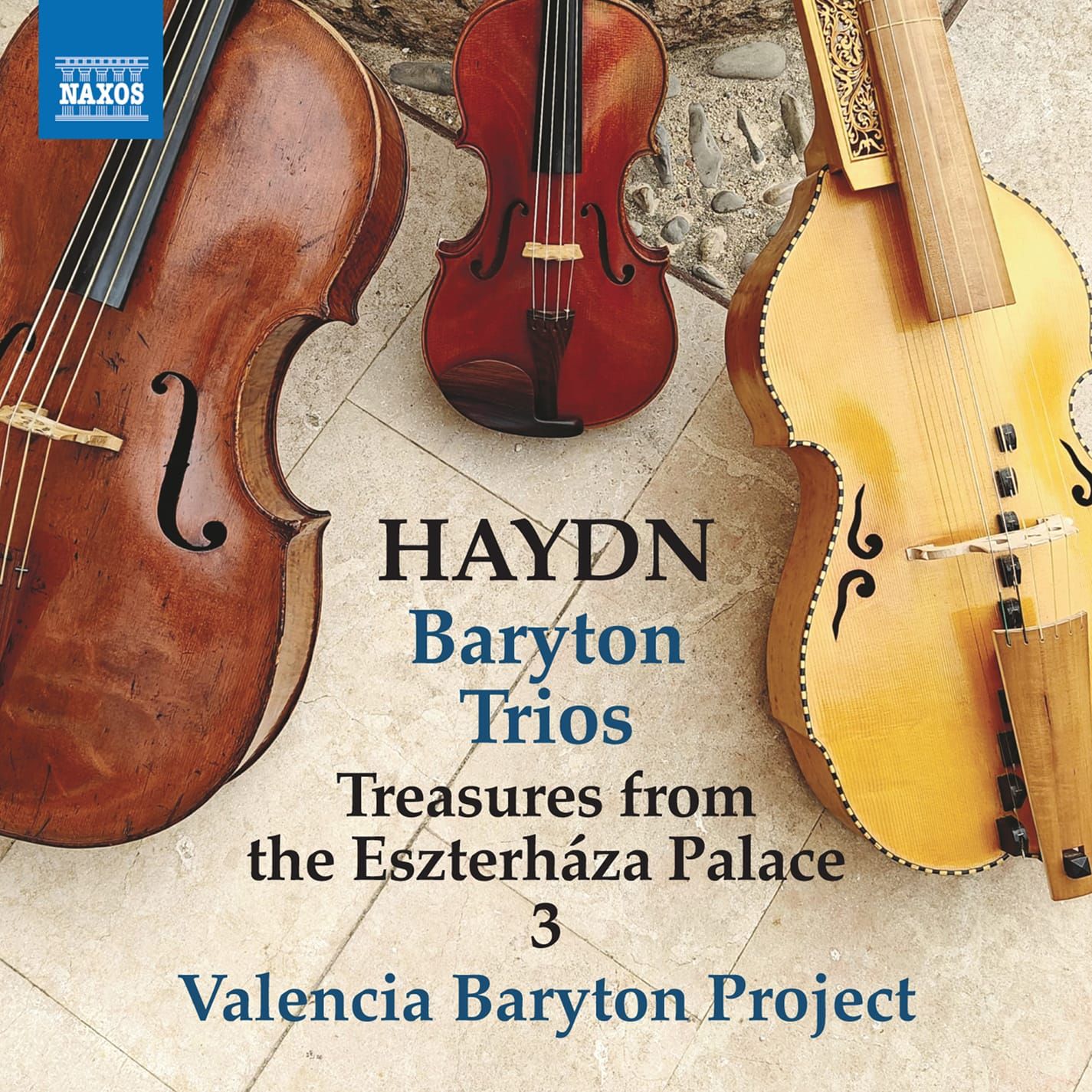
But what is a baryton? The instrument itself is more like a viola d’amore than a bass viol, and has an extra set of (sympathetic) strings behind the neck, adding resonance and opportunities for plucking effects. The performers here are the members of the Valencia Baryton Project, a Spanish group of much excellence comprising Matthew Baker, baryton; Brett Walfish, viola; and Ismar Gomes, cello. So as you can see from the line-up, the pitch is generally quite low throughout. This is the third volume so far on Naxos.
Nice that we have a film of the first movement of the first of the six trios on this disc: the G-Major, Hob. XI:80, which it is suggested was written in 1769: the venue for the recording is the Castillo de Riba-roja de Túria in Valencia:
As i so many of the Trios, the first movement absolutely dominates: 7"27 against a Menuetto (1"20) and a Presto finale (2"03). As so often, too, the tempo is relatively slow (here, a Moderato), while the remaining movements are faster. The theme of the first movement is markedly gentile. The Menuetto is marked Allegretto, and the Valencia Baryton Project certainly is brisk; but what delicious ornamentation at the very end!:
What I like about the finale is that, although it is identifiably Presto (as opposed to Allegro assai, for example), the Valencai Baryton Project gives every note time to speak:
While each Trio has its own feel, the formal template is the same throughout. Contemporary with the Sturm und Drang Symphonies, the 1768 A-Major Trio (Hob. XI:57), and Ben Hogwood's excellent notes rightly parallel this Trio with the Symphony No 49, “Passione”. The first movement of the A-Major Hob. XI;57 is incredibly profound, and this is the most eloquent of performances:
... and here's a performance of No. 49, by Il Giardino Armonic ond Giovanni Antonini.
The Menuetto does nothing to dispel the mood (all this, despite the key of A-Mjajor, usually thought of as markedly sunny!); it is left to the Presto finale to introduce a livelier aspect:
The G-Major, Hob. XI:26 is of unknown date, and unusually begins with a fast movement (Presto assai); the emotional centre lies in the second movement Andante. The first movement has its harmonic darkenings that prepare for the tonic minor of that Andante, though:
That six-minute Andante is truly beautiful; there's plenty of gentilité, but it is under a palpable cloud. Matthew Baker uses the subtlest of vibrato to fine effect here, before the Menuetto finale, which seems to have ambitions towards the hunt:
As Hogwood's notes suggest, the opening Adagio of the D-Major Trio, Hob. XI:72 could be from teh Baroque period. The weighting of movements, while maintaining the model, is a touch more egalitarian here: the Adagio is 5"44, the Allegro assai 3"40 and the Menuatto finale, 2:06. Hints of Classical as opposed to Baroque tropes are in the first movement as well: a bass pulsing underpinning a melody might come from one of Haydn's own symphonies:
Again, there is a symphonic element tot eh Allegro assai second movement; the contrasting episode is for solo baryton (with a cadenza by Baker that enters suddenly and in its pizzicato and strummed brilliance seems to take us to sunny Valencia itself!):
The use of texture, including plain octaves, is significant in the rather slinky finale.
Penultimately, a trip to C-Major, published around December 1771. Hogwood likens this to a "viol consort," and the loosely-scored opening of the Adagio supports this well. There is some extraordinary part-writing in the latter stages of this movement:
Haydn has infinite invention: the part-writing in the Allegro is blissful, too:
Even the Menuetto is somewhat veiled here. Surely this C-Major Trio is the crowning glory of this album!
Finally, another D-Major Trio, Hob. XI:50, and lovely that the first movement is a clear theme and four variations: Haydn was a master of this form, and so it is here (the fourth variation illustrates that plucking of the baryton's second set of strings). Again, there's a cadenza by Baker, and some extraordinary textures:
The Allegro di molto is a chamber music gem, in a performance here of minute shades, of a lightness that whispers. And what a great film this is:
The disc closes with a Menuetto marked "Moderato," but what a Trio, interior, unpredictable, wafting the harmonic wind:
Recommended without hesitation. It has been suggested, not only by the great Haydn scholar H. C. Robbins Landon, but also by Oliver Strunk, that these are "practice pieces" for string quartets-to-come: Robbins Landon cites the sets of quartets published as Opp. 9 and 17.
It is worth noting that it was Strunk that led the way, in a 1932 article in Musical Quarterly: Haydn's Divertimenti for Baryton, Viola, and Bass (After Manuscripts in the Library of Congress), Volume 18 No. 2, April 1932. Incidentally, Strunk's entire 1950 book, Source Readings in Music History, is available for free here.
More recently, James Mackay of Loyola University, Louisiana, has published on this music: Editing Haydn's Baryton Trios, Hob. XI: 25-96, and Haydn's Laboratory: The Baryton Trios of 1766-71.
This disc is available from Amazon here; iDagio here.
.