Gluck: Rare Arie d'opera on Tactus
... a cautious recommendation
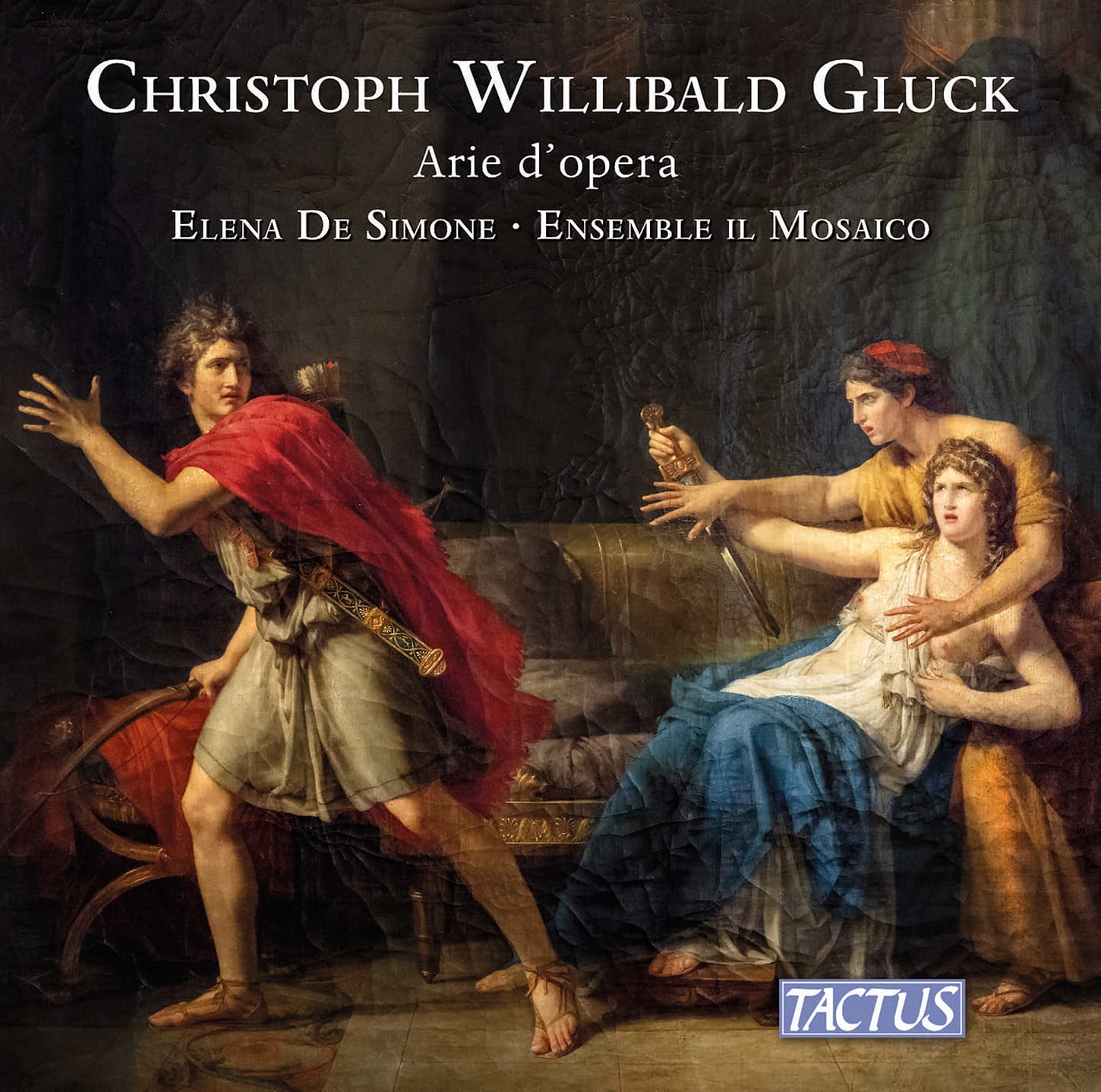
This disc traces Gluck's operatic activity for the years 1743-45, and has a his real musicological purpose. Previously (reviewing for Fanfare), I was less than taken by Elena de Simone's Tactus disc of arias by Agnesi; some of the same problems recur, but in less pronounced fashion; I'm therefore happy to give a cautious recommendation to this disc.
Arie d'opera begins at the end, with the last of the works, L'Ippollito (first performed in January 1745 at the Teatro Regio Ducale in Milan) to a text by Marchese Giuseppe Gorini Corio based on Euripides (Hippolytus) and Racine (Phèdre e Hoppolyte). The aria here, "Dirai all' idol mio" is one of some pathos, as the principal character Hippolytus asks his brother Arbace to tell Arsinoe that he is to die. The original interpreter was the castrato Angelo Maria Monticelli, who no less a figure than Charles Buney compared to Farinelli and Senesino.
Tha previous disc mentioned above included arias for La Sofonisha; here, we have "Tremo fra dubbi miei,” as the first of several arias interspersed across the disc, a minor-mode aria whose virtuosity stands in contrast to the extrract from L'Ippolito. De Simone's lowest register is not the firmest, but she negotiates the agile melismas well, and the contrasting section holds much pathos. And one important thing: De Simone has a phenomenally accurate trill:
The first of the operas chronologically next, Il Tigane (libretto Carlo Goldoni) was staged in 1743. Tigrane loved Cleopatra (as do others, naturally), and submits to the will of the father, Mitridate (Mithridates). Oronte's aria "Se spunta amica stella" uses the metaphor of a nocturnal journey in which a helmsman places all his hope in the single star ("Stella") he can see in the night sky. Here, we have an Adagio for the A section and an Allegro for the B (Oronte longing to marry Cleopatra, as his express his chance to attain the throne). The original aria was written for the castrato Giuseppe Gallieni. This is.a truly beautiful aria, and the Ensemble Il Mosaico excels in shading and subtlety. I am less taken by De Simone's contribution in the slow music; perhaps just a touch of vibrato would have sweetened the pudding.
Also from Tigrane is "Parto da te mio bene," a beautiful, slow aria that achieves maximal expression though a simply accompaniment on stings against the soloist's florid line. "Sì ben mio, morro' se il vuoi" is a marvellous aria (though not the longest on the disc, it exudes a real sense of space);
Also written for Galleini was "Se viver non poss'io" from the opera Poro (first performed on Boxing Day 1744 in Turin). It is an aria of great grace and melodic inspiration on Gluck's part:
A "shadow aria" from La Sofonisha, "Là sul margine di Lete"; oboes present the calls of dead heroes here! :
Unfortunately, I find De Simone a little uncontrolled at times in the third and final aria for Sofonisha, "Oh frangi i lacci miei". The closing track, from Il Tigrane, is lovely, though. Iisten to the tightness of De Simone's ornaments in "Rasserena il mesto ciglio":
Elena De Simone's own booklet notes are erudite and eminently readable. mixed, but valuable disc.
Arie d'opera can be purchased via Amazon here.