Niche Berlin Harpsichord Concertos
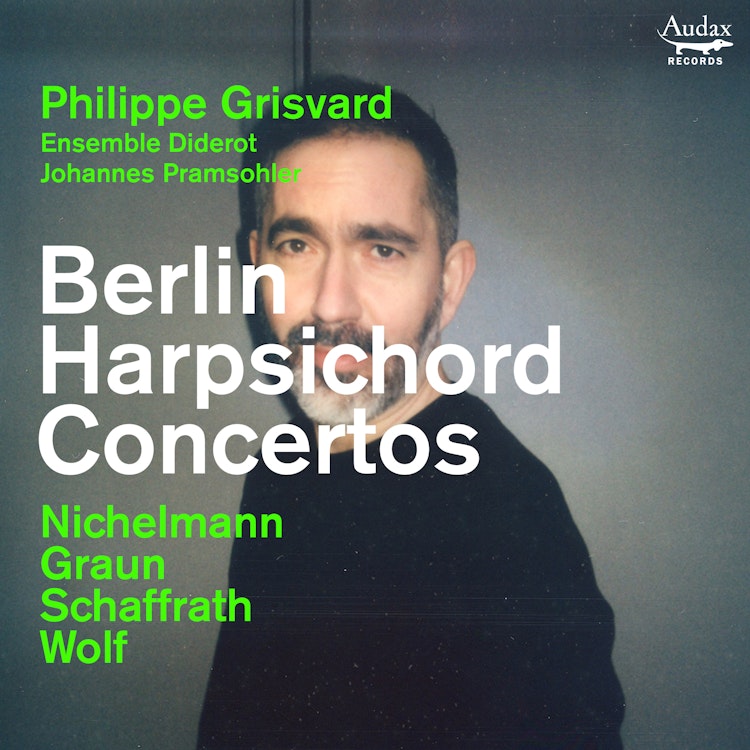
All four concertos here are World Premiere recordings
All four concertos here are World Premiere recordings.
Christoph Nichelmann (1717-62) was at the Thomasschule in Leipzig; his life took hm to Berlin via Hamburg (the hub which held Telemann and the theorist Johann Matheson). He had beef, as we might say today, with C. P. E. Bach, and yet it is C.P.E. who is brought to mind in thsi concerto in this excellent performance. Giisvard is a superb harpsichordist, and if I might want just a little brighter sound from the instrument.recording, there is no doubting the vivacity of this performance, Ensemble Diderot in fine rhythmic fettle
The Adagio is actually quite gallant, almost but not quite J. C. Bach (the "London" one); only the sudden, sharp chords from the strings indicate otherwise. The finale is fascinatingly unpredictable. Grisvard's adenza is magnificent:
The unison opening to Graun's Concerto, which takes us from D-Minor to D-Major. Graun is much more of a known quantity: try his opera, Polydorus (post), of this coupling of Graun with CP. P. E. Bach Viola Concertos. In his harpsichord concertos. teh gallant meets Vivaldian ritornello. The notes are right to describe the orchestral writing as "symphonic"; and yet Graun weaves the harpsichord in beautifully:
The gallant is most marked in the central Adagio (listen to the lightness of the lower orchestral strings here, so no textures are muddied). There is nothing workaday about this music - even an ascending scale can take on great significance (as in the strings in the lead-in to the cadenza):
Teh finale seems to be a mix between C. P. E. Bach, J. C. Bach, and Mozart to my ears. All credit to Grisvard for the cleanliness of his left-hand trill, too.
The name of Christoph Schafrath (c. 1710-1763) from Dresden was a founding member of the chapel established by Friedrich. Known as an avid follower of Bach in his youth, once can hear the influence on this concerto, especially in the first movement (the sighing sequences of appoggiaturas, for example):
The slow movement seems to take Baroque gesture (a descenidng scale that is almost like flowing tears) and reframe it within a slightly later cradle, while the finale remains resolutely in the minor mode. And yet how the music fizzes: at one point Schaffrath works with texture alone, and how beautifully:
Finally, a concerto by Ernst Wilhelm Wolf (1735-92). In my previous post of music by Wolf, I wrote:
Ernst Wilhelm Wolf (1735-1792), born in Großenbehringen, near Gotha. was court kapellmeister in Weimar. He was active musically in Weimer for over three decades. Musically, his greatest influences were Carl Philipp Emanuel Bach and the “empfindsamer Stil” and the works of the Berlin Kapellmeister Carl Heinrich Graun..
Wolf studied in Jena, and he came to Weimar via Leipzig (this concerto was composed either in Weimar or Leipzig). Now we have a harpsichord concerto, heavily indebted to C. P. E. Bach in the gesturalism of the first movement:
The central Adagio is more gallant, perhaps, at least initially, but takes us to some barren Baroque spaces - it is a remarkable movement that underscored that Wolf is a composer worth investigating:
The finale an Allegro di molto, perhaps pales a touch after the slow movement, but is nevertheless given much life here.
The Ensemble Diderot comprises five members, one to a part: Violin and director Johannes Pramsohler (who plays a 1713 violin from Bescia), Roldán Bernabé (violin), Alexandre Baido (viola), Gulrim Choï (cello) and François Leyrit, double-bass. There are excellent notes by Peter Wollny.
This disc is available at Amazon here. Streaming below.