Vaporised Tivoli: The Music of Anders Hillborg
A stunning, beautiful, impactful release
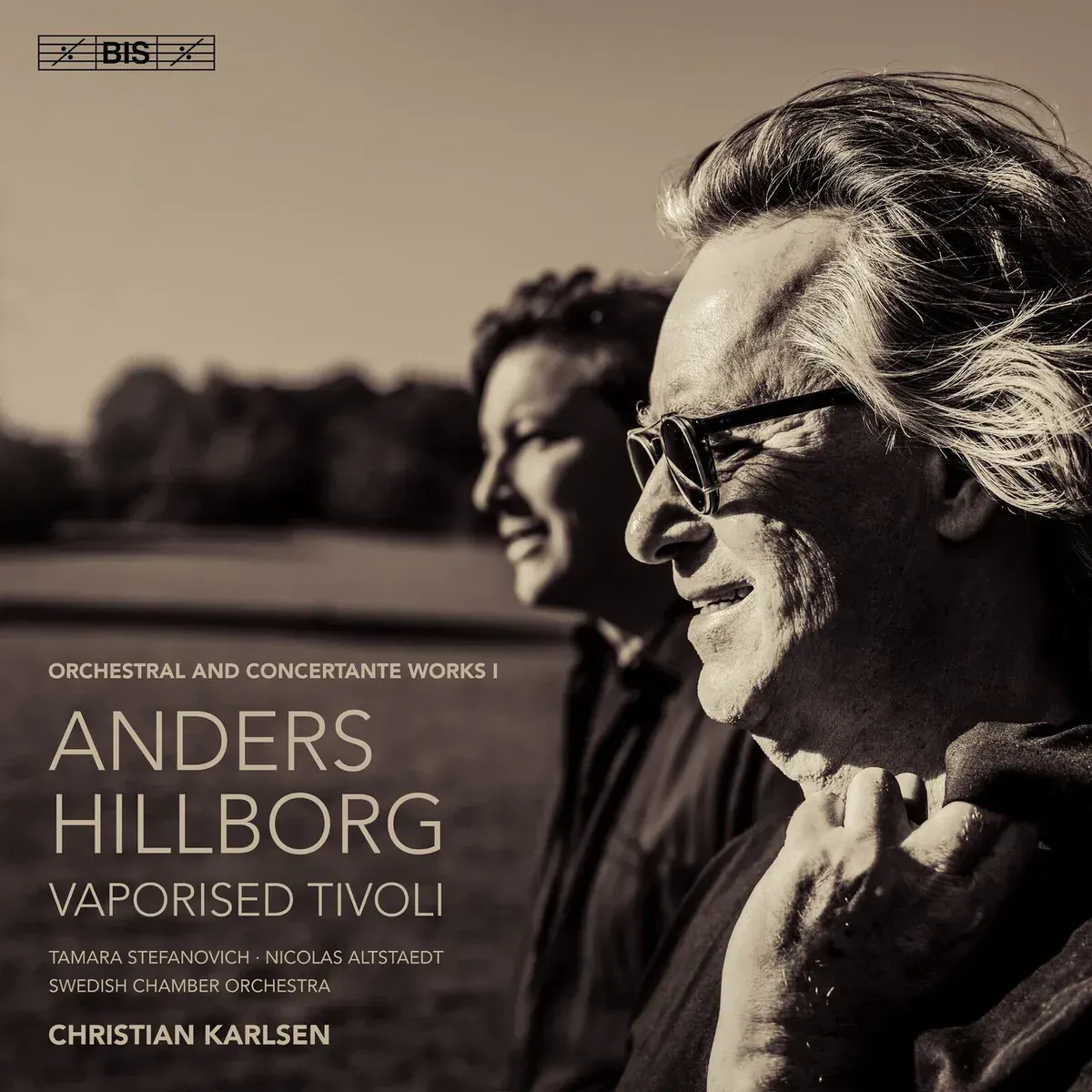
Designated (in small caps) as "Orchestral and Concertante Works I," this is a brilliant introduction to the music of "Sweden's most performed living composer". Hillborg studied in Stockholm with, among others, Per Lindgren before falling under the spell of Ligeti. In his book The Northern Silence, Andrew Mellor writes (p. 254) that Hillborg ...
... manages to sound himself even in works that bear little comparison to their predecessors. Hillborg composes with the clarity of the pop music he originally wrote, with the cool objectivity of a classic Scandinavian functionalist and with more than a hint of the narrative Nordic noir.
The clash of Modernist Scandic dissonance against consonance at the opening of Anders Hillborg's Piano Concerto No. 1 (2001/5) is visceral. The concerto was written for Roland Pöntinen, who premiered it under Okko Kamu (a conductor who has previously worked extensively with Manchester's Hallé Orchestra); the 2005 revision heard here was similarly premiered by Pöntinen, now with Salonen at the helm. Micro-polyphony meets keyboard virtuosity:
Andrew Mellor, in his notes reminds us it comes immediately after the "flamboyance" of Peacock Tales (Hillborg's clarinet concerto). He's not kidding - and not only musically, watch what Martin Fröst has to do physically here:
The low movement moves towards stasis - what Mellor memorably describes as "like a hanging mobile" with the piano "channelling the ghosts of music past". Again, tonal constructs are here, now surfacing rather than juxtaposed, softenings, deepenings. The resonance between Stefanovich and the Swedish Chamber Orchestra under Karlsen is remarkable:
There is an icy beauty to that movement; the finale begins as a virtuoso Modernist toccata (Stefanovich is superb, sparkling). The piano's bass grounds the aerial spirallings: this is remarkable music, remarkably performed. The music's unwinding towards its conclusion is beautifully realised here. And just wait until you hear that final chord!:
John Kongsgaard is a wine maker who commissioned Hillborg to write a work celebrating said beverage. Cleverly, the label of this wine quotes the Arietta from Beethoven's final piano sonata (serene yrt complex, rich yet ethereal”!) - the perfect starting point for Hillborg. The Beethoven is a vital part of Hillborg's variations, but Hillborg's technique is different in that he presents what he calls “meditations” with ...
... music that floats effortlessly through the centuries, displaying reminiscences of Baroque, folk-music, Renaissance and Romanticism, but with Beethoven's Arietta theme as the musical epicentre
There is pure statement here, but there is also implied statement, distortion, and “vaporisation” of Beethoven's theme. Written in 2006 for string quartet, it was arranged by the composer for string orchestra in 2021, and this is what we hear here, in a simply beautiful recording by Jens Braun (Producer) and Fabian Frank (recording engineer):
... and here's a performance of the string quartet version by the Calder Quartet from Napa Valley, California (where Kongsgaard winery, itself called Arietta, lies):
What was part of the piano concerto's discourse becomes vital here: the arrival of tonal constructs in diverse ways with diverse meanings (both structural and emotive). And how the music glows towards the end. The Swedish Chamber Orchestra is simply magnificent throughout.
Dating from 2010, Vaporised Tivoli is written for sinfonietta. It opens with wind and brass "stutterings," its overt Modernism and breath-based texture in full contrast to the close of the Kongsgaard Variations. Fultter-tongued horns (approached by glissando) take on a decidedly elephantine aspect before it all morphs into big band territory. "Tivoli" itself means "fairground": the first part of the piece represents kids running around a fairground; the "pulling of the plug" (Hillborg's phrase) probably represents the children running out of juice, a sonically clear "bleeding" of energy before the music glitters. Again, as in the Kongsgaard Variations, there is musical disintegration, but also something darker: Hillborg was influences by Ray Bradbury's novel Something Wicked This Way Comes (a travelling tivoli that prays on the towns it visits). This is only 9"15, but is magnificent:
Finally, the Cello Concerto (2020) with Nicolas Altstedt as soloist, to whom it is dedicated. We move from big bands to interiorised melody. Fascinatingly, there are passages that deliberately evoke an Elizabethan viol consort, but as if viewed through a sheet of ice, or, as Hillborg puts it, "through a gauze":
The second section seems to contain all that is quintessentially Hillborg in its icily withheld textures, and listen to how the music warms when the cello enters at score letter T (the second video below - they flow into one another on the disc):
The beauty of this slow section has to be experienced; as does the sheer control of Altstaedt and the strings of the Swedish Chamber Orchestra. BIS' release is a hybrid SACD, and offers one of the finest recordings of recent years, too.
Consonance is repurposed again the fourth section, a sort of glowing referent that ushers in a dance that is as headlong as it is hedonistic before the "viol music" returns to usher in the glowings of the final six minutes. The term "vaporised" could possibly be used in this instance, again, as the music seems to dissolve into charged silences and then glow with consonance. I simply cannot imagine a finer performance than this:
A stunning, beautiful, impactful release. This disc is available from Amazon here; iDagio here.