
The Tears and Fire of the Muses: Jordi Savall at Wigmore Hall
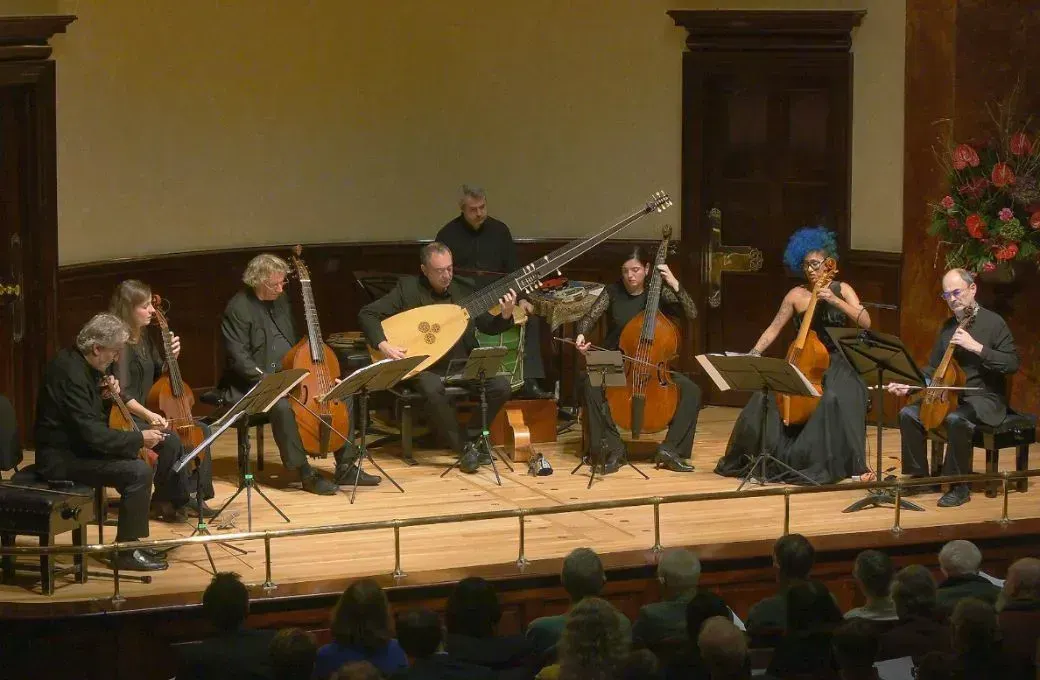
The Tears and Fire of the Muses, Claudio Monteverdi Revolution Hespèrion XXI; Soloists of La Capella Reial de Catalunya. Wigore Hall, 1pm, 26.05.2026
Samuel Scheidt Pavan dolorosa, SSWV 41; Courant dolorosa, SSWV 47.
Monteverdi Lamento d’Arianna, SV 107.
Dowland Lachrimae Antiquae (1604).
Anthony Holborne The Teares of the Muses (publ. 1599)
Monteverdi Sestina: Lagrime d’amante al sepolcro sell’amata, SV 111.
Dowland Lachrimae Gementes (1604). The Earl of Essex Galliard (1604)
Monteverdi Qui rise, o Tiirsi, SV 113.
Dowland Semper Dowland, semper dolens (1604)
Giacomo Gorzani La Barcha del mio amore (1563)
Monteverdi Tirse e Clori, SV 145
What a feast of music Wigmore Hall offered on May 26, part of its 125th Anniversary Festival: Jordi Savall at lunchtime, Amik Grigorian in the evening. Savall’s programme might not have been the happiest (the two largest Monteverdi works, Lagrime and Lamento d’Arianna, were written around the death of Caterina Martinelli, his muse who died too young, and for whom he wrote his lost second opera, Arianna, supplemented and complemented by Dowland’s melancholic core), but it was infinitely beautiful.
Samuel Scheidt was a surprise opener, although the two pieces chimed perfectly with the theme: “Paduan dolorosa” and “Courant dolorosa” from Ludi musici, published in 1621. The instrumentalists were to the fore, singers initially at the back: the consort was exquisitely video, Savall at the left, overseeing, non-interventionally. How Scheidt’s counterpoint spoke, lines perfectly pure, cadences arrived at with real inevitability. Lachrymose descending scales appear regularly here, and would recur throughout the lunchtime concert. The “Courant” might have more movement (and did), but it remained a prolongation of the core emotion, dance rhythms underpinned by grief, a smile on a sad face. And what a difference perfect tuning makes!
Heard in its five-voice form, the Lamento d’Arianna (text Ottavio Rinuccini) takes on extraordinary power; a power somehow emphasised by hearing voices after a purely instrumental expression of grief. So it was the opening “Lasciatemi morire!” (Let me die) was itself heartbreaking, its repeat at the close of the first stanza even more so. Perfect unisons acted as anchors, as arrival points. Bass Salvatore Vitale offered firm foundation when required; the two upper voices, soprano Anna Piroli and mezzo Maria Chiaro Gallo, were perfect foils for each other. A fanfare-like motif at “Son queste le corona” (Are these the crowns) was notable, but so was the sheer harmonic sensitivity. Individual contributions were many: Piroli’s “Ah Teseo, ah Teseo mio” around half way through, for example. The singers ensured the work always moved: there was no undue dwelling on “la misera Arianna,” yet it still carried remarkable weight, Rapid delivery was superbly negotiated, too.
How to follow that? Download’s instrumental Lachrimae Antiquae of 1604 for five viols and lute (Philippe Pierlot, alto viol, Lizsania Fernández, tenor viol; Filipa Meneses, bass viol; Xavier Puertas, violone; Enrique Solonis, theorbo/guitar). Solonis’ theorbo garlanded the grief; most of all there was a sense of waves of sadness as the music swells and retreats; it was complemented by the rather more active The Teares of the Muses by Anthony Holborne (1545-1602; published 1599). Active it might be, but any ambitions towards jauntiness were certainly foiled by the closing passages, the final cadence a composed “sigh”.
The so-called “Sestina” (“Lagrime d’amante al sepolcro dell’amata”; A lover’s tears at the tomb of his beloved) is one of Monteverdi’s most astonishing statements. This is the composer at his most pure. He sets the text unforgettably, the low voices mirroring the burial of the beloved in the "frozen earth”. The rays of Heaven’s light at “Sweet maiden, you are gathered in Heaven” were unforgettable, especially when delivered with such purity as that offered by the Capella Reial de Catalunya soloists. And how carefully calibrated the slow unfolding of “O chrome d’or” (O golden tresses), how heartfelt the cry at “Ohimȅ”. Towards the end, obsessive repetitions play a part; this is harrowing music, harrowingly and yet perfectly delivered.
Equating Monteverdi’s “Sestina” with Dowland’s Lachrimae Gementes (1604) was genius. More waves of pain, seemingly relentless; The Earl of Essex Galliard (sometimes seen as The Earl of Essex, His Galliard) offered rhythmic contrast, both beautifully played.
Back to Monteverdi the concertato (for five voices, but featuring Piroli and Gallo) Qui rise, o Tirse of 1614. The florid lines, so independent (until they’re not), so melismatic, were magical, echoed by the tenor and baritone of Raffaele Giordiani and Mauro Borgioni. It was Piroli again who impressed, a first amongst high-ranking equals, at “Qui l’angelica voce e le parole” (Here spoke the angelic voice and the words). The text (Giambatista Marino) plays on memory, a blissful memory preserved; and yet, as the many descents attest, one in the past.
One of Dowland’s most famous pieces, Semper Dowland semper dolens (1604) spoke of blossoming of grief, heard against the rapid figuration of La Barcha del mio amore by Giacomo Gorzanis (c. 1520- c. 1575-9), very much like a folksong (and recorded by Savall for Alia Vox, incidentally).
Finally, Tirsi e Clori (1616, from the seventh book of madrigals), words by Alessandro Striggio, Borgioni and Pironi made a perfect team here; Pironi certainly made the change of pace after Tirsi’s (Borgioni’s) opening count. Her “Dolcissimo Tirsi” was unforgettable. Lovely to hear the dance rhythms in the lower strings emphasised at Tirsi’s “Su, Clori mio core” (Come, Cloris, my love) - they are not always. Pironi and Borgioni’s voices fit so perfectly together, and when the extension of that occurs - a tutti of all voices at “Balliamo” (let us dance), the effect was magnificent. The music thenceforth was positively joyous.
A long lunchtime concert (around 90 minutes), but not so long there couldn’t be an encore: a Ritornello from L’Orfeo (SV 318) - perhaps a pre-echo for the full opera at Glyndebourne this June!