Czech Discoveries: Kukal and Teml on Animal Music
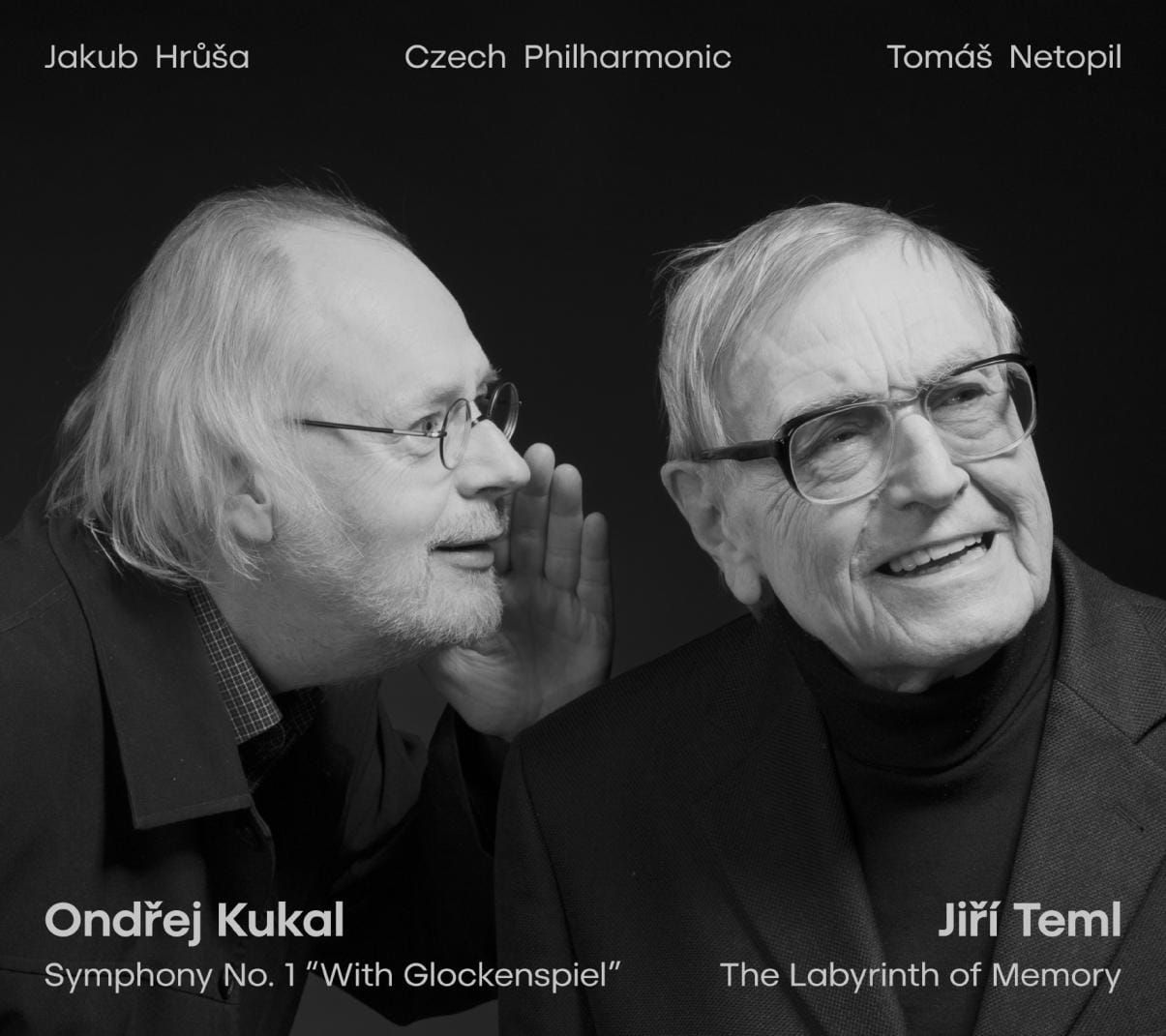
After an all-Czech Wimbledon Ladies' Final, a very much all-Czech symphonic release: Ondřej, Jiří, Jakub and Tomáš conspire to give is a very special disc of live performances.
Ondřej Kukal (born 1964) is a graduate of the Prague Conservatoire and the Academy of Performing Arts in Prague. He was a student of Josef Vlach in violin, and of Jindřich Feld in composition.
From 1985 to 1995 he was a member of the New Vlach Quartet, from 1991 to 1996 he was a principal conductor of the South Bohemian Chamber Philharmonic Orchestra, České Budějovice. In 1993 he became a conductor of the Czech Chamber Orchestra established by Václav Talich in 1946; in 1996 he became a permanent conductor of the Prague Radio Symphony Orchestra and a concert master of the Prague Chamber Orchestra.
In 1999 he obtained a scholarship from the Bavarian Government for a six-month creative stay in Bamberg in Germany. Since 2002, Ondřej Kukal has been a chief conductor of the Hradec Králové Philharmonic Orchestra. He has been a regular guest of leading Czech orchestras - the Czech Philharmonic, the Prague Symphony Orchestra, the State Philharmonic Brno etc. He also conducted the BBC Symphony Orchestra. In 2006 he conducted an initial concert of the International Music Festival Prague Spring and Kukal´s interpretation of Má vlast/My country was compared to Rafael Kubelík´s creations by the critics. Despite the breadth of his conducting performance we can find by Ondřej Kukal an increased interest in Czech authors from the 18th century up to the present. The majority of his own composing production has been recorded by Czech Radio; many of his works are available on CDs. His Clarinettino - Concertino for a clarinet and strings was awarded by the Classic 94 prize.
The piece here, Symphony No. 1, "With Glockenspiel" (1999) - also sometimes seen as "with chimes," or "with carillon" - was awarded the prize from OSA (Society for the Protection of the Rights of Music Authors and Publishers) in 2005. It was enabled via a grant from the Bavarian government. The work was premiered under the conductor's baton with the South Bohemian Chamber Orchestra (České Budjeovice).
Kukal's story is both fascinating and tragic: in 2003, scheduled to conduct the opening of the Prague Spring, he suffered from viral meningoencephalitis, which caused amnesia. After an hiatus, he thinks of his life as a "before" and "after": Kukal's musical memory was intact and he could continue as composer. , resuming composition in 2004.
Here's the album teaser for the Kukal:
There is a sense of organic growth from the chthonic beginning. It almost sounds like a Modernist cliché of yesteryear to begin with, but the opening out is softer, perhaps a lighter version of the opening of Tristan's third act. Timpani, so important in this symphony, gently pound away in the background as the ascending motif rises then starts again as if emerging from the depths. A superbly played bassoon solo offers a way out (and up, in terms of pitch)l The marking is "Andante spiritoso". A composed ascent, the opening minutes are beautifully written, beautifully interpreted by Jakub Hrůša, and beautifully played by the Czech Philharmonic. A dark intensity informs the whole, with crass descents crowning ta climax followed by an eerie glockenspiel aftermath:
That ascending figure becomes stuttery and disturbed for the short "Gradazione" movement, frenzied, yes, but with Hrůša at the helm, every strand is there, beautifully balanced. The move to the far more directional "Allegro energico" is clear: again that three-note ascent here with a sort of inevitability of forward movement that si first cousin to Holst's "Mars" from The Planets. The contrasts are clear, but also glowing. This is remarkable music, deeply powerful, When the shadows of the works opening appear, they are quickly amalgamated into a brighter Weltanschauung, as if to say their time is spent. The climax, again percussion-garlanded, is significant; but its brightness dissolves into an orchestral welter of sound which allows for the frozen "Epilog"
A magnificent symphony. Kukal has a strong voice; his piece is cogent, beautifully structured and above all packs a powerful emotional punch. The performance is superb: the only way one would know it is live is via the extra frisson.
Composer Jiří Teml (born 1935) offers The Labyrinth of Memory, which he calls a “symphonic image”. This live recording with patching (Feb 5-7, 2025) of the World Premiere, and here the Czech Philharmonic is conducted by Tomáš Netopil.
A delayed premiere: the original was slated for 2020, but the plague got in the way. Instead, the 2025 performance celebrated Teml's 90th birthday. Teml has described the piece as ...
... a kind of reminiscence about my life. There are moitifs representing toys from my childhood, but also unpleasant and difficult memories, such as illness.
Here is a conversation between composer and conductor about this piece:
Contrasts are at the heart of the piece, but there is an underlying thematic cohesion. The music changes mood quickly, from child-like skipping to furrowed-brow determination in a heartbeat. There is beauty aplenty, not least in the phenomenally played clarinet solos and fine solo violin (arguably a touch too spotlit). The composer's achievement is to carve out a piece that appears free-form and yet is cohesive, a stream of consciousness with arrival points, if you will. The passage of hope that arrives after the 140minute mark on trumpets feels well prepared, for example, as does the consonant calm of the very close:
A fine release, well worth of investigation, and available from Amazon here.