
Bello tiempo passato
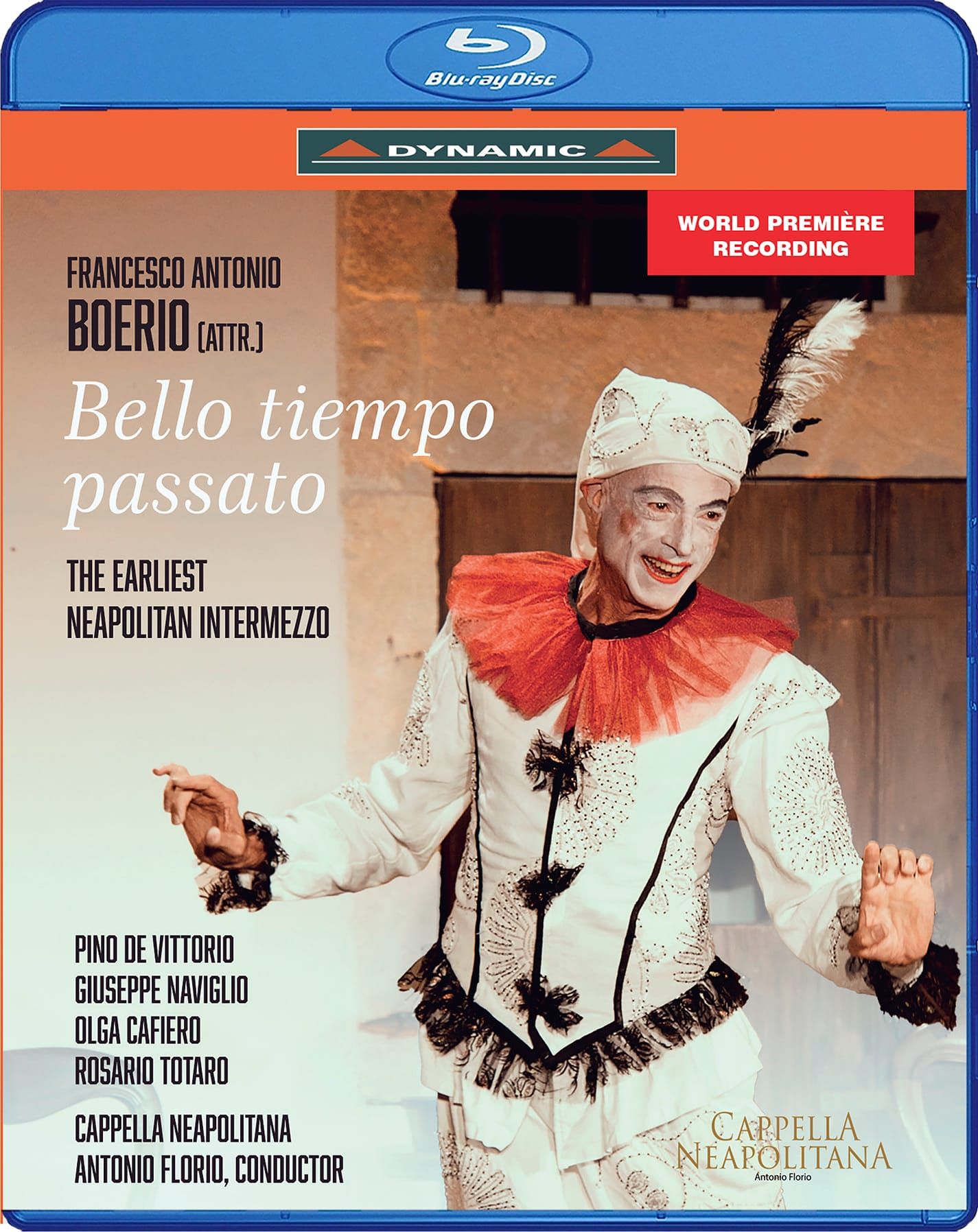
“Fine old days”: Boerio (probably)'s 1673 comic intermezzo
We are in the world of the commedia dell'arte here. In the early 1670s, soon after Venetian opera became established in Naples, a series of comic figures began to inhabit opera. Here, a Neapolitan, a Calabrian, and a Boy, a, plus a fourth, ‘The Spaniard’, appear in a comic intermezzo inserted in the 1673 opera Il disperato innocente by the little-known Francesco Antonio Boerio.
What is important here, apart from the music's clear charm, is that this is the oldest surviving Neapolitan comic intermezzo, and, along with its Prologue, seems to have been written by other authors.
This video preserves a historically informed performance given by Antonio Florio with Pino De Vittorio that explores the tradition of the intermezzo in 17th-century plots. Fitting, then, that we have the "Cappella Neapolitana" here, offering a performance in time-appropriate costume to the highest standard (and with some fabulous acting). Cappella Neapolitano/s conductor, Antonio Florio, has reconstructed the text and revised the manuscript in a beautiful act of musicology. The band is comprised of eight members, five of which make up the continuo (cello, archlute, theorbo, Spanish guitar/calascione - also known as "liuto della giraffa" on account of its long neck. and harpsichord). The performance was taken down at Naples (San Freancesco delle Monarche) in March 2023.
So what exactly is an "intermezzo"? it's an interlude within an opera - characters were extrapolated from the main opera being performed. It comes from a theatrical tradition from the religious dramas of the 16th-Century, the itenerent artists of the Commedia dell'arte, associated with Naples in the form of Silvio Fiorillo, the first interpreter of the character Pulcinella.
Venetian opera arrived in Naples around 1650 (in the festivities around the defeat of Masaniell. Neapolitan versionf of Cavalli's Didone and "Il Nerone" (a version of Monteverdi's L'incoronazione di Poppea). The adaptations were by the likes of Francesco Cirillo and Francesco Provenzale.
Il disperato innocente was staged - the music is by Francesco Anotonio Boero to a libretto by Baldassarre Pisani. The characters found here (and in the intermezzo) - the Calabrian, the Neapolitan, the Boy) are often found in music around this time in both secular and "scared" operas (the latter exemplified by La colomba ferita by Provenzale, which includes the same characters).The MS of Bello tiempo passato is held at Naples under the name La Lisaura and holds what we hear here - the oldest extant Neapolitan comic intermezzo.
In this performance, the Prologue is cut so we only have the summary at the opening (by the Neapolitan). This is in Neapolitan, in homage to the 17th-Century Neapolitan literary tradition (references in the title of the intermezzo 0 the good old days). There follows a description of the dynamics of theatres, of the machinations of an operatic performance, and a dig at journos. A fill version of the Prologue was used at the first modern staging of Provenzale's opera Stellicaura in Bari (1996,, Petruzello Theatre), recorded in 1995 by Florio in his recording of Francesco Provenzale: Cantate canzonette e dialoghi (Symphonia SY 94S29, full title Cantate napoletane dell' età Barocca : Vol. 2).
The piece opens in the dangerous side streets of Spanish Naples in the late 1600s. The Calabrian complains about separation from his love and his lot. He meets a crooked Neapolitan, who tries to win him over with promises of good food and by pretending he is an ex-soldier. A "Boy" acts as an agent of chaos; later a Spanish soldier arrives, hold and famous. Shenanigans between Calabrian, Neapolitan and the Innkeeper provide the balance oft he tissue-thin plot, with the Boy as saviour in this micro-drama.
Various languages/dialects are heard: the Neapolitan in Napoletano, the Calabrian in Calabrese, the Spaniard in Spanish, and the Boy (a trouser role) in Toscano (standard Italian).
Pino (Giuseppe) di Vittorio is the most stunning actor and tenor (he also sings, although not here, as a sopranist). He dominates the stage, and every aspect of his assumption is perfect, from the way he embraces the "period acting" to his declamation. HIs scenes with Calabrese (Giuseppe Naviglio) are magnificent, their voices as differentiated as their costumes. Their voices work perfectly together.
The Ragazzo of Olga Cafiero is beautifully clean-voiced; baritone Rosario Totaro is a brilianrt actor his voice nicely "pinched" to reflect his character (while opening out nicely when the opportunity arises). The passage between Ragazzo and Spagnolo about 50 minutes in is simply brilliant. Here's Cafiero's"Oh che gusto":
.. and her's Totao in Spagnolo's "Pues yo soy":
The most "dramatic" moment is the slo-mo duel towards the end (De Vittrorio and Cafiero, the "battaglia"). But what emerges is a charming example of a very specific genre, beautifully realise.d. The final tutti, in which the singers (except for Ragazzo) don the masks associated with the commedia del'arte, seems the perfect way to close.
Formally, the piecs includes a numher of Passacaglias and Tarantellas. Here's the beautiful Passacaglia II:
.. and here's the remarkable, "Tarantella II," beautifully varied in expression and demeanour, the two violins of Marco Piantoni and Nurzia Sorrentino impeccably eloquent:
Here's a teaser for the video:
Sadly, only sound-only tracks are on YouTube, but to get a feel for the instrumental world, here's the opening instrumental "La Follia":
A remarkable release, as pleasing as it is historically important. It is available at Amazon on DVD here, and on Bluray here. There's only a couple of pounds between them; the present post is based on the excellent Bluray.