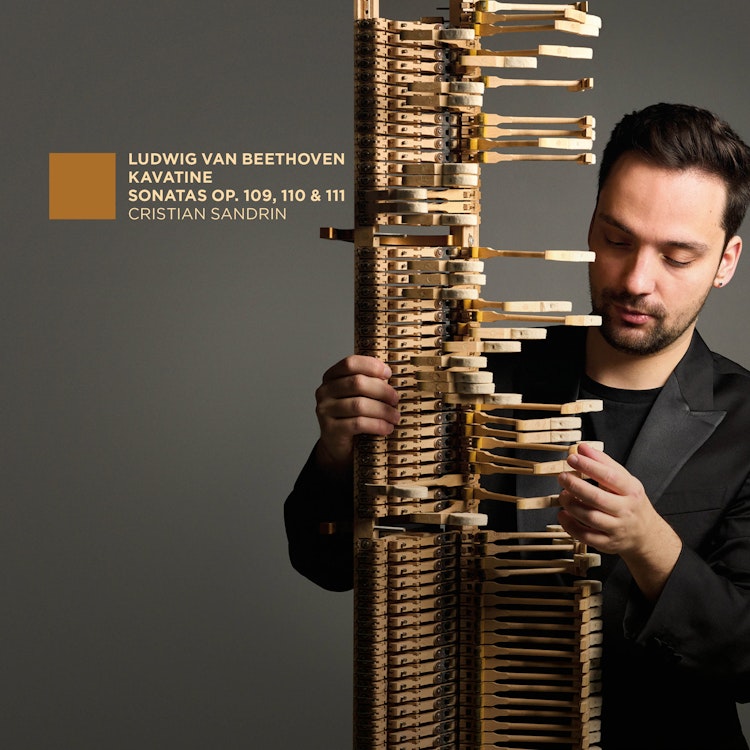
Beethoven's final trilogy of piano sonatas: Cristian Sandrin excels
Exploration isnt' just about repertoire; it's also about new talent. Crisian Sandrin here gives performances of the last three Beethoven piano sonatas for the ages: plus a bonus (Carl Tausig's arrangement for piano of the "Cavatine" from the Op. 130 String Quartet).
Here's the teaser for the disc:
The performance of Op. 109 begins with two movements of exquisite beauty in which every detail is honoured, all held within a new-perfect piano recording. The record company is the memorably-named Evil Penguin, their presentation perfect (although I did think at first glance that the cover was the pianist with a wooden contrabassoon as opposed to a piano's mechanism! - something about the way he's holding it ...).:
The finale is the great expansion of caabile ("Gesangvoll"); a vast exploration of a heme on a cosmic level. Sandi's jouncy encapsulates Beethoven's own snuggle between the human and teh Divine and as such it is a moe human journey the, sy, the tanscendenally beautiful Uchida: His staccato is mechanistic, fascinating, his legato moon and full-toned. Here is someone who can make a piano sing. Lae Beethoven's deb to Bach is acknowledge in the had touch and clarity of plan inpolyphony. The performance is like a masterclass:
The inclusion of the Tasing is to point out similarities between the Cavatina and the cantabile nature of Op. 110. The is a crystalline brilliance to Sandrin's touch in Op. 110 (i). His sense of pulse is excellent, too, so the sense of unfolding is never interrupted by rushing:
The sheer power of the Allegro molto is remarkable, half of this the instument and recording, half Sadrin's ability to play without breaking tone; plus, of course, that rhythmic mastery:
Certainly the Adagio ma non troppo opening to the finale - approaching the Fuga - seems closely related to the Op. 130 Cavana here. The fugue itself merges as naturally as in any performance I have ever heard.
And that transcription is beautiful, absolutely the emotion equivalent to what we have just heard. In fact, it nestles beautifully between Op. 110 and Op. 111's Arietta. Sandin's sense of unfolding line is stunning, as is his harmonic sensitivity:
In between those comes the granitic first movement of Sonata No. 32, the opening bass diminished seventh leap commanding, the binding dissonances later powerful beyond measure.
Thee's a volatility to Sandin's first movement that is not purely volcanic. Thee is an almost romantic oscillation between the lyrical and the dynamic; resolution sems only possible via the heavenly expanse of Op. 111 (ii).
The finale seems to exist beyond time before finding its momentum, and this is not achieved though a near-glacial important but through chord weighting, firm harmonic basis, and long-erm hearing and vision. Th sense of organic growth, f opening out, is visceral. Possibly most impressive is Sndrin's control a pianissimo, not just at th famous extreme rebel poi bu immdaely rio. A makable account.
As a supplement, here are videos of Sandrin's performances of Oppp. 109-111 in London, at LSO S Luke's:
This very special Evil Penguin disc is available from Amazon here.