
Bach Goldberg Variations (as you've never heard them)
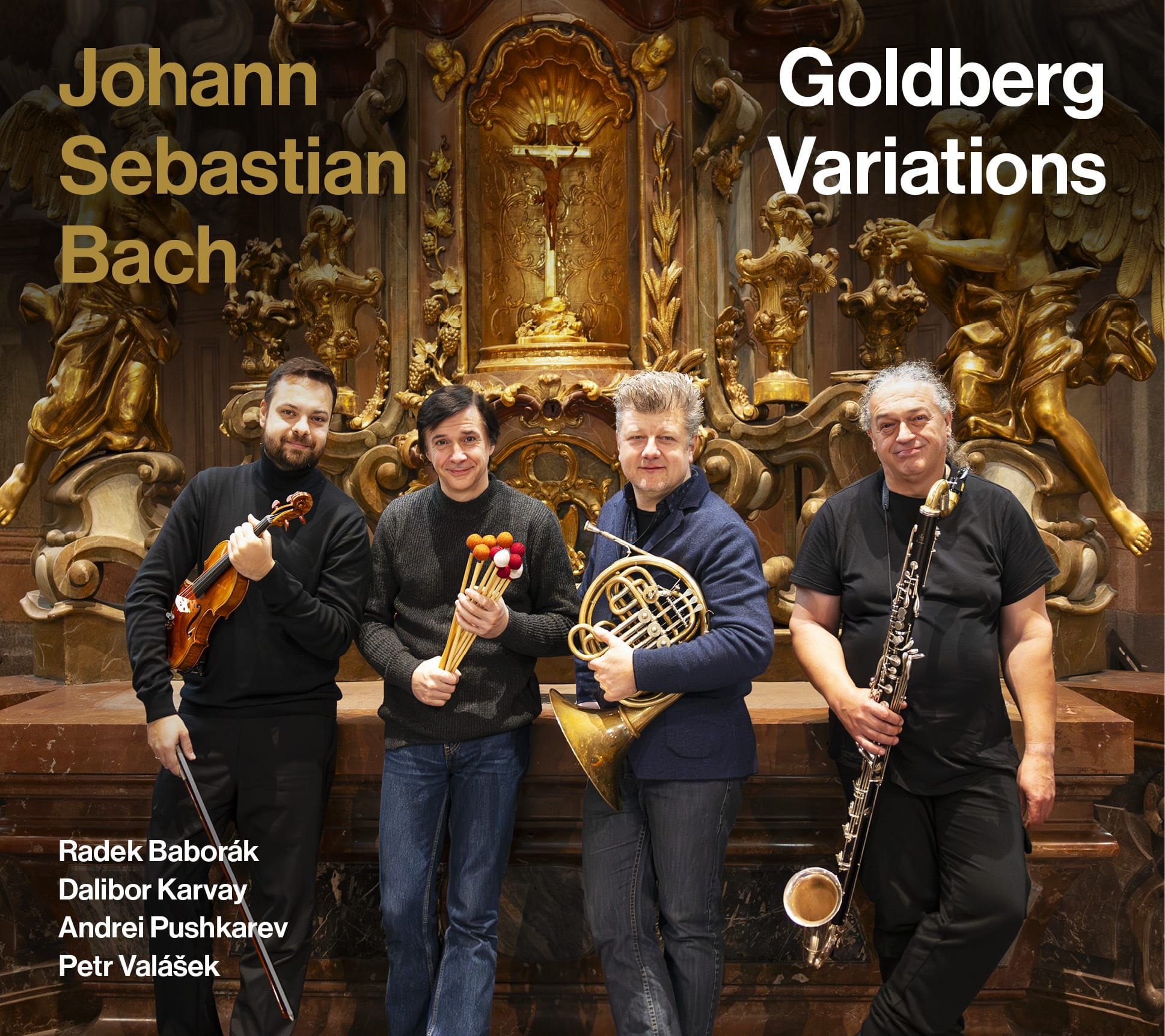
There are kazilliions of Goldbergs out there. Here's one with a difference: an arrangement by Tomáš Ille (born 1971) for French horn (Radek Baborák), violin (Dalibor Karvay), marimba (Andrei Pushkarev) and bass clarinet (Petr Velášek).
These variations have inspired many, from Landowska on harpsichord through Hewitt on piano to Lang Lang (on another planet), plus myriad arrangements, Sitkovetsky's for string trio probably one of the most famous. Carl Czerny made one of the first, for piano , adding his own editorial marks (fingerings, phrasing); Busoni's version plays fast and free with the variations' order.
This combo is new though. And it really kind of works. Released on the Czech Animal Music label, it was conceived by master horn player Radek Baborák during his tenure as curator of the chamber music series at the Dvořák Prague Festival (a chamber music festival) in 2017. That arrangement was forFrench horn, guitar, violin, and bassoon. This is a rewrite for this recording, made in Prague in October 2025.
Barborák says,
Performed in this line-up, the Goldberg Variations resemble a conversation between four friends discussing one central theme. Figuratively speaking, they approach it from the perspectives of their individual instruments and distinctive characteristics. At times, they stand in sharp contrast to one another; at others, they seem to arrive at a shared understanding … Whether performed by a soloist or by ensembles of different sizes, the Goldberg Variations always represent both an artistic and technical challenge. Yet even after centuries, this music remains an endless source of inspiration and creativity.
Here's an introductory video - quite detailed and well worth a watch, not least for the view of the beautiful recording venue, Saints Simon and Jude Church in Prague The piece was, incredibly, recorded in one day (October 17, 2025).
A little about the performers: Slovakian violinist Dalibor Karvay, served as First Concertmaster of the Vienna Symphony Orchestra from 2020 to 2025; Czech bass clarinettist Petr Valášek, a member the clarinet quartet Clarinet Factory; and Latvian-Ukrainian percussionist Andrei Pushkarev of Grammy Award-winning chamber orchestra Kremerata Baltica led by Gidon Kremer. Also, this release marks Radek Baborák’s seventh album on Animal Music. Before focusing primarily on his international solo career, conducting and chamber music, he enjoyed an extensive career as Principal Horn with orchestras such as the Czech Philharmonic, Munich Philharmonic and Berlin Philharmonic.
Here's the Aria:
There is stunning playing here. Baborák is a true virtuoso, and how it shows in Variatio 7:
Other variations, like the very next one, are more like conversations:
The different timbres enable proper individuation of voices, as is Variatio 10, which really needs this (it's a Fughetta):
Different instruments these may be, but there are four equal 'voices' her,e as you can hear in Variatio 14:
The Variatio 15 (Canone alla Quinta) beings about a natural break, and how the players achieve this. It's a beautiful ending; the silence is programmed in on a CD playing, and then the French "ouverture" is launched:
All four players are virtuosos in their own right. I have rarely heard horn playing like this, for example Baborák's agility is matched by few; perhaps only Pip Eastop these days?). Try his super-even lip trills in Variatio 28 - they are even matched perfectly with teh trills of violinist Dalibor Karvey, no mean feat:
I love the evenness of Valášek's bass clarinet in Variatio 19, too:
Ther eis wit here, too: in the charming two-instrument descents of Variatio 23:
... and what of the so-called "Black Pearl" variation, Variatio 25. Just a tad less expansive than the theme itself (4'35 against 4'54), it offers a meditative space, yes, but quite an exploratory one:
There's a sort of colourful 'Quodlibet," the tempo perfectly chosen, for all its complexities still a dance, before the return of the Aria. Here's that Variatio 30 (the "Quodlibet"):
Teh return to the Aria still has an effect, of course. It is not perhaps as profound as some ofteh rgeat performances, but it works nicely, decorations of line tastefully applied:
This disc is available at Amazon here.