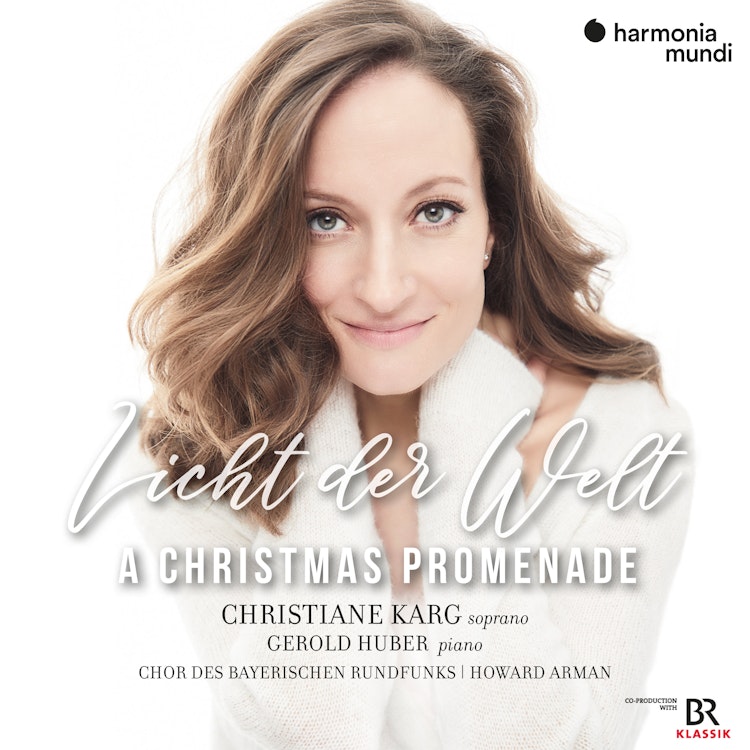
A Wigmore Christmas: Christiane Karg and Gerold Huber
A shot but satisfying Christmas terat
Humperdinck Weihnachtsliede: Weihnachten, EHWV 111; Das Licht der Welt, EHWV 132; Christkindleins Wiegenlied; Weihnachsfreude.
Cornelius Weihnachtslieder, Op. 8: Christbaum; Die Hirten; Die Könige; Christkind
Mendelssohn Weihnachtslied
Marx Chrisbaum
Richard Strauss Weihnachtsgefühl. Die Heiligen Könige us Morgenland, Op. 56/6.
Reger Neue Kindelieder, Op. 142: Maria am Rosnstrauch.
Wolf Spanisches Liederbuch: Ach, des Knaben Augen; Die ihr schwebet.
Toldrà Cantarcillo.
Nin Vilancicos españolas: excerpts
Saint-Saëns La madonna col bambino.
Respighi Noël ancien
Ravel Noël des jouets.
Chaminade Le noël des oiseaux.
Massenet Le noël des humbles. Noël de fleurs. Noël paien.
'Weihnachten – es naht die jubelvolle Zeit' was written at the start of Wigmore Hall's free programme: Christmas – the joyous time is approaching. Innit.
And to celebrate the annual celebration and holiday, Christiane Karg and Gerold Huber bought a recital based around their disc, Licht der Welt (A Christmas Promenade). Monday evening is obviously the dead spot for Wigmore Hall, for why else would there be so much space in the auditorium? Christiane Karg is a major singer on the world stage; Gerold Huber is one of the foremost collaborative pianists around.
Karg's voice is magical in itself. Perhaps there was just a touch of Karg settling in to the first song, Humperdinck's “Weihnachten,” the first of four songs from the 1898 Weihnactslieder, and perhaps the legato could hav been smooth at ''Lichte Himmelsboten schweben' (Gleaming angels float). Not so Huber, whose sound was perfect, so clear and yet warm. Karg and Huber did manage the change of tone at the third verse beautifully (better even than their recording) at 'Und schon hat mit tausend Sternen' (And the brilliant sky has already been lit up by thousands of stars). Karg's legato was back in full force in the lovely 'Der Licht der Welt' (The Light of the World). She added more Humpedinck to the pot than is on the disc: the gentle rhythmic rocking of the lullaby 'Christkindleins Weigenlied' (The Infant Jesus' Lullaby); what made Karg and Huber's performance so interesting was the idenntification of darker tones within a song form, a lullaby, tradtionally associated with unalloyed innocence (more obvious than, say Angelika Kirschlager and Helmut Deutsch's performance on Sony).
And so to joy: 'Weihnachtsfreud' (Chrismas Joy). Setting Richard Dehmel (he so beloved of the Expressionists, and of Richard Strauss), Humperdinck's music retains a sense of innocence. I was however the final extended setting of 'O Weihnachtsfeud' that was so memorable.
Good to see some Peter Cornelius here: four songs of six from his Op. 8 song cycle composed beween 1856 and 1870, Weihnachtslieder (Christmas Songs). The first song, 'Christbaum' (The Christmas tree) was lovely and playful; This song is a beautiful dialogue between voice and piano, Huber absolutely an equal 'voice'; 'Die Hirten' (The Shepherds) was light and caressing in contrast. I mentioned Expressionism earlier, and 'Die Könige' (The Kings) begins with an almost Expressionist line, before settling into more conventional consonance (the effect is heightened in Karg and Huber's recording, where they are joined by the Chorus of the Bavarian Radio!). Here it is on their disc:
Finally, 'Christkind,' wherein Huber's linking passages between stanzas wee ever fascinating, especially heard against Karg's narrational way with the text.
Onto more familiar ground: Mendelssohn's Weihnachtslied of 1832 (not to be confusd with his rather darker Winterlied, Op. Op. 19a/3 / MWV K 72; some might know that through Fischer-Dieskau). Karg sang with appealing simplicity, but here Huber did feel rather too heavy at the opening; compensating for this was Karg's almost breathless delivery of the crucial line, 'O wer bin ich' (O, who am I?). There was an impesison that the song was not fully honoured, however; compensting fo that were the final thee songs, Marx's Christbaum (1910) was beautiful and sophisticated, the snaking chomaicism a joy, as was the sheer delicacy of the opening and the mystery of the second stanza (Horst Du auch?). Here's the recording:
Karg's one was incredibly pure around this point: remarkable. And placing Marx and Richard Strauss next to each other is genius: a rcal highlight was Strauss' Wihnachtsgefühl (Chistmas feeling), Huber's tone so warm, Karg's line so impeccably Strausian. The final song of the first half was Strauss' 'Die heiligen dei Kõnige aus Mogland (The three holy kings fom Easter Lands), a much darker song that sets Heine, the long piano postlude perfectly judged, and Karg indulging in spellbinding story-telling.
The first half was all in German; the second played with German, Catalan, Spanish, and French. How good to see some Reger here. I did write in my notes 'At least it's not Maria Wiegenlied'; that, it turned out was the first encore!. Maria im Rosenstrauch (Maria by the rosebush) is a lullaby that turns round in on itself harmonically, Reger's chromaticism completely convincing. Reger has an individual voice; as to Hugo Wolf, he has many. Here we heard “Ach, des Knaben Augen' (Ah, th Infant's Eyes; Spanisches Liederbuch, from that collection's Geistliche Liedebuch). Karg made a simple neighbour note in the first phrase count for so much; no detail was missed as a plateau of calm was created. But if there is such a thing as 'core Wolf,' it is 'Die ihr Schwebet' (You who hover), a catalogue of mystery brlliantly done here, Huber's low ocaves usheing in un-Christmassy worlds.
While Eduard Toldrà's music is perhaps not everyday currency, his Cantarcillo (A Little Carol, from his 1941/41 Canciones) was on Karg and Huber's disc. Righly so, it is lovely, a gentle rocking with an Iberian twist (interestingly, Karg makes a massive rolled 'r' on “Riguosos ylos' in both recital and recording).
Nin is another composer who should get out more: three 'Villancicos' from his 1932 collecion: the hushed 'Villancico vasco' (Basque folk carol), the more assertive 'Villancico murciano' (Folk carol from Murcia), the suave 'Villancico castellano' (Castalian carol), and finally the darker 'Villancico asturino' (Asturian carol), full of sparse textures. Unforgettable.
It was a rather nice idea to have French composer Camille Saint-Saëns setting an Italian text, and Italian composer Ottorino Respighi setting French, next to each other. Saint-Saëns' La madona col bambino opens with a phase that is pure Saint-Saëns, so clear, so innocent and somehow intensely Chistmassy at the same time. This is a beautiful song (its close, particularly); against this was Respighi's Noël ancien ( P 97/4). the very opening felt low for Karg, but the freedom of line thereafter compensated.
Ravel, Chaminade and Massenet completed the French segment: Huber created a veritable forest of colour in Ravel's opening; there was a sense of wonder throughout, while at the end Huber created a cacophonous, joyous carillon. Wondeul to hear some Chaminade, her Le noël des oiseaux (Noël of the birds) is charming, itself with its invocaion fo bells ('cloches sonorés'). Beautiful song.
Talking of which, Massenet was surely incapable of writing anything that wasn't beautiful. His Le Noël des humbles (Noël of the meek) is full of his trademark melodies-from-Heaven this had a gentle 'swing' to it (and, as always, very wod was so, so clear). Karg and Huber gave every stanza a different characterisation. The Noël des fleurs was fragant and flowing, while the final Noël païen (Pagan Noël) with its great rolled chods and affecting harrmonies.
Two encores: that Reger 'Maria Wiegenlied' (from Schlichte Weisen, Op. 76), and a folk song, Es wird scho glei dumpa' (some might know it via a Jonas Kaufmann Christmas album!).
For all that there were a lot of songs here, it was an early finish. But the evening remained satisfying: after all, there is a limit to how much gentle Christmas music one can take in one sitting.
The disc referenced above is available from Amazon here. Streaming below: