
A Grand Measure of Inspiration: A Watchman post
In these times we are facing existential questions. What the hell is going on politically? Why does the news seem like an episode of The Simpsons or South Park? A joke, sketch or bad review can lead to a lawsuit—or worse. We frequently find ourselves wondering what we can do to pause the madness and find a way forwards for our long-term future.
Defining the madness isn’t easy, as it stemmed from the best intentions, celebrating diversity, and rejecting exclusion. Noble ambitions, but alas we seemed unable to handle the very freedom we sought. The sense of a cohesive society—of belonging—faded, and this gave rise to a nostalgia for the previous certainties, the simplicity of “us” versus “them” . All too quickly, we found ourselves in a space of dark confusion, questioning the obvious and closing our eyes while going downhill.
But we still have culture—a refuge in the darkness as well as a way celebrate life in more hopeful times. And culture isn’t moribund—it lives and breathes; it tries its best to balance the regressive trends in society. And there are still some optimists, fighting on the peaceful front of enlightenment, well-armed with education, artistic gestures their weapons.
One such is the Slovak composer and teacher Tomáš Boroš, born in 1971. After serving as head of the Department of Music Education at the Faculty of Education at Comenius University in Bratislava, he and his colleagues developed the innovative Superar programme, providing musical training of the highest standard for young people throughout Europe, regardless of creed, class or colour. The benefits of this programme extend beyond just music, nurturing critical thinking skills and social interaction.
Aside from his work in education, as a composer Boroš recently released a three-CD set entitled Gestures, featuring a great selection of works for various forces composed over the last few years, brilliantly performed by all of the participants.
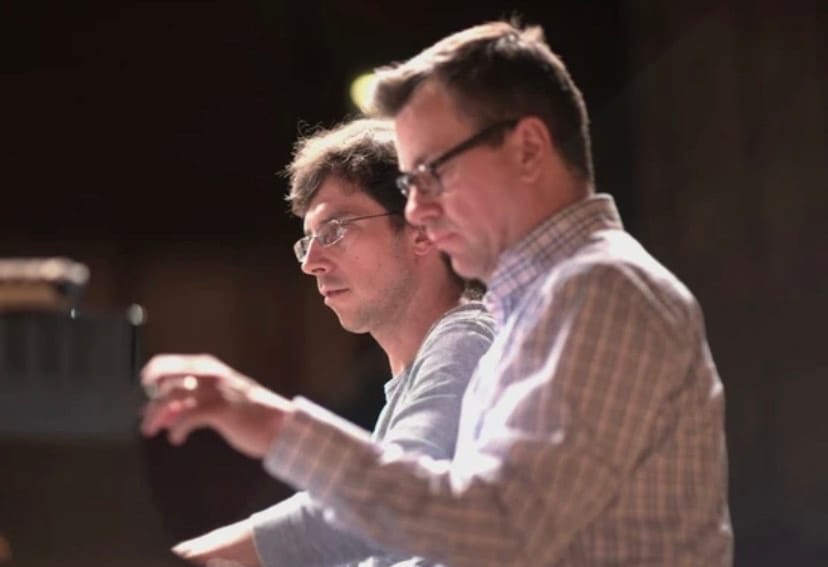
On the intriguing and impactful journey through the three discs, the listener encounters a wealth of thoughts and feelings, from the spark of magic in Music for Toy Piano (2020), convincingly played by Ivan Šiller, a “keyboard sorcerer” , who—just in time for Christmas!— leaves you with the impression that a real miracle is simply a matter of technique. Blocks (2014) for soprano and ensemble, reveals a more playful side to Boroš, portraying a teacher who develops a way to transform structure into emotion, making the learning process into a game. Boroš’s humour is also on display in two of the larger scale works, 2022’s Little Concerto (with Grand Gestures) for two pianos and orchestra and Gestures (2023) for two pianos doubling on percussion, tempered by neo-romanticism, but with a thoroughly contemporary sensibility—a salutary reminder that the history and development of music is a continuous—and continuing— process, indi^erent to post hoc labels and pigeon-holes.
Songs for soprano and piano (2014), poetic settings of texts by Maša Haľamová, explores the boundary between male and female art and is characterised by its perfect fusion.
Tomas Boroš’s work is a testament to dedication and the realisation of talent within a skilful framework that sustains culture and ignites hope by transforming confusion into trust for the future.
Released in 2025 and funded by the HUDOBNÝ FOND / MUSIC FUND SLOVAKIA, this issue deserves not only a five-star review but also a bow in recognition of its talent, skills and sincerity.
The release is available here.
By Hana Gubenko
The Watchman Magazine