
Siegfried at RBO - a (vocal) triumph
Barrie Kosky’s most recent staging of the Ring continues at Covent Garden with Siegfried
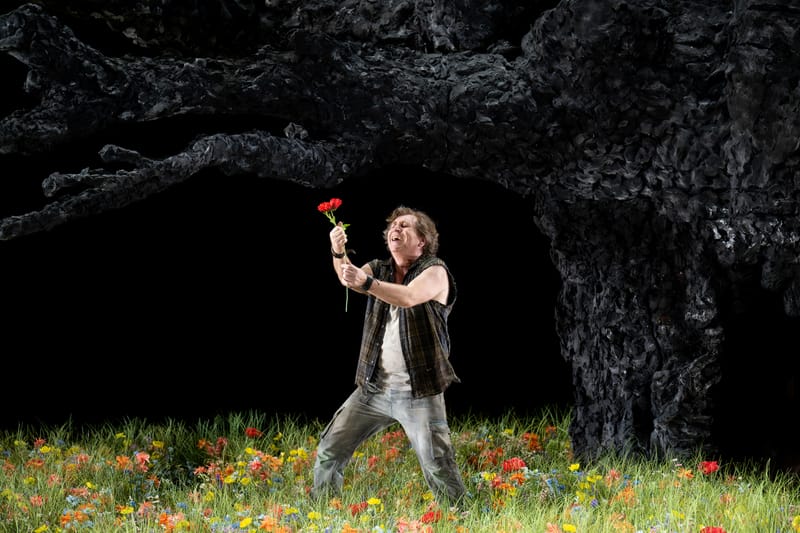
Barrie Kosky’s most recent staging of the Ring continues at Covent Garden with Siegfried; the director had previously declared himself unsatisfied with his staging for Staatsoper Hannover in 2009-11. While this Ring still has one vital part to go, we are in a better position to judge the most recent incarnation; my review of Die Walküre appeared on the Critics' Circle website here.
There are threads spun between the parts, starting with the steampunk machinery of Rheingold, there, attached to the World Ash tree, in Siegfried part of the swordsmithing process. And as the World Ash Tree re-establishes its omnipresence in Kosky’s Ring, so we realise it itself threads its way through the world’s history and traditions: the Greek Goddess Nemesis carried an ash branch as symbol of justice; then there’s the ash-nymph Andasteia, foster-nurse of Zeus, while Poseidon and Achilles both have points of contact. The World Ash Tree in early Germanic tradition was called the Tree of Mimir (no homophonic coincidence, surely?) and in the Edda is Ygsdassil. In Kosky’s Siegfried, we are a long way from the World Ash leaking gold in Rhinegold (‘Rhinegoo,’ as I referred to it at the time). Its dark form is a dead space, minimally animated through occasional interaction, but maximally, and spookily, animated via Alessandro Carletti’s lighting. In the second act, Kosky’s slight-of-eye of the spear as a visual echo of the tree was most effective.
Whether or not this Ring is a ‘collective dream’ in relation to myth (something Kosky has posited), Kosky’s staging suggests it is the intersection and conversation between myth and fairy tale that concerns us here. Mime’s house, most of the way up a tree (I’ll leave you to guess which tree), surely has resonances with witches' houses in enchanted forests and therefore dark fairy tale. At least from the angle of my seat, one of the branches appeared like curled witch’s fingers. The floral overload of the third act (tempered by that meta-theatre of the RBO’s backstage) at once takes us to a fairy-tale idyllic space that would not be out of place in the meadow by the river Pegnitz in Meistersinger; or perhaps this is some sort of utopia on the astral plane?
And so it is that we see liminal states colliding: myth/fairytale, theatre/reality, corporeal/astral: psychic crossroads, all. Perhaps Walküre is more obviously the place for the reminder of the earthly plane, for it is in that music drama that humans and gods/goddesses most directly intersect and interact, but here crossroads remain a reminder of Wagner’s mortal/immortal dance. Perhaps the myth/fairytale intersection is Kosky teasing us … or, more likely, reminding us that dark fairytale is just as emotionally punchy as myth, while simultaneously honouring Siegfried as the ‘scherzo of the Ring’ - something repeatedly mentioned in the RBO programme booklet and borne out sonically via Pappano’s conducting, with its x-ray clarification of texture. .
Each act has its own ‘flavour,’ and this is reflected in Kosky’s staging via Rufus Didwiszus’s brilliant stage designs and, on an equal footing, Alessandro Carletti’s lighting designs, which allow Ygdrassil not only to glower as an ominous omnipresence, but which also use shadow-work to huge effect. The first act with those steampunk forgings cedes to the snowy forest of the second act, ,in which Wotan becomes Schubert’s Winterreise w(W)anderer and which features illuminated buildings in snow that recall Jonathan Miller's ENO Bohème. This in turn cedes to that oh-so-flowery third act, this last a stark contrast to the burnt landscapes of Rheingold and Walküre, a meadow where colours are captured in a sort of hyper-reality. The flowers also hide Brünnhilde well here, enabling what turned out to be a major coup; zero audience tittering at ‘Das is kein Mann’ (the revelation that it is Brünnhilde under the armour).
Antisemitism has long been associated with Siegfried, in Wagner’s stark juxtaposition of the dwarf Mime (whining, nagging, physically repellant: see The Cambridge Companion to Wagner’s Der Ring des Nibelungen, pp. 297-316, for example) and the ‘Aryan’ superhero Siegfried. For the historically-informed Siegfried under Kent Nagano at Dresden and elsewhere last year,, there was a whole booklet essay addressing this, Wagners Anisemitismus, by Dr. Dominik Frank. This aspect seems more implicit in Kosky’s staging, which instead opts to bring out one of Kosky’s core focuses: the interaction between dyads of characters, be it Siegmund/Siegllnde or Wotan/Brünnhilde in Walküre, or Mime/Siegfried in act one here (and so on …). Certainly, there is no doubting the contrasts between this somewhat androgynous Mime and the pure maleness of Siegfried the hero in this production …
As in Kosky’s Rheingold, we again have a dual Erda: one sung (Weibke Lehmkuhl, announced as unwell but able to sing), one acted (Ilona Linthwaite, who will share the role with Marcella Riordan going forwards). It is the acting Erda who is omnipresent, mostly simply watching from bench, swing, or the inside of that tree. Interesting to note that her characteristic rotation (‘rotisserie Erda’), seen earlier in Kosky’s Ring, was absent. Mostly, she is a static observer, a sort of silent Greek Chorus. There are interactions, as in Walküre, when she presented flowers to Siegmund and Sieglinde, here as a befeathered ‘Woodbird Erda’ - but it is the silent presence that is so impressive. When the young Erda is birthed from the old via a huge dress, the effect is less duplication than the experiencing of different incarnations, a sort of Erda-Kundry.
Vocally, there was one clear hero, the titular Hero: Andreas Schager, amazingly making his RBO debut. Schager can clearly sing the most demanding Heldentenor lines until his head falls off. He is a true Heldentenor, and, even rarer, a Heldentenor who can act. We delight in his tomfoolery as much as we engage with his discovery of his beloved, or the slaying of Fafner. There is little doubt he will vanquish the sparkly Fafner, either. Every word is clear, every word has its place. Divergencies between stage and pit were minimal, a testament to Pappano’s authority over his players. For those who understandably cannot wait to hear Schager in Götterdämmerung, a trip to Austria is necessary: after a stint as Erik Holländer, he will sing both Siegfrieds (Siegfried and Götterdämmerung) at the Vienna State Opera in May and June, in Sven-Eric Bechtolf’s production conducted by Pablo Heras-Casado
Peter Hoare offered an archetypal Mime, as vocally tireless as his ‘son,’ relishing the pure physicality of his part. But it was the two Christophers (Maltman and Purves) that offered insights galore, especially the Wanderer of Chstopher Maltman. While Maltman the Lieder singer was more detectable as Wotan in the previous instalment of the Ring (a trend? - I see Christian Gehaher takes on his first Wotan Rheingold at his year’s Salzburg Easter Festival under Kirill Petrenko), here Maltman was more outward-facing, more dramatically authoritative. The Wanderer/Mime questionings of the first act enabled the starkest of character contrasts, Maltman unwaveringly both sure and mature, Mime all bluster and hyperactivity. The Wanderer’s interactions with Erda in the final act were unforgettable. Against this Wanderer was Christopher Purves’ ‘Schwarz-Alberich’ (the term is used by Wagner for the first time in Siegfried, set directly against the Wanderer’s self-labeling as 'Licht-Alberich'). The opening of the second act, which finds Alberich alone in a pre-echo of Hagen’s Watch (‘In Wald und Nacht …’) was well done, but most of all it was the interactions between the two that impressed; another of Kosky’s focuses on interpersonal dialogue.
Solomon Howard reprised Fafner (last seen in fratricidal form in Rheingold). When we do see him emerge from his “cave” - the sheds - he is clad in a sparkly gold suit: Wagnerian bling in extremis (costumes Victoria Behr). Howard’s Fafner is significantly more impressive than his Hunding, vocally present and resonant. And as the Woodbird, Sarah Dufresne reinforced her already well-established credentials in a soaring, agile account of her part.
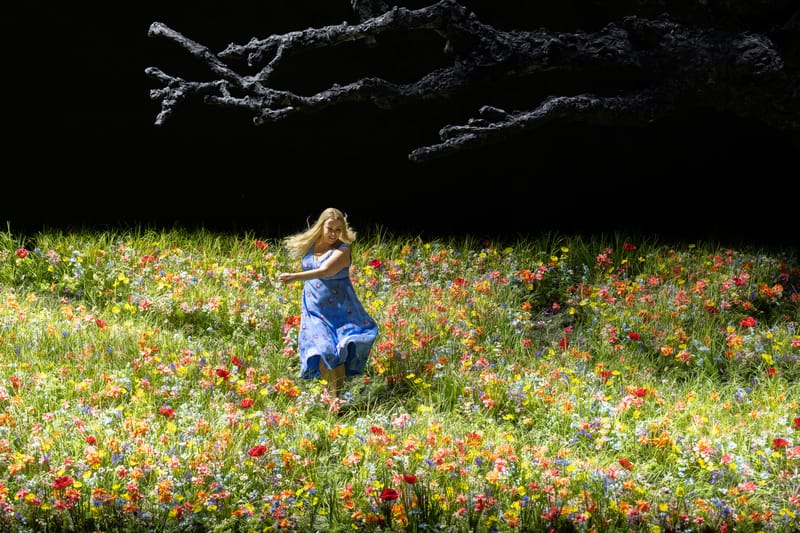
And what of Brünnhilde? She literally sleeps her way through this music drama until the end. Here, the part was fittingly taken by one of the finest Wagnerian sopranos around, Elisabet Strid. Why fittingly? Because Brünnhilde needs to be Siegfried’s equal in the final stretch. In 2019, as a Hausfrau Sieglinde Walküre in Stephen Langridge’s Gothenburg Ring, Strid stole the show, an absolute force of Nature. Strid was no less a force here, but now one that frolics in the flowers before ending the evening literally throwing herself at Siegfried (the ‘catch’ was perfect on the first night). Both Strid and Schager were vocally, dramatically - and sexually, for that matter - perfectly attuned, both giving their all for that famously high close.
Antonio Pappano’s emphasis on detail results in so many fascinating moments, and in itself reflects Siegfried-as-Scherzo. The orchestral playing was superb. Everything was well-paced, with just enough space for every word to ‘speak’. The famous horn call was a triumph, while the tuba plumbed the subterranean depths expressively, And of the many fine woodwind contributions, it was Principal Clarinet whose phrasing was unfailingly, meltingly beautiful, whose solos brought total pleasure.
Götterdämmerung is without doubt eagerly awaited; and then a complete cycle? By then under Hrůša? Either way, Götterdämmerung’s arrival will enable a proper consideration of Kosky’s conception. In the meantime, celebrate Siegfried's smorgasbord of great singing.
Photos © RBO / Monika Ritterhaus