
Scaling Everest - conductor Mandle Cheung’s journey to Mahler’s “Resurrection” Symphony
Mandle Cheung’s story is certainly extraordinary ... London awaits with bated breath
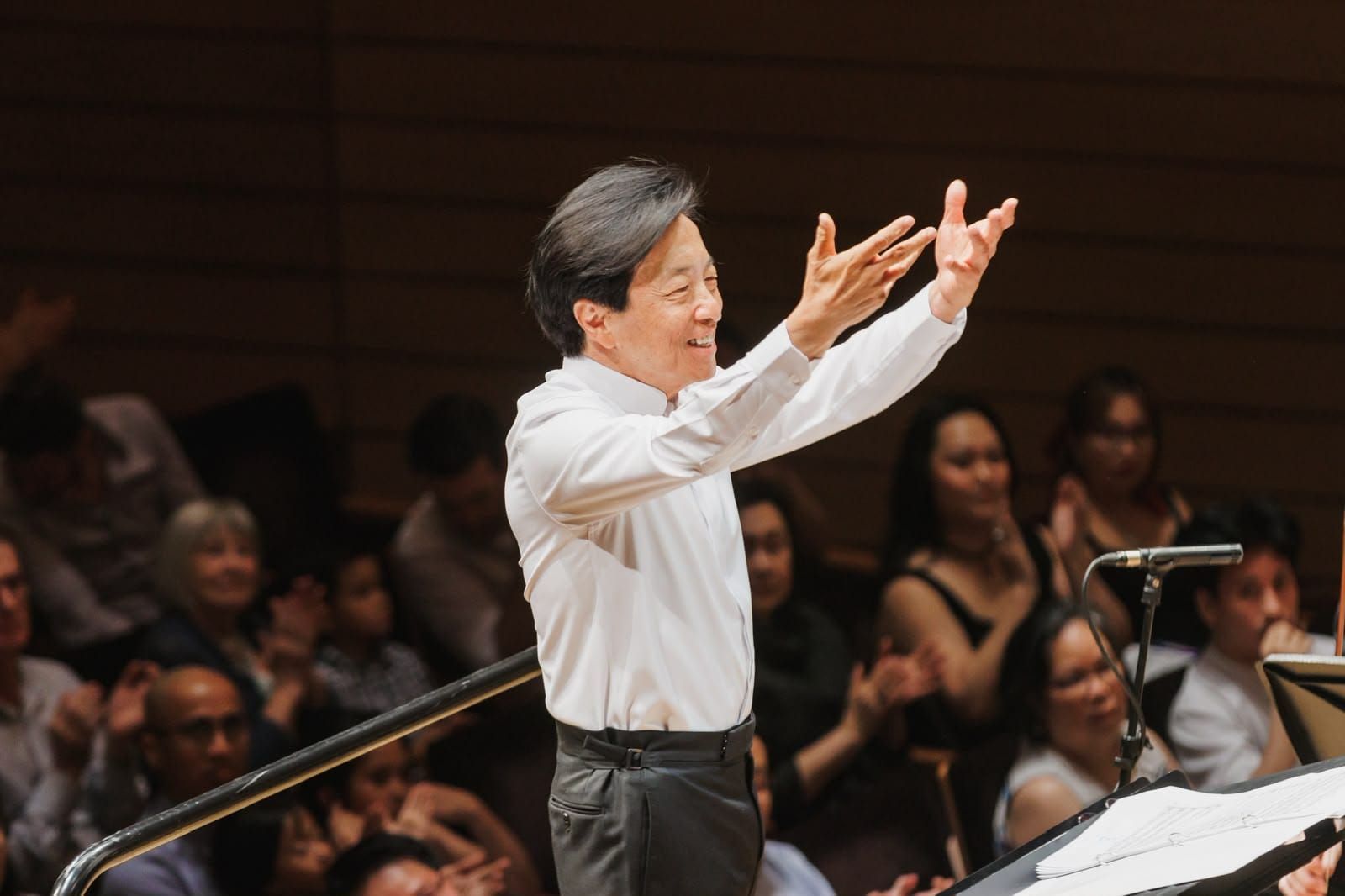
On Friday, August 21 2026, Mandle Cheung will conduct the Royal Philharmonic Orchestra, with the Brighton Festival Chorus and soloists Elizabeth Watts and Jennifer Johnston in Mahler’s mighty Second Symphony at a sold-out Alexandra Palace (link). What makes this concert different from the norm is that the conductor is a tech mogul who has taught himself to conduct. Before the first downbeat opinions are, inevitably, rife (not least Tom Service’s recent Guardian article).
When Cheung conducted the “Resurrection” with the Toronto Symphony Orchestra last year in Canada, there was also press coverage (see the Toronto Globe and Mail newspaper: here, for example). But the proof of the pudding is in the eating, and I for one am hungry for the concert, especially after talking with Maestro Cheung, hearing his story, and most of all experiencing both his infectious enthusiasm and self-belief.
Asked about the ambition - or even need - to conduct, Cheung responds, “you have to talk to my genes”: an in-built (pre-programmed?) necessity, perhaps. Cheung had the idea to conduct in 2015, and it “slowly surfaced”.
I knew two pianists, Sharon and Cecilia Lee, they helped me put together 25 musicians; I used those musicians to help me read the score of Mahler 1. Cecilia stood next to me, and I had the score, and she helped me turn the pages. That was my first reading of any orchestral score, and then we slowly got it up to maybe 80 performers at the first concert in 2018, in a small concert hall.
Cheung was born in Hong Kong, but raised in Canada. Very different places! “I came to Canada from Hong Kong to the University of Manitoba in 1968, when I was 21. I stayed ever since, I never left Canada,” he says. When he formed his orchestra, he called it the Mandle Philharmonic (“it was suggested by Sharon, so we stuck with it”). The process of how he got to that point was initiated via the music of Saint-Saëns: I mention that I was so glad to read that it was this composer who acted as gateway, as although some of that composer's pieces have huge popularity, there are so many that don’t, and deserve it - his opera Henri VIII for example!.
I remember that very clearly. I was 13 years old, I was behind the house in the back yard, and I had a little FM antenna radio with earphone, I was listening to the radio, and then Saint-Saëns’s Third Violin Concerto came on, and that was it. Ever since then, Classical music became the only thing I listen to .
A recognition? A homecoming? I ask. “I heard it, I loved it, that’s it. It’s quite simple actually”.
Cheung’s path to the rostrum is certainly a different one, a road less travelled: no conservatoire, no Kapellmeisterisch minor orchestras en route to greatness. In isolation, that’s either rash or a miracle-in-waiting, but Cheung does have something of a performance background … “In High School I was in the harmonica band. The chromatic harmonica is quite small, with a button at the end. The holes are divided, and when you press with the first finger it changes the holes, so it doubles the number of notes. It has quite a range. There is a bass harmonica that plays very low, and there is a chord harmonica which can go up to hexachords - it’s quite cool”.

In fact, Cheung played Arthur Benjamin’s Harmonica Concerto with the CBC Symphony (the concerto is by the same composer that wrote the famous Jamaican Rumba). “I took three introductory music classes at the University of Manitoba, and one of them was taught by Arthur Polson, who was the concertmaster of the Winnipeg Symphony from 1966 to 1986, and he invited me to play with them. It’s the same players, they call themselves the CBC Orchestra, and we played the Benjamin.”
All of which is a long way from the tech and telecommunications sector of Cheung’s “day job”. Certainly, the communications aspect maps over into music (“Ever since I remember, I have no problem talking to people. It’s just genetics”). It’s a delicate question, but I tentatively ask it: I presume it gave him the financial backing to pursue your dreams?
Yes: I started a company ComputerTalk by myself. I rented a room in a basement downtown, and hired part-time programmers to start with, then the first full-time programmer Dennis Menard, who was on a four-year graduate course in Computer Science at the University of Waterloo (Ontario), a very well-known tech university in Canada. He joined in the later 1980s, a few months after we started, and was with us until he passed away a couple of years ago. He was with us for 35 years.
Now Cheung is coming fully into the international spotlight, I was looking for a precedent, and I suppose it is the late Gilbert Kaplan (1941-2016) whose name springs to mind. Was Kaplan, I wondered, an influence, and/or an inspiration?
I only read about him many years after: a journalist at the Toronto Globe and Mail, Leslie Barcza wrote an article, not published by the Globe, but on his own website Barczablog, a comparison of my Toronto Symphony performance with the recording by Gilbert Kaplan. I had never heard the recording myself, and that’s when I heard of Kaplan. It was a very well-written article
Mahler has featured heavily in Cheung’s programmes: Symphonies 1, 2 and 4 so far. In June 2025, Cheung conducted Mahler 2, which he repeats at Alexandra Palace and (with the Hong Kong Philharmonic) in 2027. Perhaps we are moving towards a complete cycle? After all, No. 8 will follow in November at Roy Thomson Hall, Toronto (which will be the first performance of that piece in Toronto since 2012).
To me, Mahler 2 is the Mount Everest of music, and we scaled it. Mahler 8 is the Himalayas. We are now assembling two adult choirs and we are hiring the Toronto Children's Choir. So a total of 450 singers, and there will be over 100 musicians. It won’t be ‘Symphony of a Thousand,’ but it will be ‘Symphony of Over 500’.
When asked what is it about Mahler that appeals, Cheung traces the history of the symphony through time:
You start with the Haydn symphonies, and you go through Mozart, then Beethoven, Berlioz, and sooner or later you end up with Mahler, and that’s it. There is nobody after Mahler. Once you reach Mahler, that’s it: If you know of a composer who writes on this scale, let me know, I missed it”.
So, I make a parallel between Mahler’s Das Lied von der Erde and Zemlinsky's Lyric Symphony, Op. 18 (1922/23), but in terms of numbers I am minded to mention Havergal Brian’s Gothic Symphony of 1919-27, which uses similarly impressive forces as Mahler’s Second and Eighth symphonies? “It doesn’t have the emotional appeal that I felt compared to Mahler” is Cheung’s response - which, after all, is fair enough.
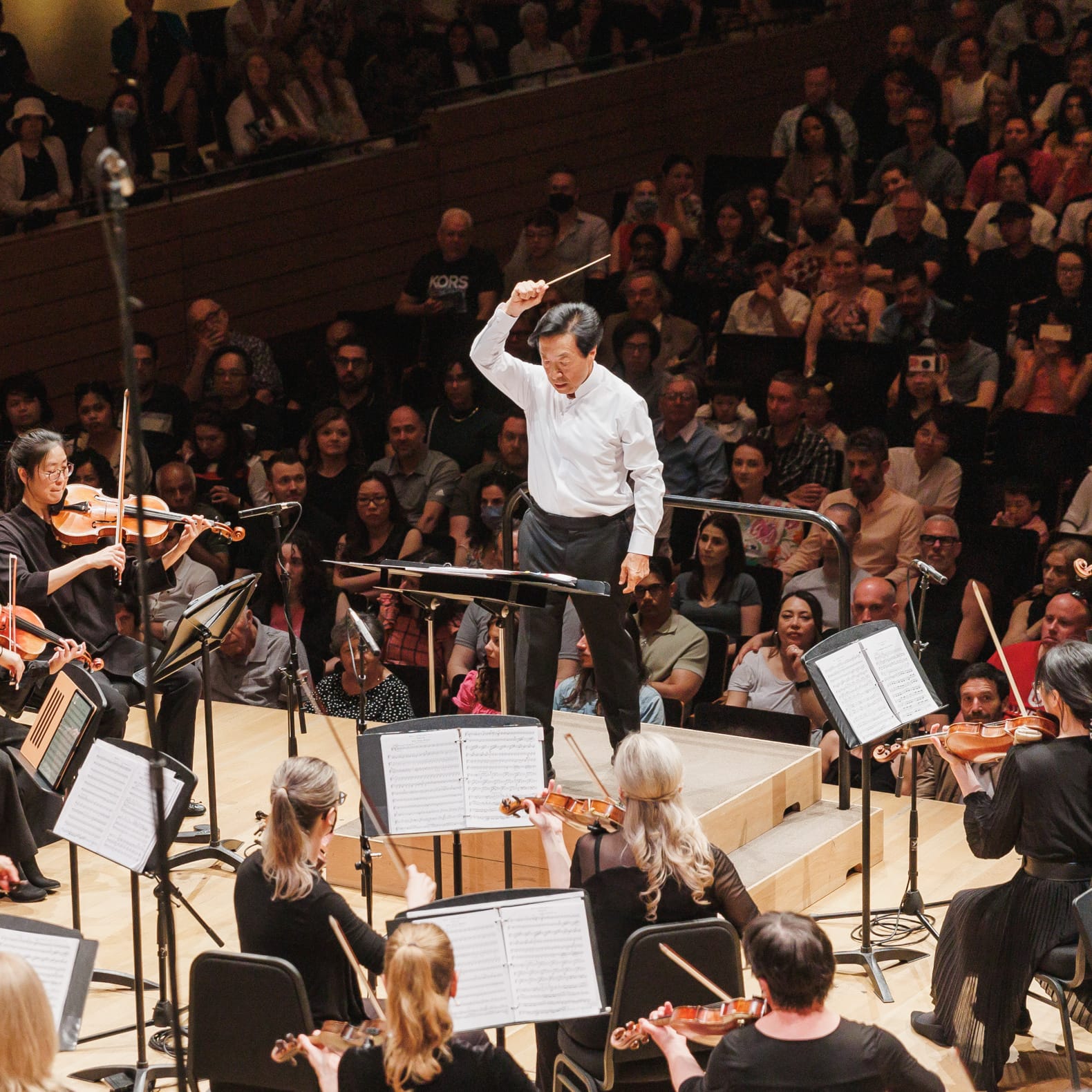
Filling the large concert halls these works require is no easy task: Cheung employs a team who look after Facebook and Instagram (“and that’s how we promote and sell tickets”). Continuing the idea of connection, Cheung likes to give a spoken introduction to his concerts.
Before each concert, while backstage I will prepare a couple of hundred words, and I will have a microphone that speaks from backstage to the entire audience before I walk on the stage and conduct.
So we hear him before we see him … which is a rather nice dramatic touch.
Cheung’s preparation is based on score reading (he uses the Kaplan edition for Mahler 2, published by Universal Edition) and he also says, "I listen to the Berlin Philharmonic, and Karajan, who I watch very carefully: every film that shows his baton, I look, and listen to the music. I learn from it."
Cheung’s journey to the rostrum features more practical experience than formal teachers:
I spoke to a couple of conductors, many, many years ago, and most of them I don’t feel they know anything about conducting, so there is nothing really to learn. I have stood in the orchestra pit while an orchestra performs, but I always listen to the music and I say, ‘I wouldn’t play it that way’. It is a good thing that I have managed to stand in an orchestra pit a couple of times.
I do wonder about long-range thought and its relationship with the Mahlerian surface activity: there is a definite trajectory to the final chorus in the Second, and it’s a long journey at that!
It is indeed, but I have no academic background behind me at all. I observe the batons of conductors, and listen to the music and study the score. The Berlin Philharmonic is the only orchestra I learn from”
Inevitably the idea of this - an amateur conducting a professional orchestra in Mahler - will raise eyebrows, even hackles. How does Cheung respond to criticism of this - that money buys this privilege as opposed to working one’s way through the ranks, for example? We can’t ignore that Guardian article by Tom Service (and the comments) here. And while that represents the prospective press, how does Cheung react to critical press?
I don’t even read them. People tell me, but to me it is all about the audience. If the audience likes it, I’m doing great; if the audience hates it, I’m doing badly. One of our players, Woosol Cho, who plays with one of the well-known orchestras in Canada, the Hamilton, she played many concerts and subbed for the Toronto Symphony once in a while, and if you ask her, she will tell you she had never seen so many standing ovations as with the Mandle Philharmonic. She doesn’t see standing ovations apart from with the Mandle Philharmonic.
And Cheung is fiercely proud of what he has achieved:
I have grown my company ComputerTalk from a 10 x 10 basement from an idea by myself to 100 staff. It’s not that big, but it' s a nice size and I make a good income that allows me to hire these musicians. I didn’t ask for donations, I didn’t have an inheritance. Every dollar I spent on musicians and music and renting the venue and so on, I made that income myself
And the venue itself, Alexandra Palace, is very well respected. But why there, as opposed to, say, the Festival Hall? “That was recommended to me, Jean-Jacques Cesbron, who I met when I met Lang Lang. I thought I can use his help and I hired him, and he is the one who suggested the concert hall”
There will be two full days of rehearsals, which may well feel like luxury to a London orchestra (“It’s a lot for my shoulders, too,” quips Cheung). Whatever happens, this particular bit of Mahlerian mountaineering will be an event. Mandle Cheung’s story is certainly extraordinary in and of itself; the music must do the talking, though. London awaits with bated breath.