
Opera Forge's Wagner Walküre
With Opera Forge, a anew, bold venture is launched, one I should like to encounter again
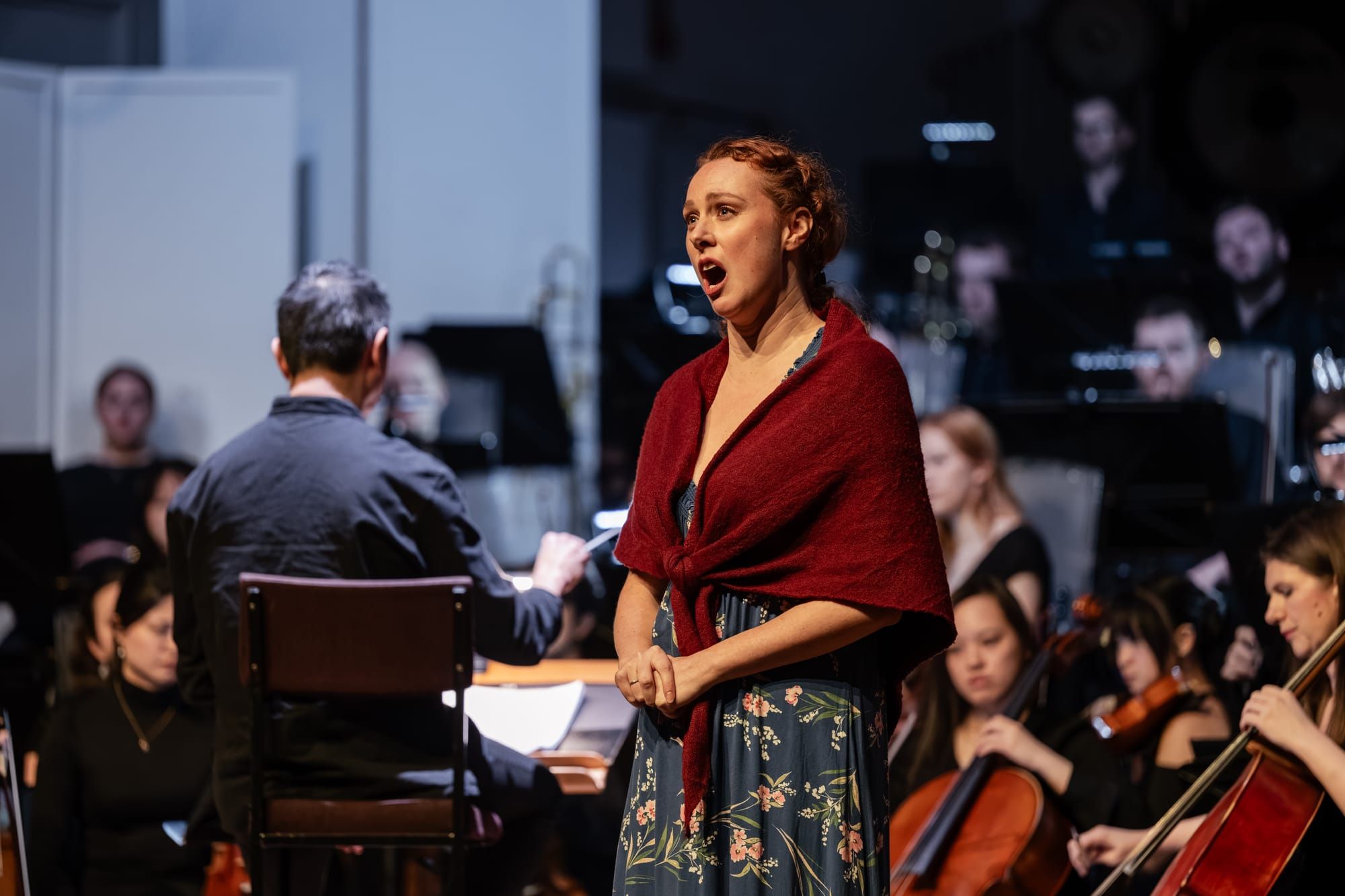
Opera Forge is a new London-based venture led by Artistic Director and conductor Kelvin Lim. Central to Opera Forge’s ethos is a commitment to champion new singers: this provides opportunities for younger singers to take on the long, dramatic roles Wagner provides. The original idea dates back to the Wagner centenary in 2013 (when Lim first formed the company); he revived it with Katerina Mina, who here sang Brünnhilde, in 2025. The first official outing for Opera Forge was a Working Day and Concert at Trinity Laban organised by Mastersingers UK .
Sir John Tomlinson will need no introduction as a singer, but here we find him in the role of director. Himself no stranger to the role of Wotan, Tomlinson appeared at Bayreuth for some 18 consecutive seasons (including as Wotan, and as Hagen). He is also, along with the renowned Susan Bullock, a Patron of Opera Forge.
Semi-staged productions can work remarkably well, and did here in the case of Die Walküre: a couple of tables and chairs, and in dress that is “half concert and half theatrical wear, almost as if they’d walked in from the streets of London,” as Tomlinson’s own introductory note has it, “one homeless and exhausted, another off clubbing, a third doing the weekly shop, another dressed up for a grand occasion”. There is indeed a motley crew of characters in this piece, from Head God and his feisty daughter to the brutish Hunding and the not-to-be-messed-with Fricka. Projected lighting (and indeed lightning, in the opening storm) was an effective measure.
The published synopsis gives further clues as to the background ideas by giving a “heading” to each part (Act One includes “The Fugitive,” “the Twins,” “the Sword,” while Act Two comprises “The God’s Command,” “Fricka’s Intervention, and “The Tragedy”; the final act is “The Valkyries,” “The Punishment,” and “The Fire”). Characters are nicely delineated via dress and demeanour; the limited space is used superbly, from aisles to stage (the orchestra is bunched to one side). Siegund and Sieglinde initially occupy opposite sides of the stage; their destiny is to unite them, of course, reflected in their inexorable physical pull.
Conductor Kelvin Lim is no stranger to the Wagner world either: he is the recipient of a Bayreuth Bursary. He conducted the Orpheus Sinfonia in a reduction by Francis Griffin for around 35 players (32 on stage), a practice well-established in fringe opera via Jonathan dove’s reduction, and Regents Opera performances. Each act of Walküre has its own flavour, its own tintà (more properly here Grundfarbe? Klangfarbe?!), and Lim conveyed this perfectly, taking us into the dark, deep depths of Wotan’s psyche in the second act while balancing the difficult opening to perfection, presenting raw drama and passion in the first (perhaps there needs to be a tensile core to avoid sags though), and offering the most touching of leave-takings in the third. HIs knowledge of the score is certainly secure: he was able to successfully re-align orchestra and singers, and to encourage unanimity when it was under threat, on several occasions.
The orchestra played stalwartly and often brilliantly: brass were creamy, and strings en masse coped well with Wagner’s sometimes superhuman demands. A special word for the solo cello of Rebecca Hipplewhite, so expressive in the first act. The cast was equally carefully chosen, with the Siegmund of Mark Le Brocq and the Sieglinde of Sky Ingram equally matched, vocally (physically, there is a bit of an age gap in this production, but given that they are brother and sister, that’s the least of their problems). Intriguingly, Tomlinson’s concept speaks of a separation between the two characters “for various reasons” and now they find themselves, “there is hope”; not too different from Stephen Langridge’s idea of a primordial separation in the Rheingold of his Gothenburg Ring. The icy, fear-based distance between Sieglinde and Hunding is of a different ilk, and if Aidan Smith’s Hunding is not the blackest or most ogreish I have seen, his black-clad malevolence still cast its shadow both vocally and in physical presence. Sieglinde is a victim, about to be freed, but from her demeanour she finds it difficult to let in any light - in Hunding’s presence she looks down, keen to avoid conflict and pain.
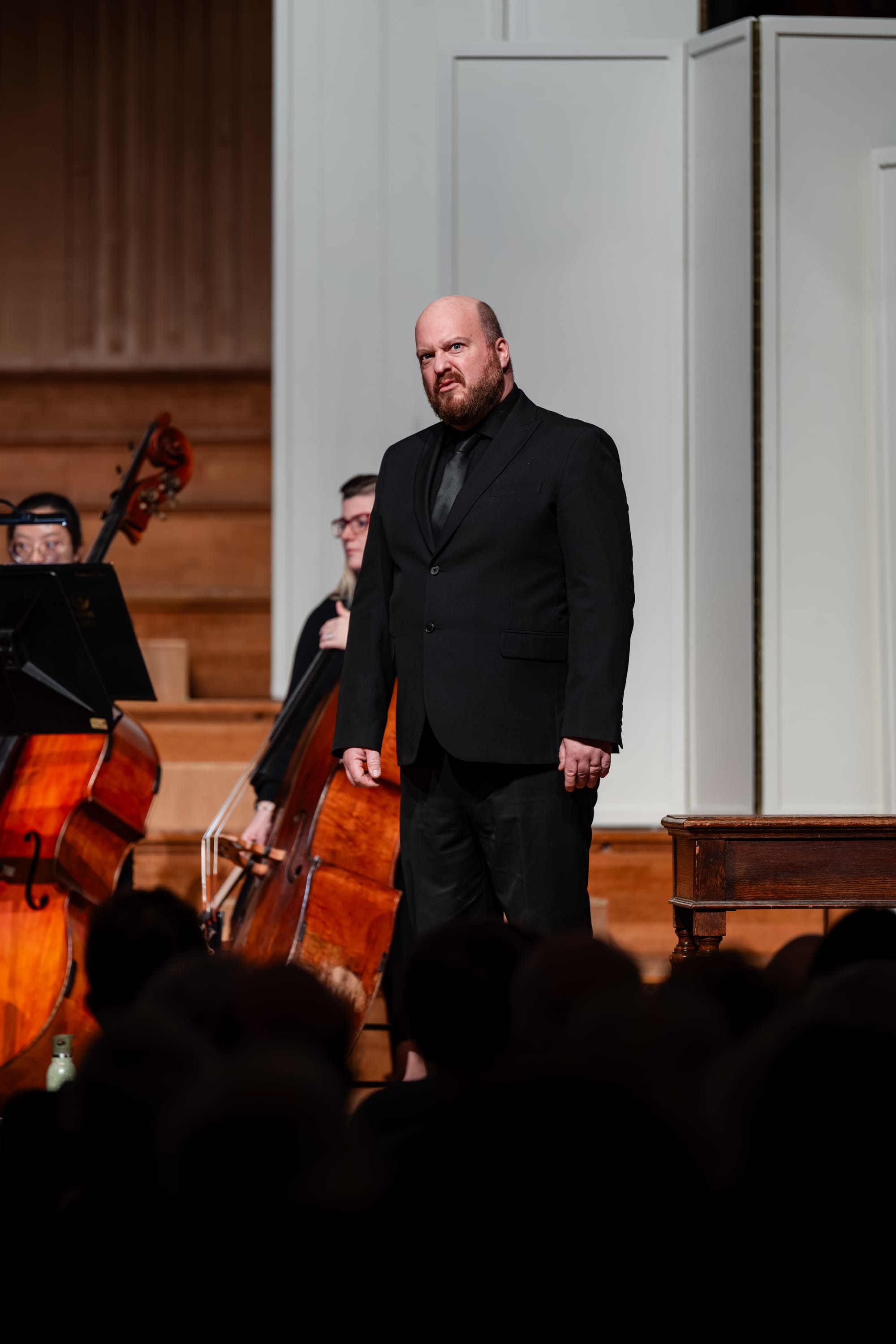
Mark Le Brocq, one of the better-known members of the cast, was a strong Seigmund, his ‘O süsseste Wonne!” a real highlight, But it was Sky Ingram’s Sieglinde I found the most believable, emotionally. A Guildhall graduate (and National Opera Studio), Ingram has taken a wide range of roles across many organisations, including RBO’s The Rape of Lucretia; without doubt her career will only grow. Her great moment in the final act, “O hehrstes Wunder!” crowned a fine assumption.
The second act is (arguably) Wagner’s greatest single achievement in the Ring. The sheer level of psychological insight is off the scale, as is that of philosophical penetration, particularly regarding Will (and the idea of Brünnhilde as extension of Wotan’s Will - or not, as it turns out). Katerina Mina can certainly hurl out the “Haijotoho”s (the final climactic notes launched like bullets into the supportive RAM acoustic). Wotan and Brünnhilde’s garments seemed to reflect their bond, each a distorted mirror of the other. Pauls Putnins’ Wotan was an incredibly human, flawed Head God, caught in his own web of Law. But the dominant force here in act two was Fircka, the indomitable British-Ukrainian mezzo Rozanna Madylus making her role debut at her alma mater, the Royal Academy. Her voice is infinitely strong, and few are the males, God or not, who would dare get on her bad side. Madylus’ steely delivery perfectly reflected this character without ever sounding timbrally harsh. A real discovery - I believe I had heard her only once, briefly, in the much smaller role of Filipyevna in Tchaikovsky’s Eugene Onegin for Wild Arts at Thaxted Festival in July last year; this opened out the envelope beautifully.
Act Two really belongs to Wotan, and indeed Putnins was at his finest here, his cry of “Götternot” properly from his soul, while in cahoots with Lim, “Das Ende” was properly heard as a structural arrival point. Wotan’s near-death encounter with Mina’s Brünnhilde also worked well, Lim fashioning a Wagnerian quilt of encounters that will shape the trajectory of the Ring.
The Valkyries’ hoods did have a whiff of The Traitors about them (such is the power of populist television!), but as they gathered as a gaggle - is that the correct collective noun? - in the corner of the stage, vainly shielding Brünnhilde in the final act against Wotan’s wrath, it was evident this was a collective statement of the strength of Divine Femininity in its most Kali-like aspect. Some of the names of individual Valkyries have impressed previously - Angharad Lyddon in a variety of previous roles, including Flosshilde Götterdӓmmerung with Jurowski at the Royal Festival Hall, and Maria/Pantalis Boito Mefistofele with Chelsea Opera Group in 2019, while Georgia Mae Bishop has found favour as Giovanna Rigoletto OHP 2023 and Isoletta in Chelsea Opera Group’s La straniera (Bellini) in 2025. Others are new to me, but there was no weak link here. British mezzo Gemma Morsley impressed particularly here, as a strong Rossweise; but the fact is that, together, they sounded more like a full chorus.
The final act provides an unforgettable ending, and the most famous of beginnings in the Walkürenritt. Projected clouds on the RAM’s walls at its outset gave an idea of the prevailing inclement weather - and Tomlinson had his Valkyries use the entire space to enter. Most notable, though, was Brünnhilde entering basically carrying Sieglinde, a character who spends a good chunk of the opera post-first act either unconscious, or near-unconscious. Putnins came into his own in this final act, moving from sheer fury at Brünnhilde and an implacable cold shoulder to a final, partial, softening. There were some signs of Mina tiring, but she marshalled her reserves and offered an unforgettable “Du zeugtest ein edles Geschlecht”; her scene 5 “Was es so schmählich?” carried powerful dramatic weight, too.
The whole was even crowned by excellent surtitles, which seemed to use a most intelligent translation. But the best thing is that a new, bold venture is launched, and one I should like to encounter again. For those that could not get there for this performance, second and last at Duke’s Hall on December 6.
Die Walküre (1851-56, arr. Francis Griffin)
Music & Libretto: Richard Wagner
Cast:
Wotan - Pauls Putnins; Brünnhilde - Katerina Mina; Sieglinde - Sky Ingram; Siegmund - Mark Le Brocq; Fricka - Rozanna Madylus; Hunding - Aidan Smith; Helmwige - Lauren Roscoe; Ortlinde - Christina Orjis; Gerhilde - Anna Gregory; Waltraute - Angharad Lyddon; Siegrune - Louisa Petaï; Rossweise - Gemma Morsley; Grimgerde - Kathy Taylor-Jones; Schwerleite - Georgia May Bishop.
Production:
Director - Sir John Tomlinson, CBE; Assistant Director - Eleanor Struff; Production Assistant - Grace Whillis; Lighting Designer - Graham Large; Makeup Consultant - Louisa Petaï; Subtitles - Nick Fowler
Duke’s Hall, Royal Academy of Music, London, 22 NOvember 2026