
Martha Argerich and Dong Hyek Lim at the Royal Festival Hall
Katfreitagszauber, one day early.
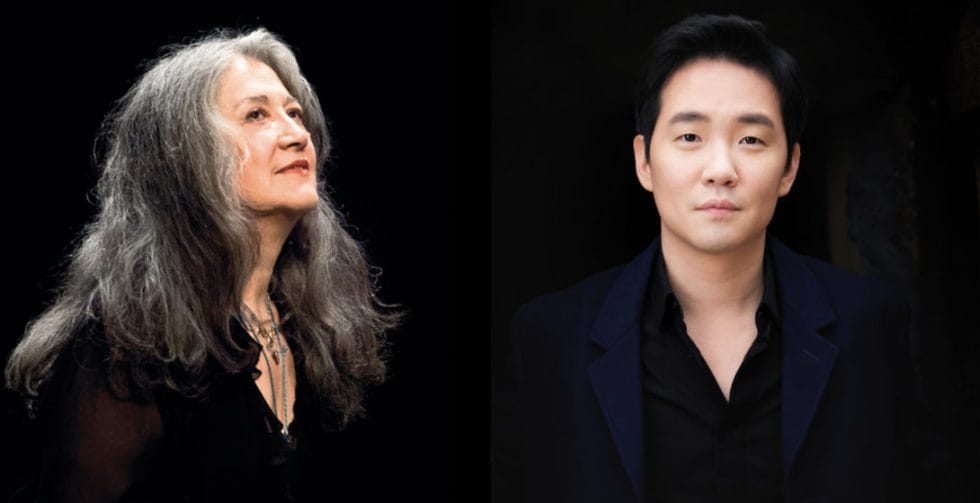
Big names can mean big surprises: will they show? Will they play what they say they'll play? I remember when Claudio Arrau played at the Royal Festival Hall back in the 1980s - the big question was, would he show? I called the box office from the University of Surrey, Guildford, at lunchtime - "Has he cancelled?"; "Not yet," came the reply "and there are student standbys". So off we went .. and he showed (the programme on that occasion included Beethoven "Appassionata" and the Liszt B-Minor Sonata). Or the time Ivo Pogorelić (same venue) showed up and reversed the order of the programme’s halves with zero announcement.
Argerich and her partner-in-crime this time, Dong Hyek Lim, showed up (his name is sometimes seen hyphenated, Dong-Hyek Lim). But they didn't play what we thought they would play, and from the freesheet's adherence to the original programme, it must have been a last-minute change. Instead of Schubert F-Minor Fantasia and Mozart Sonata for Two Pianos in C, K 521, followed by Rachmaninov Symphonic Dances, we got Mozart Sonata for Two Pianos in D, K 448/375a, Ravel La valse, and then the Rachmaninov. And then - the complete Schubert as an encore. So we gained: and got a full two-hour recital in the process.
Seoul-born and Moscow, Hannover and Juilliard-educated Dong Hyek Lim surely holds a unique competition placement, in sharing Third Prize in the 2005 Chopin Competition with his brother, Dong Min Lim (in the 2005 Chopin Competition for Young Pianists in Moscow, Dong Hyek took second, Dong Min first). Here's the thing: Dong Hyek Lim is an excellent pianist. In any other situation, he might have us all at his feet; but sharing a stage with Argerich, what we have is a mightily fine pianist against a justifiably legendary pianist. Argerich plays with a palpable greatness rarely encountered today, a rightness in everything she touches. Lim had a repeated tendency to over-project, As to the connection between the two of them, some might remember a disc entitled "Marta Argerich presents ..." with Lim as subject, on EMI Classics.
The Mozart D-Major, K 448 /375a is a jewel in Mozart's output, and was treated as such. Just as the invention was unflagging, so was the performance, the first movement absolutely, as Mozart asks. 'con spirito'. Nice to have the exposition repeat. too. Mozart delights in passing passages between the two pianists, and these were beautifully equal - although it is worth noting the two pianists' tones are differentiated, with Argerich the more crystalline. When it came to those oh-so-characterful acciaccatura comments, Mozart at his most playful, it was Argerich who nailed it.
The Andante (G-Major) was fueled by grace, but also offered up a question: were the players thinking orchestrally? did they rehearse with orchestral parallels in mind, imagined scorings? Certainly, Lim's approach to the moment where Mozart gives him the movement's lowest-pitches seemed so. Were those trombones? possibly, but they did not quite work; against this, the two created the most exquisite dissonances: part-writing when other duos find no part-writing. Argerich's articulation was perfect, beyond criticism: a real case of Lim being 'merely' excellent in his responses.
There was perhaps that 'orchestral' slant to the finale, with palpable horn calls. The marking is Allegro molto, but this was surely closer to Presto - Argerich's recording with Sergei Babayan is truer. Joy came in revelling in one aspect that was true throughout both this sonata and the concert as a whole: the true ensemble from Argerich and Lim: Mozart requires true togetherness of attack right from the very first chord: and what a source of pleasure it was to experience it.
Ravel's "Poème choréographique" La valse in its two-piano version is, as a piece, a study in half-lights and blazing white light. This is the least-heard of the three versions of the piece (orchestra, solo piano, two pianos), but how effective it is! Argerich's 'growling' beginning, Lim's flecks of light. As the piece progressed, it was as if the two pianos became welded together as one 'super-piano'. The art here is to find clarity in twilight: dotted rhythms had perfect articulation, while octaves acted as 'markers'. There was not an equal performative split between light and dark, though: the players seemed more attuned to the shadows. Perhaps the very close could have benefited from a touch more abandon, though: this is heady stuff, and it felt just a touch reined-in, the glissandos throughout just a touch lacking in ecstasy and extroversion.
Here's a live performance of Argerich with Nelson Freire, Munich, 1982, which very much does catch alight:
So, post-interval, the Rachmaninov Symphonic Dances. The pair has recorded this piece (and Argerich has also recorded it with Nicolas Economou). While the orchestral version is certainly in technicolour, Argerich and Lim brought their own sense of colour. Again, chords were so together, almost superhumanly so; clarity was again paramount in Rachmaninov's thornier writing (incidentally, technique was - predictably - never an issue for either pianist). It was the more reflective sections of the first movement (marked Lento) that were truly magical, however. Here's a video linked to the pair's recording, as a supplement for anyone that was lucky enough to be there:
... and here's an accompanying 'making of'/promo' video:
The slinky waltz of the second movement found Lim over-projected again at the opening (you can actually hear his harshness of tone on their recording, too). The change of programme made sense now, however: here was Rachmaninov's own La valse, the dance proper emerging from a liminal space, although in Rachmaninov's case perhaps more Roald Dahl's Tales of the Unexpected than Jungian swamp. There were moments of pure magic in the heady finale: a phenomenal double ascent, Argerich's rendition of the melody, super-high (around two minutes in). And then there were Rachmaninov's characteristic bells, here a carillon of descending parallel chords, Argerich perhaps just that touch brighter, more convincing.
... and so, that encore: Schubert's Fantasy for piano four hands in F--Minor, D 940 (Op. 103). Again, Argerich has put this down with other pianists. Here's one with Sergio Tiempo
But on the night, what a delight to hear it after we thought it had been untimely ripp'd. Lim was Primo, and again the opening was a touch forced in terms of projection. And again, that excellence/perfection divide, here in those vital first movement trills. What was so impressive though was the taut rhythms and, just as importantly, pulse: they never rushed their fences, giving Schubert's majesty a chance to speak. There was an issue in the Scherzo, a page-turning disagreement (I suspect the young lady who was turning for Lim had not seen the repeat and expected the Trio ...) but it did not seem to affect the performance. And the Trio, when it came, was deliciously characterful (so well pedalled by Argerich). The return to the opening in the final stages was pure magic - a truly special moment in an evening packed with them.
What a way to usher in the Easter long weekend. Katfreitagszauber, one day early.