Happy birthday, Mozart: from The Mozartists
Ian Page really does represent a perfect marriage of musicology and performance
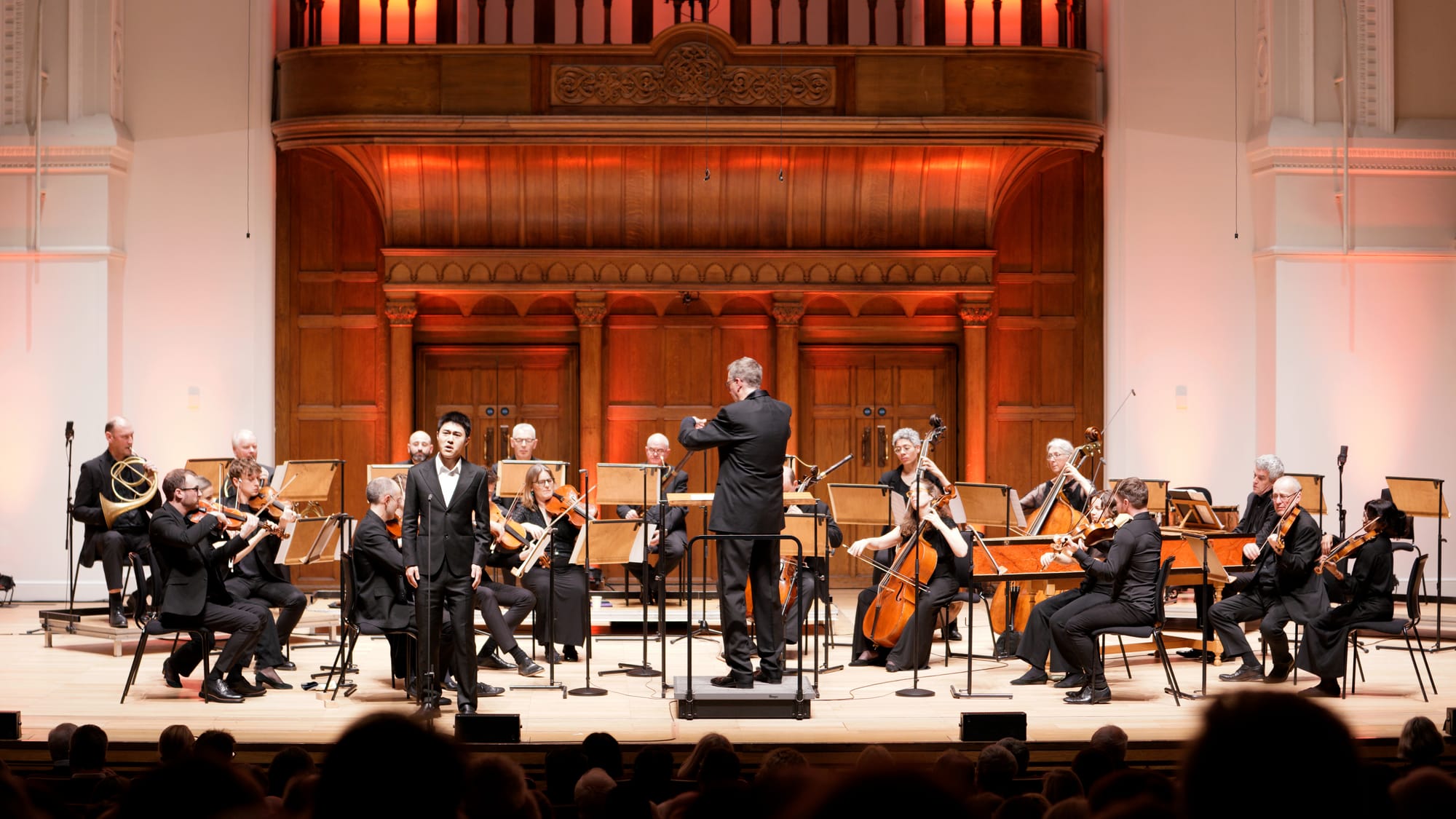
Mozart Birthday Concert Zheng Jing (countertenor); Alexander Semple (baritone); The Mozartists / Ian Page (conductor). Cadogan Hall, London, 27.01.2026
Mozart Thamos, Konig in Agypen, K 345: Entr’acte (Act 1). Concert aria, “Ombra felice”.
Haydn Symphony No. 69 in C, ‘Laudon’. Three arias from Der Feuerbrunst.
Mozart Thamos: Two Entr’actes. Symphony from ‘Haffner’ Serenade, K 250.
What a fantastic way to celebrate Mozart's birthday (for such it was, January 27). One might be forgiven for thinking the concert ended with the ‘Haffner’ Symphony, but this is the extrapolated ‘symphony’ from the ‘Haffner’ Serenade, a different scenario.
And what a pleasure to hear extracts from the incidental music to Thamos, rarely head these days. The score’s gestation is complex (initially, Mozart composed only two choruses, but when a visiting troupe to Vienna also performed the play by Tobias Philipp von Gebler, entr’actes were added, the extant choruses revised, and a new choral finale (with new text by Johann Schachner) composed. While the play has high ideals (a dynastic power-struggle in ancient Egypt), the music is perhaps more modest. The first is set in C minor and cast in sonata form. The performance was nicely punchy from brass and timpani, and there were some lovely bassoon contributions (Philip Turbett). But upper stings took time to settle in terms of ensemble.
It was good to meet the young counter-tenor Zheng Jiang via Mozart's concert aia ‘Omba felice … Io ti lascio’ (Happy shade! ./.. I leave you). This is Mozart’s only concert aria for alto, a beautiful product of 1776 written for Italian castrato Francesco Fortini (a court singer of the Elector of Bavaria, then on a visit to Salzburg). The text is taken from Giovanni di Gamerr’s Medonte, re d’Epiro (the same writer who penned the libretto for Lucio Silla). Here, Medonte’s chief of staff, Arsace, sings of farewell to his beloved (who happens to be the King’s wife, Selene). It begins with an orchestral-backed recitative. Jiang sang well, and has an attractive, creamy voice, but trips into his lower register felt weak and it felt as if there was a registral beak. The aria proper is beautiful initially with a heavenly melody, dramatic later as the protagonist voices his internal torment.
Closing the first half was Haydn’s Symphony No. 69 in C, the so-called ‘Loudon’. Thought to have been performed at the Esterhazy palace, the nickname's origins are hazy. It may have come from Haydn, but it also might have come from his publisher, Artaria in honour of Field Marshall Ernst Gideon von Loudon (the booklet notes point out the vagaries of spelling at thai period, so it is a little disappointing to find his has no connection with the Loudon of Penderecki's opera after Aldous Huxley, The Devils of Loudon).
It is impossible, I would suggest, not to like Haydn. The 69th symphony, though, has not always had the best press: H. C. Robbins Landon in particular turned against it. . The programme notes suggest the influence of comic opera on his piece, and the contrasting themes of the first movement certainly seem to agree. The performance here was beautifully together (including the very opening), the sound nicely bright. It did rather feel as if this symphony received more rehearsal than the first Thanos Entr’acte; the slow movement (Un poco adago piu tasto andante) showing perfect unanimity from first violins and blessed with gentle and light pianissimos (and a ppp on one repeat), meaning the robust Menuetto was cast into contrast. There is more than a hint of ‘Sturm und Drang’ to parts of this movement, continued into the scampering Presto finale. Trumpets and drums came into their own here (luxury casting of David Blackadder and Philip Bainbridge, with Ton Lee on timpani)
Whale the second part mirrored the first in its format of Entr’ac(s) - aria(s) - symphony, there was a swap of composers: here, a wonderful and cruelly rare opportunity to hear parts of a Haydn opera. First though,two more Entr’actes from Thamos. There is something Haydnque about the visceral Entr’acte between acts four and five: an elemental evocation that softens into some lovely lyricism. The first Entr’acte we heard was certainly punchy, with some lovely harmonic shifts, beautifully realised. The final ‘Zwischenspiel,’ as it is designated, is angular of interval and markedly unpredictable, offering another side to the Mozart we think we know.
It was fascinating to hear three arias from Haydn’s Die Feuerbrunst: here we have a direct equivalence between Papageno from Mozart’s Die Zauberflote and the character ‘Hanswurst’ (literally, ‘Hans Sausage’). The first aria, ‘Poztausend säpperment!’ (translated as “Blistering barnacles’!) seems to have a direct thematic relationship to the chorus “Und eine neue Welt’ from Die Schopfung. All credit to Alexander Semple, who brought huge character to his delivery while paying attention to every detail. The horns made the best fist they could of the screaming high part (which requires ultra-high ‘pops’ of notes), but it was Semple’s sound that impressed most, a beautiful, firm baritone. Bizarrely, thinking of equivalents, the aria ‘Was fang i’ armer Worstel an?’ (What can I do?) could least initially hail from Mozart’s Entfúhung; the slithery chromatic string descents are pure Haydn though. In the opera, there is an interjection from another character between the two stanzas; not here, obviously, so the change to bright, sprightlier music is sudden. Semple can vocalise at speed, it is clear. The final aia, ‘Da ist dis Katz’ (There’s the cat) found Semple pretending to be cold in the extended orchestral opening; The first line was almost intoned; this comedy aria about a pesky, elusive feline was a real highlight. And as for Semple, I very much look forward to seeing him again.
You can hear the cpo recoding of Die Feuersbrunst on a playlist beginning here (which obviously includes the arias heard here).
Finally, the symphony from the ‘’Haffner’ Serenade (so, not the ‘Haffner’ Symphony). Commissioned for a wedding, the whole Serenade is Mozart at his finest. Page and The Mozartists’ performance was magnificent: the tutti cescendi in the first movement were models of their kind. Interestingly, Page’s conducting was a its most graceful in his piece, allowing the players more freedom. The cham of the contrasting moments was equal to anything Haydn could muster, while the bright D major gave off sun throughout. The Andante includes a supe-high horn entrance out of nowhere (well managed), and some lovely pizzicao scoring late on. But this is surely not Mozart at his finest, despite some lovely solo violin moments (Daniel Edgar). The Menuetto brings with it a lovely turn to the minor, while the finale, an Allegro assai after a grazioso opening Adagio, is the finest movement, its energy not a million miles from Mozart's Zauberflóte Overture. Plenty of energy and biting accents in this performance. Nice to have repeats, too.
Ian Page really does represent a perfect marriage of musicology and performance. One encore: the Andante grazioso from the Divertimento No. 9 in E flat, K 240, for winds.
The Haydn/cpo full opera is available from Amazon here. Straeming below.
 Text: Else Radant