
Handel in Shoreditch: a Tamerlano triumph
A triumph, most of all for Handel, and specifically Tamerlano, which has for too long been in the shade of the operas that surround it, Giulio Cesare and Rodelinda
Those who attended Irish National Opera’s Bajazet at the Linbury Theatre in 2021 (review here) will be familiar with the story here. Handel accorded titular status to Tamerlano, Different librettos, though: Handel’s principally uses Nicolà Francesco Haym’s adaptation of Agustino Piovene’s Tamerlano (along with another libretto entitled Bajazet after Nicolas Pradon’s Tameran, ou La Mort de Bajazet), while Vivaldi’s uses Piovene’s libretto. Two magnificent viewpoints on the same subject matter, though, and London is lucky to have heard both in a relatively short period of time.
Handel’s take was allegedly composed in just under three weeks in 1724 (and so just succeeds Giulio Cesare), and was premiered at the King’s Theatre that October, staged nine times and revived in Spring 1725, The titular Tamerlano is a peasant who rose to power in the Tartar Empire in Central Asia. he has captured Bajazet, the Ottoman Emperor and here one of the first great tenor roles in opera, who at the opera’s opening is suicidal, restrained only by his love for his daughter, Asteria. Unfortunately, despot Tamerlano would marry Asteria …
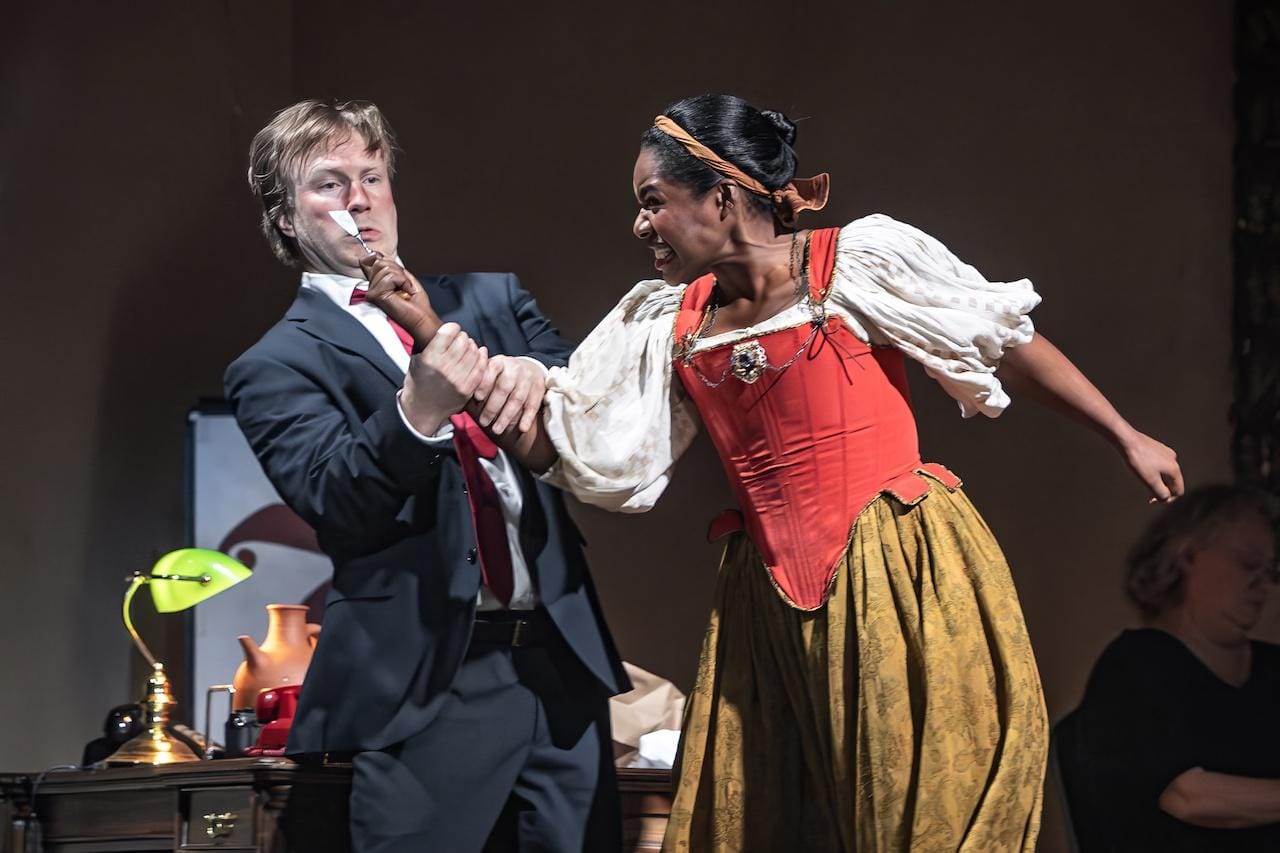
This Handel Tamerlano took place at Shoreditch Town Hall. Director Orpha Phelan’s production sets the opera in the round, using both space (itself on a couple of levels) enclosed by the audience and the stage itself. Her idea is to see characters as archetypes that can be equated to famous personages throughout history and which therefore span different eras simultaneously, most obviously the meshing of the tyrant Tamerlano and one Donald Trump, esq, all self-importance, blue jacket, red tie and McDonald’s takeaways. There is even a reference to ‘impeachment;’ in the sung text. The lesser role of Leone is Sigmund Freud (sung with firmness and acted with real character byJonathan Brown), which chimes in with the supertitle announcement this is ‘Social Experiment 2.0,’ seems to be puppetmaster. Bajazet (Benjamin Hullett) is a Renaissance painter, I think Galilei, while Andronico is Alexander the Great. Irene seems representative of a Jane Austin heroine. This results in a sort of character dissociation, which instead of being a negative, makes the conceit of Freud all the more effective.
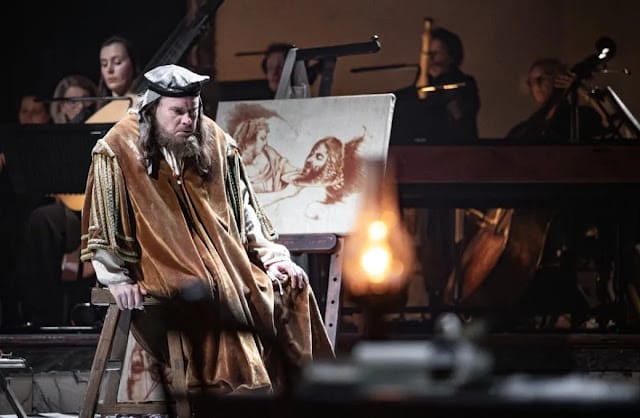
Characters not directly involved in the ongoing action tend to stay on stage, which means we see characters from multiple ‘angles,’ in the director’s own words.
For all of the cleverness of the production, it is Handel's music and its realisation that really counts. The Academy of Ancient Music was on top form, Lawrence Cummings’ direction as energetic as ever, resulting in a punchy Overture.
As Tamerlano, James Laing’s voice was a touch weak to begin with, and never fully focused (noticeable in his ‘Vuo dar pace’ in the opera’s second scene. Ironically, he felt the only weak link in the cast: Nardus Williams impresses in everything she sings, and seems to have particular affinity to Handel, as her title role in ENO’s Partenope revealed, and here: as the major role of Asteria, her ‘Non più tempo’ in act two a thing of light beauty, delivered with superb vocal agility.. Tenor Benjamin Huilett was spectacular as Bajazet, right from the lovely, stately aria, ‘Forte e lieto’ through to the astonishing strength (and range - it goes low for a tenor) of ‘Empio, empio, per farti guerra’ towards the opera’s close.
It was Jake Ingbar’s lovely counter-tenor voice, strong yet lyrical, that truly impressed of the higher-range males: another singer who contributed to that ENO Partenope (as Armindo), Jake Ingbar has a voice of utter beauty and lyricism but with a core of steel (just as well, as Alexander the Great …). Like Williams, Kitty Whately impresses on each encounter, here a splendidly involving Irene, her act one ‘Dal crudel che m’ha tradita’ a positive masterclass of Handelian singing.
There is much ‘aria action’ in Tamerlano; but there is a huge amount of recitative, too, delivered with real immediacy (harpsichord nicely bolstered by Kristina Watt’s theorbo as well as AAM cello). Somehow, the final ensemble, the only ‘chorus’ in the evening, seemed so right, a meeting of much stellar vocal talent, ascending legato lines reaching to the Heavens (or, as the text implies, from night to day).
The AAM’s attack and tireless maintenance of atmosphere throughout might well be the most impressive aspect of the evening, though. How they captured, as one example, the minor-key heart of the opening of Tamerlano’s ‘Dammi pace’ (act 1 Scene 4), or the sheer force of ‘Fremi, minacci’ in the final act.
A triumph, most of all for Handel, and specifically Tamerlano, which has for too long been in the shade of the operas that surround it, Giulio Cesare and Rodelinda.
Tamerlano, HWV 18 (1724, sung in English)
Composer
George Frederic Handel
Libretto
Nicola Francesco Haym
Cast and production staff:
Tamerlano - James Laing; Bajazet - Benjamin Hulett; Asteria - Nardus Williams; Andronico - Jake Ingbar; Irene - Kitty Whately; Leone - Jonathan Brown
Director - Orpha Phelan; Designer - Madeleine Boyd; Lighting - Matt Hoskins.
Shoreditch Town Hall, London, Thursday, March 26, 2026