
Glyndebourne's first staging of Monteverdi's L'Orfeo
It is truly astonishing to think that this is Glyndebourne’s first Monteverdi L’Orfeo. It is not the first Monteverdi there, though: both Poppea (first seen 1962), and Il Ritorno d’Ulisse in patria (1972) have previously featured.
One of the earliest operas (premiered in Mantua in 1607), and certainly opera’s first fully-formed masterpiece, L’Orfeo has the distinction of effectively birthing a now global art-form. Director William Kentridge himself has talked about L’Orfeo being an opera about opera - which brings it firmly in the 2026 Glyndebourne season thread of opera as meta-theatre. His previous stagings include Zauberflöte and Shostakovich’s The Nose and, significantly, a Ritorno, which featured some 13 wooden puppets.
This performance of L’Orfeo was beset by a delayed start thanks to a significant problem with the trains (kudos to Glyndebourne for arranging alternative destinations of coaches for those of us London-bound afterwards), but what a privilege to be at this historic performance. Musically, there are few complaints, although the opening’s fanfares (Toccata) sounded a touch muted. As the evening progressed, though, the sheer virtuosity of the players of the Orchestra of the Age of Enlightenment under Jonathan Cohen shone, in unanimity of ensemble and both in individual solos and in Monteverdi’s pairings of instruments. The eight-personed continuo included included theorbos, lirone, violone, bass viol and double harp, while keyboard instruments (Cohen again) were not only harpsichord and organ, but also the unforgettable, otherworldly sound of a ‘regal’ (a type of reed organ)
Jonathan Cohen’s conception of the piece was often swift, which meant there was a real sense of dramatic momentum as well as dramatic shape. Yet space was there for the singers, allowing for Monteverdi’s increasingly florid vocal melismas to count. A strong cast, of whom more soon, offered generally stylish contributions.
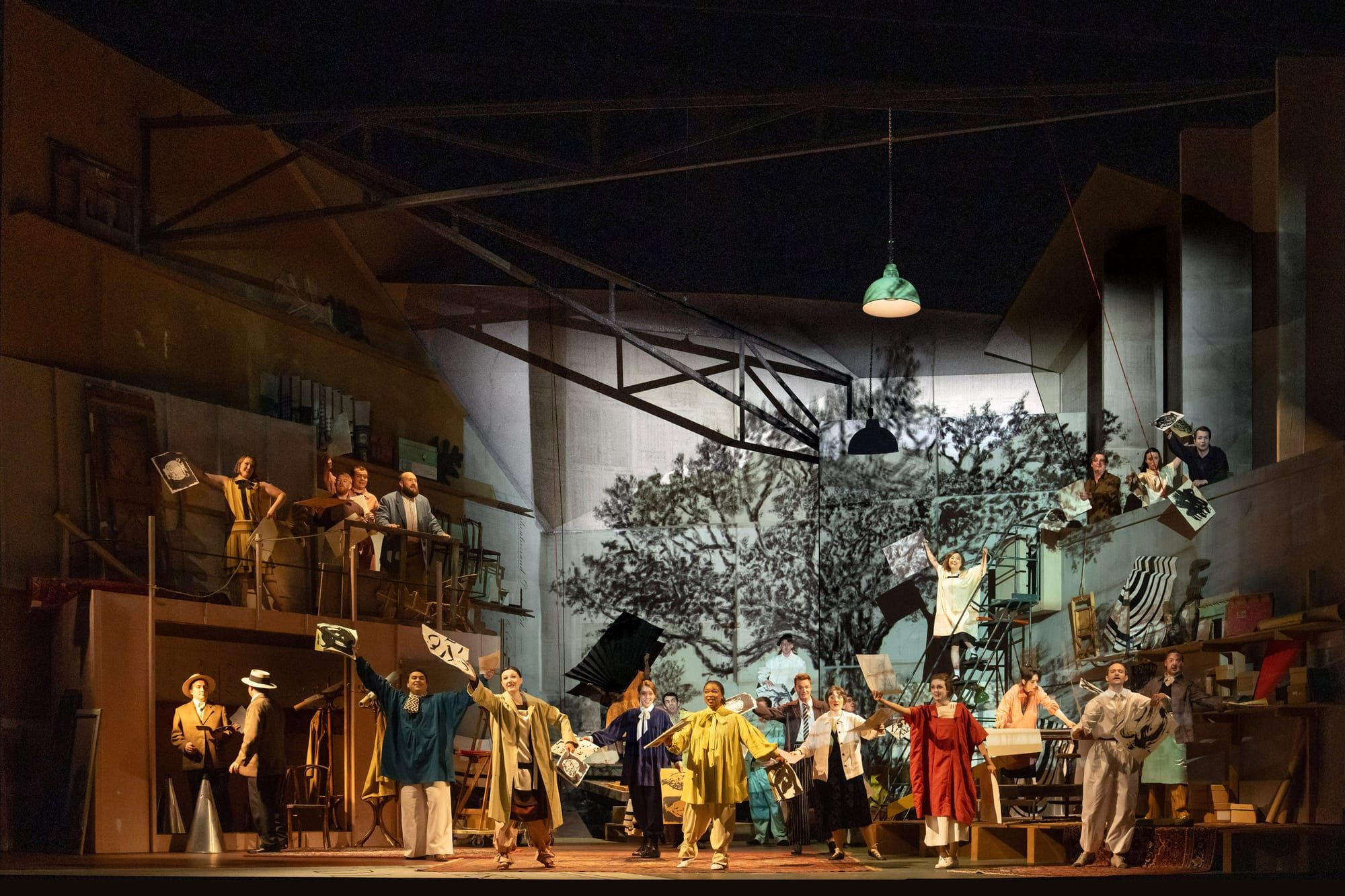
Unfortunately, the trains were not the only fly in the ointment. Intentionally, William Kentridge’s production is to say the least, busy. As in the Rossini Turco in italia of this season (there directed by Marianne Clément), video images are projected onto a screen (Video Designer Janus Fouché) - plus words from Rilke, which, given that there is a concurrent ongoing translation plus the Italian singing, is too much of an overload.
Again as with Turco, the piece is ‘written’ into existence, here by La Musica, but Kentridge’s incessant stream of images (with someone pulling a rope, presumably to imply ‘scrolling’), while clever, and including a morphing lyre, is another aspect of the production’s overload. The result is that there is a danger that the music gets lost in the mix. Plus there are, after all, already embedded layerings: a setting of an early-1600s opera relocated to around a century ago, not to mention Ovid’s original. That works fine: but the on-stage congestion, less so.
So, La Musica’s role is therefore that of Creatrix, against Orfeo as Creator of Song, of music itself. The 1920s setting is a nod to Rainer Maria Rilke’s retelling of Orpheus (Die Sonetten an Orpheus). The imaginative set designs, by Sabine Theunissen, were clearly the slave of Kentridge’s quirks. But the real hero of the production was Lighting Designer Urs Schönebaum, who created miracles of visual accentuation (both overt and subtle).
Dancers amplify the action via Gregory Maqoma’s choreography: Roseline Wilkens does an impeccable job as the imprisoned Eurydice, for example; she also gives, through movement, Eurydice a ‘voice’ she does not have in sung form (the part is minimal, vocally), Added dancers can be a useful path to follow, and there is much beauty of movement involved, but surely Monteverdi’s music holds it all - including deliberate enigma?
One of the stand-out performers was Fracesca Aspromonte as La Musica and Euridice. Anyone who has heard her recent Pentatone disc of Handel, Un’alma innamorata, will be alerted to a major voice, perfect for early music, agile, pure, fresh. The Prologue was a masterclass in Monteverdian interpretation. The idea of La Musica as an artist in her Bauhaus-glancing studio, painting in brushes of charcoal the story, is a nice one (that said, her side of the set could have doubled in Tosca).
As Orfeo, Krystian Adam (complete with Glyndebourne-style boater) was rather too static, his stage presence diminished. His voice, too, could have carried more nuance, although ‘Possento Spirito” remained moving. The implacable Charon (Caronte) in the form of Callum Thorpe offered a challenge to Orfeo met with determination, both dramatically and musically, though.
Many of the cast excelled: Xenia Puskarz Thomas (ex-Bayerisches Staatsoper) was an absolutely exceptional Messenger - beyond doubt, She also took over the role of Lo Speranza from Kieron -Connor Valentine. I will make effort to seek her performances out, while Caspar Singh’s solid Apollo aided Orpheus’ final ascent to the starry realms. I did enjoy the presence, both in stage and full-voiced, assertive vocal terms, of Pluto (Plutone), Davide Giangregorio. Mezzo Leia Lensing’s attractive voice graced the role of Proserpine (Queen of the Underworld)
Occasionally there was too much vibrato to some of the singing; vibrato as expressive means is one thing, but here there was a danger it could hop across a century or two. The Glyndebourne chorus, though, was exceptional
Monteverdi’s L’Orfeo will always have an impact, and it does here. But, in directorial terms, a cleaner punch is required,
Review originally published at Critics' Circle website, music division.