
Gangsta Salome: Richard Strauss in Bethnal Green
Perhaps fittingly, there is an establishment by the name of “Satan’s Whiskers” a hop, skip and a jump from York Hall. Richard Strauss’ Salome is a visceral juxtaposition of the good (or is that Good?: John the Baptist) and the bad (the seductress, spoiled-brat Salome) and everything in between except that which is dull.
Regents Opera’s show begins with a show-before-a-show: Herod is missing, they are out looking for him, and, enter the auditorium early, and you get to sign Herod’s birthday card as well as watch a strip that far exceeds Salome’s seven-veiled dance in intimacy (the cabaret/burlesque performer Claire de Lunacy) . And we are in the infamous East End of London, so of course references to East End lads works, just as Alberich’s air-boxing worked as a tribute to York Hall’s history in the Regent’s Opera Ring. Costumes are brilliantly conceived by Hannah Schmidt, who was also responsible for sets.
This is a dark opera: but is it “dangerous,” as the glossy programme booklet claims? Surely we’ve all seen plenty of decapitated Johns? Well, the more gory parts did cause a couple of exits on opening night, but small matter. Mark Ravenhill’s staging is in the round, with the orchestra on stage and video feeds so the cast can see conductor Ben Woodward at all times. They are needed: the full space is used, with Jokanaan both below the raised part of the stage, and in the upper back part of the hall, at various points. Off-stage singing of “Happy birthday to you” before the opera opens uses space effectively, too. But is the lighting of Azusa Ono that really makes the production: an expert with both dark and light, she captures the atmosphere of foreboding in Strauss’ score to perfection.
Ravenhill in an explanatory note parallels Salome with Hamlet (in that the central character’s father is the victim of fratricide, and that brother is now married to the hero/ine’s mother). Poison is part of Hamlet; here, one character seems to drink bleach or the suchlike (projectile vomiting in the process). But Strauss’ heroine is an “anti-Hamlet,” and reactions to their actions are very different: Hamlet a troubled hero, Salome “primitive and destructive”. Enter Feminism into the equation: according to the OED, the first use of the word was 1895, the year before the first performance of Oscar Wilde’s play (on which Strauss’ opera is based). Ravenhill posits a “familial” line from Salome to Lulu (Wedekind/Berg). Now add a bit of Sigmund Freud’s thought on hysteria into the mix. As Ravenhill points out, there is an emergence of new forms of misogyny, victim blaming and control in the world today, and “it is into this world that Salome steps tonight into our stage at York Hall, object of Herod’s and the audience’s gaze, searching to find a way forward in a landscape shaped by male power.”
It is a heady (pardon he pun) mix, and somehow it works through the raw power of the drama and of Strauss’ music. This last is even more impressive given that Strauss’ huge orchestra is reduced to 24 players (just three violins, curiously listed as “Violin 1,” “Violin 2” and “Violin 3”). The core of Strauss’ world is intact: for all of the power of the score, there are many, many feather-light moments, and we as audience revel in the process. So much is audible, and Ben Woodward directs with confidence and a firm baton. He brought much character to the performance, too, not least a Dance of the Seven Veils that seemed to reveal its origins back in the time of the earlier Strauss family, now twisted and bastardised. Despite the occasional struggle, there is so much sterling playing here, not least from the bass clarinet of Helen Bennett and the brass section of just five players (Alastair Rycroft and Matthew HOrn, horns; Simon Tong, trumpet; Rory Cartmell, trombone).
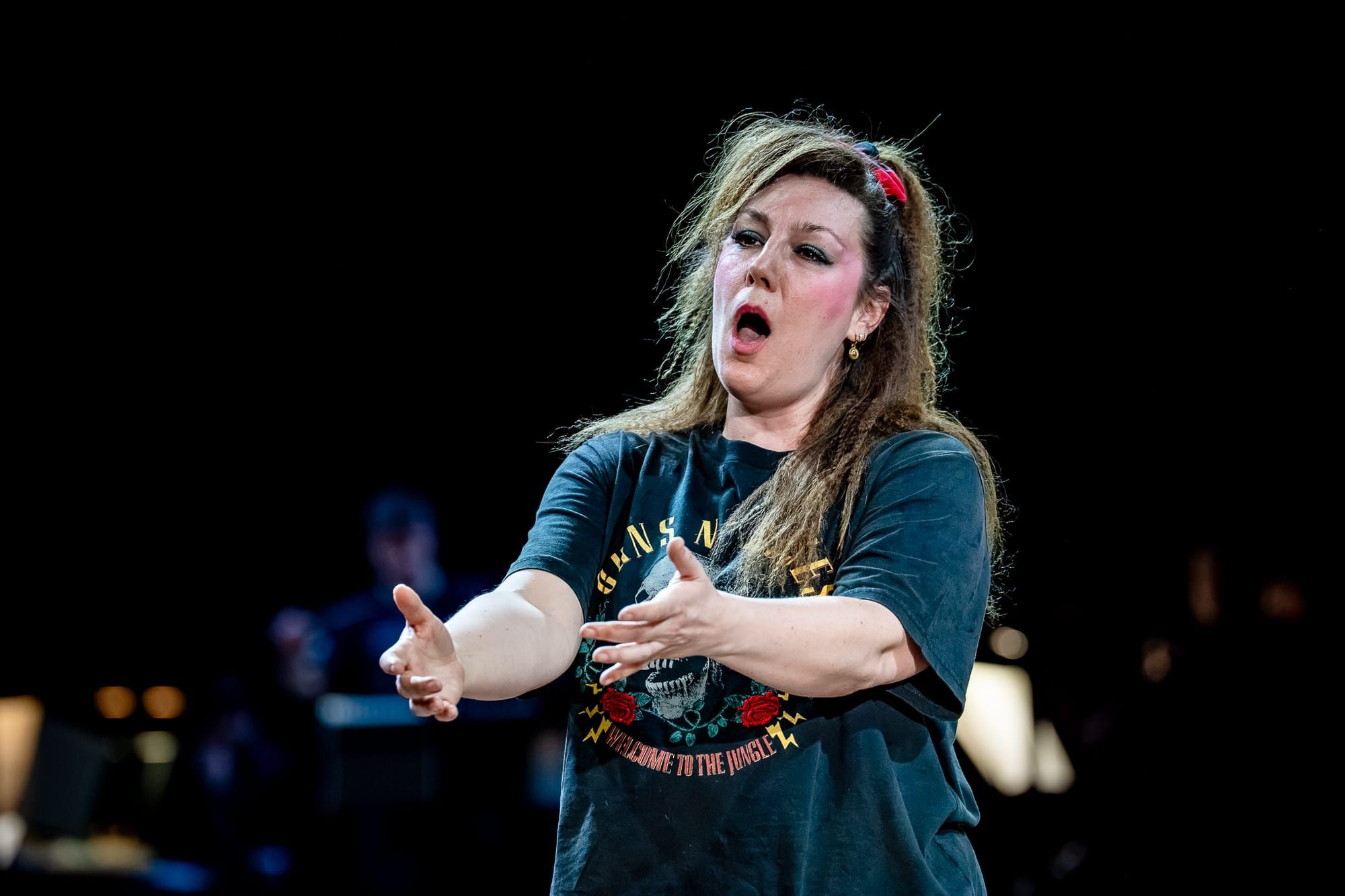
The Salome was Kirsty Taylor-Stokes on this first night, incredibly strong throughout (she shares the role across the run with Eleanor Dennis). This Salome is a spoiled teenager, desperately aware of her own sexuality but simultaneously just desperate, a party for the Ego. So the increasingly emphatic repetitions of “Gib’ mir die Kopf des Jochanaan’ gain not only traction and cumulative weight, but emerge also via a crescendo of petulance. Whether in rock band tour T-shirt or glam black dress, Taylor-Stokes did own the stage. Her top range is appropriately powerful and piercing. It must help that the orchestra is heard in reduction, but the stamina demands remain, and she was indefatigable. Possibly as a counterpart to the opening strip down to tassled nipples, Salome’s clothes remain mostly on (a dressing gown is divested). Her fascination with John's head is in itself mesmeric: a first it looks like we are dealing with a gory bag, but when the head is revealed, it certainly has.an impact.
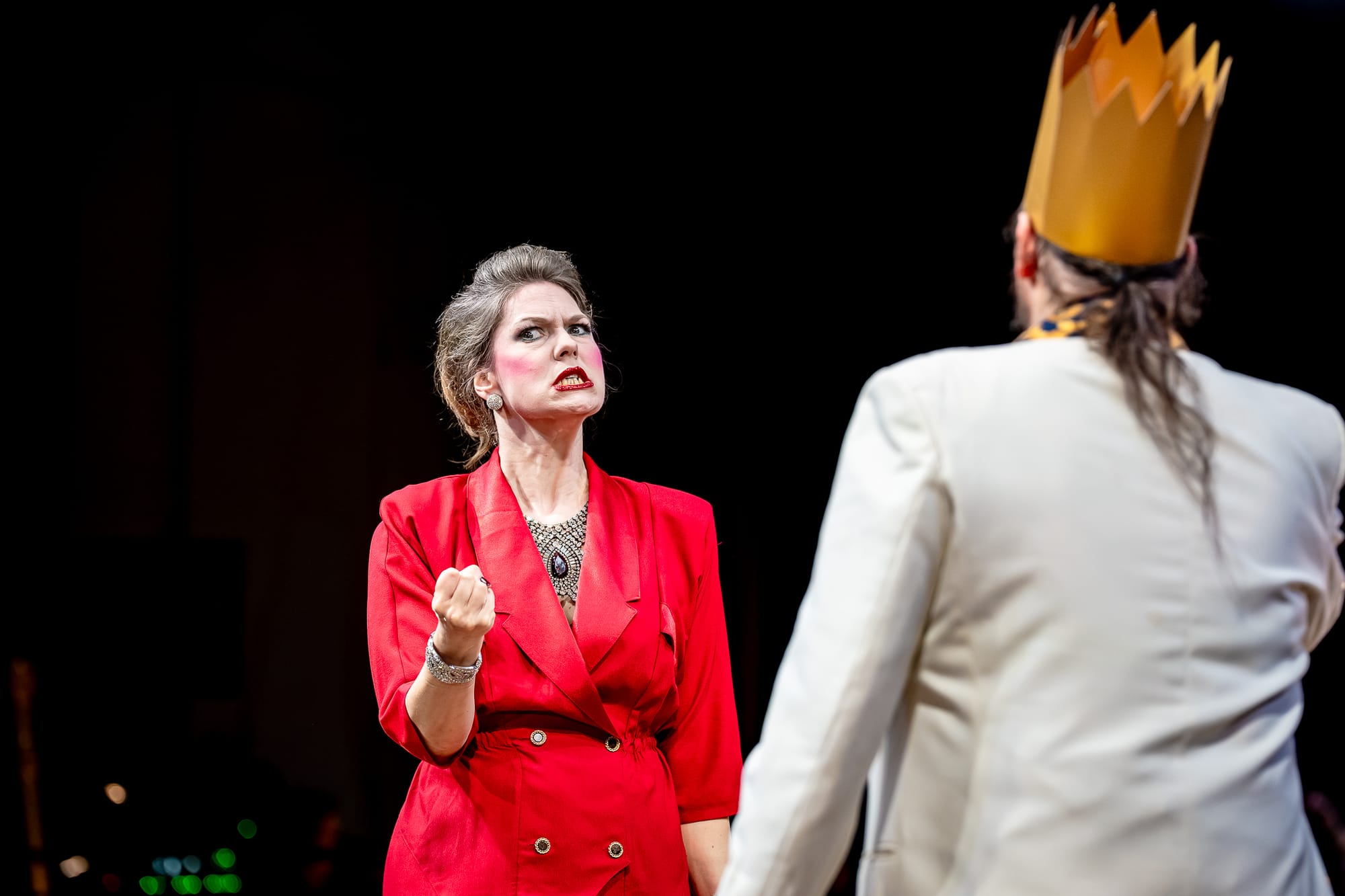
But Taylor-Stokes was not the most impressive female singer of the night, and in that it was indeed Ladies’ Night. Mae Heydorn (Erda in the Regent's Opera Ring) was simply stunning as Herodias, her aura of power and control both in persona and in voice. She has a rich but varied mezzo, used to fine effect here in this assumption of Herodias as puppet-mistress extraordinaire.
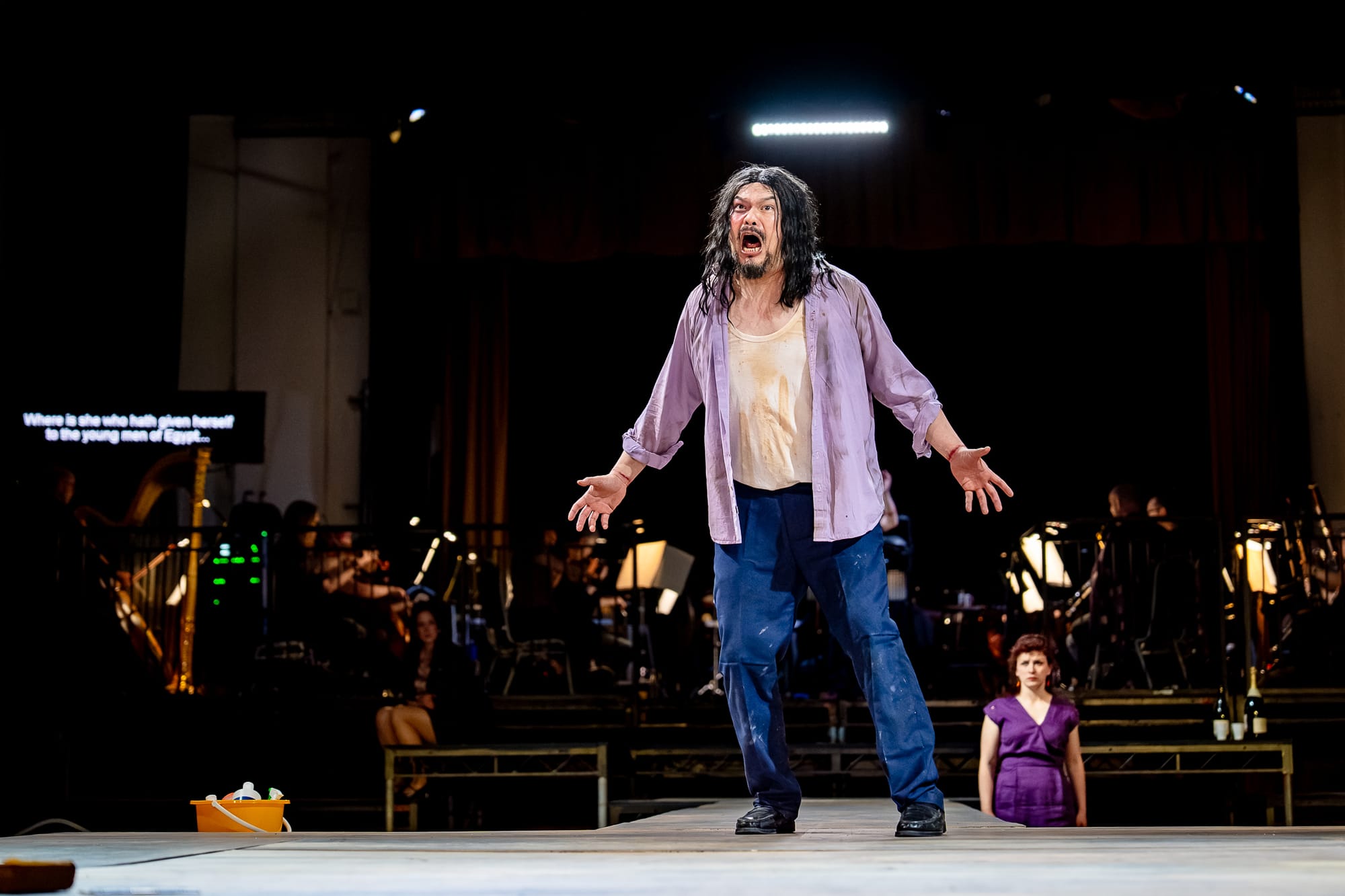
As Jochanaan, Freddie Tong positively shone, looking as believably dreadful as anyone in John the Baptist’s situation. Some occasional strain at the top of his voice was the only debit, but his pronouncements carried, er, Biblical weight. He is asked to self-flaggelate (a Christian practice to express remorse as a form of penance and as a devotional discipline in its own right), but much more besides. In Tong’s incarnation, Jochanaan emerged as a remarkably complex character, at times very human, at others touched by (and perhaps in touch with) the Divine.
So to “birthday boy” Herod (or Herodes, as he is in the opera). Is that a birthday crown from a cracker, or is that an actual crown he wears? Its flimsiness seems to reflect his grip on the Royal household. Robin Whitehouse (who was a cover for the tenor roles in the earlier Ring) was vocally a rather weak link, his voice somewhat low on power and he was lower in gravitas and, indeed, malevolence than many of his counterparts.
James Schouten, who had impressed as an outstanding Loge in the Bethnal Green and Freemanson’s Hall Rheingolds, made the Salome-obsessed Narraboth a part impossible to ignore. He it is that drinks poison and gets to vom on stage, but because his assumption of the role is so all-consuming, it becomes far more than a gesture but an intrinsic part of a broken character.
We must never forget that Regent’s Opera is an ensemble, and how that showed in the smaller parts (five Jews, two Nazarenes, two solders, a Cappadocian, and a slave). Plus ‘The Page” of Jessica Ouston, brilliantly taken by Scottish mezzo Jessica Ouston.
The winner here is Richard Strauss: how alive and fresh the opera felt. Another triumph for Regents Opera, who in March 2027 will tackle Parsifal (directed by David Pountney) and who on July 17 at Bloomsbury Theatre will give a Verdi Rigoletto.
Salome
Music: Richard Strauss
Libretto: Composer, based on Hedwig Lachmann’s German translation of Oscar Wilde’s play
Cast;
Salome - Kirsty Taylor-Stokes; Herodes - Robin Whitehouse; Jochanaan - Freddie Tong;
Herodias - Mae Heydorn; Narraboth - James Schouten; Page - Jess Ouston; First Jew - Davide Basso; Second Jew - Howard Hutt; Third Jew - Jonathan Finney; Fourth Jew - Dominick Felix;
Fifth Jew - Andrew Tinkler; Nazarene / Soldier - Felix Kemp; Nazarene - Adam Sullivan; Slave - Annabel Bigland; Cappadocian - Gerard Delrez; Soldier - Jacob Ng.
Production:
Director - Mark Ravenhill; Choreography - Aletta Collins; Set & Costume Designer - Hannah Schmidt;
Lighting Designer - Azusa Ono; Pre-show performer - Cynth Icorn; Emcee - Revolting Rosy; Burlesque performer - Claire de Lunacy.
Conductor - Ben Woodward
Photos © Steve Gregson