
Elsa Dreisig: Invocation
A most interesting release
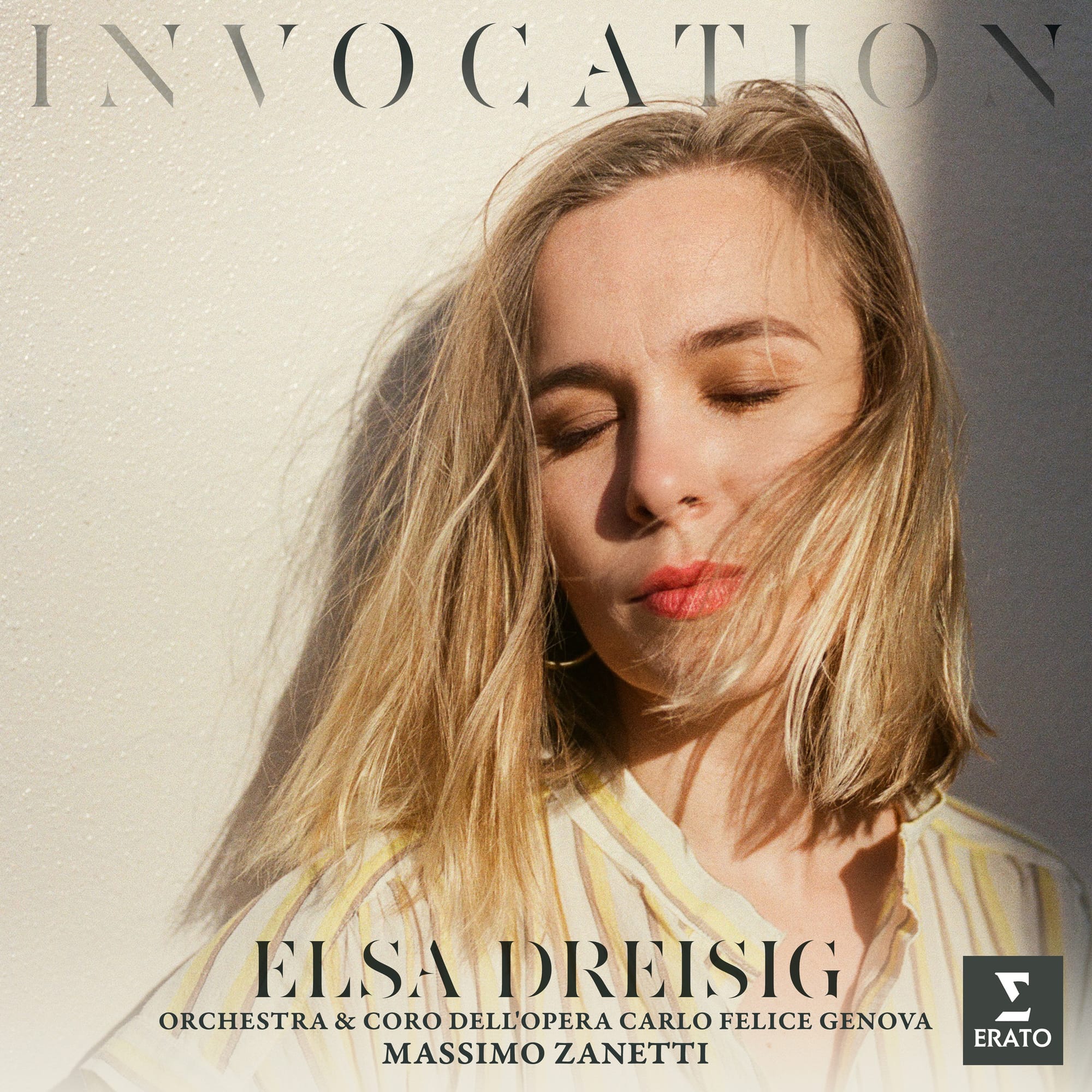
This post was originally intended to run in parallel with a report on Elsa Dreisig's Wigmore Hall recital on March 25: sadly, she had to cancel (replaced by Marianne Crebassa), but this new disc remains. Memories of her Micaela Carmen in a concert perfomance in Strasbourg in April 2023 remain strong.
Paris-born soprano Elsa Driesig (with conductor Massimo Zanetti and the Orchestra and Chorus of the Teatro Carlo Felice di Genova) places "Casta diva," as the focus of this recital (probably the only opera with a Druidic slant).
Regarding the il, Invocation As Dreisig puts it, this is when ...
... an operatic character communes with herself and where her soul sings ... These invocations bring together two dimensions. On one side there is intimacy and vulnerability, giving rise to particular vocal colours. On the other, an appeal to a supernatural power, which lends a unique dramatic intensity to the moment. It is this fusion of intimacy and drama that means the most to me … There is not just one voice or vocal colour for a role, but rather an infinite range of nuances, like so many human emotions.
There is another famous ‘lunar’ aria, the ‘Song to the Moon’ from Dvořák’s Rusalka, beautifully sung by Dreisig, with a tender, burnished tone; the decision o continue with Jenufa's pale (from Janáček's opera of that name) is genius: Czec both, and one can hear the lineage:
It's quite a way to Puccini; I'm less taken by "O mio bambino caro" (Gianni Schicchi); better is "La verging delgli Angeli" from Verdi's La Forza del destiny, where we also heard the excellent chorus of the Opera Carlo Felice, Genova. Throughout, Massimo Zanetti directs that opera's orchestra beautifully - he is clearly a experienced operatic hand:
Of the many roles here, Lauretta is the only operatic role represented on Invocation that, as yet, Elsa Dreisig has sung on stage.
And so to the cavatina, "Casta diva". Bellini is known for his long cantabile lines (he is a major influence on Chopin). Zanetti directs our attention to the scoring: sparse, expectant. Dreisig spins the line well:
The recital also reveals Dreisig's ability over a range of languages, ad how good to her some Gounod that is not Faust: instead, a I fom the lovely Mireille, "Voice la vaste plains". Gounod's writing is spellbinding, magnificently realised by Zaneti. At nearly eight minutes, this is one of the longer excerpts, time to immerse oneself:
Here's a filmed studio version of her Solveig's Song fo Peer Gynt. He voice is perfect for this:
Peter Arnold Heise (1830-79) was born in Copenhagen – his presence on Invocation acknowledges Elsa Dreisig’s connection to Denmark through her mother, the soprano Inge Dreisig, who moved to France to study at the Paris Conservatoire. Heise is admired for the many songs he composed, and Drot og Marsk, a tragedy set in the Middle Ages, stands as the most important Danish opera of the 19th century. Here, we have a lovely act IV aria:
... and here, as a treat, is Dreisig live in that piece from Dresden:
A paean to nature by Victor Hugo gave rise to Extase by the American composer Amy Beach (1867-1944); as with all Beach's music I have heard, it is both lovely, and exquisitely crafted. The song rises to glowing climax. This is the second of three songs, Op. 11:
Carolina Uccelli (1801-58) was born in Florence, Italy, and her talents as a composer were recognised by Rossini (whose opera Le Siège de Corinthe also features on Invocation, heard next); the great composer praised her “expressiveness and elegance in declamation and melody". Uccelli’s Anna di Resburgo (her second opera, composed to a libretto previously set by Meyerbeer) was premiered in Naples in 1832; it was revived in 2024, by the American company Teatro Nuovo. Harp adds beauty to the first part of his except (I also includes chorus). The opening of the excerpt's second part certainly sounds Rossinian, and the vocal writing is similarly aligned. Here's that, next to Rossini proper, Pamyra's Act III aria/invocation:
So to Wagner! Just the one (but it leaves space for Flotow later ...), "Allmächt'ge Jungfrau" from Tannhäuser is here, but it seems slightly out of place; either Dreisig nor orchesta seem fully inside Wagner's world. In this context, much better lesser-known Feench ep, and another deserving Gounod opera: Sapho, the titular character's third act aria, "Õ ma lyre immortelle":
Another gem, but Bizet this time: from Cloris et Clotilde. There really is more to Bizet than Carmen!
From the core rep, two further invocatons: Tosca's hymn to art, "Vissi d'arte," and, the more convincigly sung of the two here, Desdemoa's "Ave Maria" from Otello:
It is, though, the final item that interests more: "Letzte Rose" Harriet's third act aria from Friedrich von Flotow's once-popular Martha. You will know it!
A most interesting release. Invocation is available at Amazon here. Streaming below except for iDagio here; (Apple Music offers the album in Dolby Atmos).