
Divine Impressario: Nicolini on stage
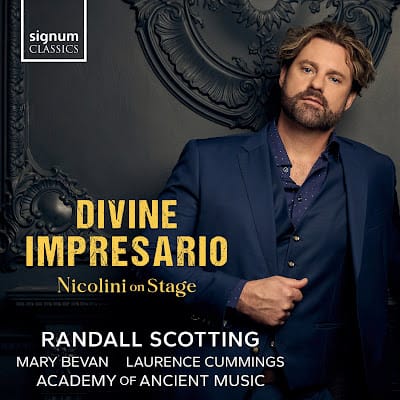
Celebrating castrato Nicolò Grimaldi (1673-1732), known (then) universally as "Nicolini," his disc presents no fewer than nine World Premiere recordings. Although Handel wrote for Nicolini (and we hear arias fom Rinaldo and Amaldigi here), so did a raft of the composers, including Gasparini, Francesco Mancini, Attilio Aiosti, and Giovanni Antonio Giaj.
Divine Impresario: why “Impresario”? Good timing for us, as we've just covered an Impesaria (Gambarini: see review here). Here's Scotting on Nicolini:
When I think of Nicolò Grimaldi, the word that comes to mid is “impressaio”. Not in the limited sense of theatre manager, but rather as a force who shaped the artform itself. Nicolini wasn't content just to stand and sing; he directed performances, he reworked libretti, and he elevated the standard of acting in opera.
Scotting is that rare and beautiful thing: a scholar-musician. His PhD thesis from the RCM was Unknown Senesino: Francesco Bernardi's Vocal Profile and Dramatic Portrayal, 1700—1740, As part of this "research thirst," Scotting traveled to England, Belgium, Austria, Germany, and Sweden to find manuscripts linked to Nicolini's performing career:
For me, stepping into this repertoire is a kind of conversation across time, with Nicolini, but also with the idea of what it means to be an impresario today. Like him, I'm drawn to music-making that is dramatically committed. In recording his music, I sought to honour his legacy as he divine impresario, defined by an ambition for opera to be more than just dazzling technique, but also a captivating and emotional experience.
So, who was Nicolini? He was born in Naples in 1673, debuting there at only twelve yeas old. He became famous over all Italy, and beyond. In 1708, he lived in London with a three-year contact and a huge (then) salary of £1000. He returned to Italy; he died in January 1732, taken ill while rehearsing on stage at he age of 59 in Naples.
The disc begins with a piece by Riccardo Broschi (1698-1756; not to be confused with Carlo Broschi): “Mostro crudele che fai?” fom Idaspe. Here, Idaspe is in a Roman amphitheatre with a lion as company.. He uses coloratura as a weapon with which to taunt the animal (as we all would in that situation, obviously); the whole spectacle, though, is an attempt to win his beloved, Berenice. He sings that the lion can have all of him except his heart, which belongs to Berenice. “Vieni col tuo furore,” he taunts (Come with your fury, the word “Vieni” (“Come”, much repeated as if the singer is inviting he animal forward with a gesture); the contrast comes with the meditation on his faithful heart, beautifully delivered:
Broschi wound up on the soundtrack of Farinelli (Les Talens Lyriques/Rousset); his “Son qual nave ch'agitata” from Artaserse has been recorded by Cecilia Bartoli (and also David Hansen for Deutsche Harmonia Mundi, and Niccolò Balducci for BIS).
Francesco Gasparini (1661-1727) is bettter-known. A progressive late Baroque composer, he penned a treatise called Armonico pratico (Bologna, 1722, available in full here), useful for its descriptions of ornamentation, notably he acciaccatura. He also taught Domenico Scarlatti. Like Handel and Vivaldi, he wrote a Bajazet (Handel's is called Tamerlano!: soon to be seen in London as part of the London Handel Festival). Bajazet was of course defeated by Tamelano; Gasparini's Bajazet is defiant in defeat, while Handel's is more accepting, interestigly. Anyway, here we have an aria from the first act of Ambleto (London, 1712), the wonderfully alliterative “Porto piagato in petto” (I carry, wounded, in my breast ..”). This is the Hamlet (Ambleto) story, the source the Danish histories of Mersius, Pontanus, and Saxo Gramatticus (so, not Shakespeare). The piece contrasts with the aria from Broschi's Idaspe well, an examination of Hamlet's internal struggle to maintain an exterior mask because of circumstances. Having feigned madness to stay at court, his aria is the audience's first opportunity to know him as he is. Straight away the AAM's stings convey the pain in Gasparini's gestures; "Porto," exclaims Hamlet, in a single statement that gets more and more expanded. The AAM strings perfectly convey the minor-mode torment here. Roulades are used expressively, and externalising unveiling of emotion:
Handel needs no introduction. Wonderful to have some Rinaldo, the titular characters aria, “Caro sposa”. A post-abduction lament (his beloved Almirena has just been taken by Armida), it is preceded by a vivid Sinfonia fom the AAM. But how lovely Scotting's held note on “Cara sposa”; how adventurous Handel's writing fo stings, replete with dissonance. Scotting and Cummings take his very slowly, and how it works, especially the contrast to the red-hot rapidity of “Del vostro Erebo sull'ora” (On the altar of you shadow world). The return of the opening makes such an impact, and Handel's sparse scoring is shown into new relief:
I loved Porpora's Ifigenia in Aulide at Bayreuth a couple of years ago (my Opera Now review is here). Here's a third act duet from Siface (1726): “Spiegami il tuo desio” (Tell me your desire; text Metastasio). It finds Scotting with soprano Mary Bevan. The two singers' interactions reflect the confused emotions of the protagonists: the king Siface and his ex, Viriate. This is a beautiful siciliano. Bevan is in spcactacular voice; and, importantly, although occupying similar vocal ranges, Scotting and Bevan's voices ae nicely differentiated. his is also a nice reminder of Porpora's genius - the moe of his music I hear, the more I believe this: the composer's use of overlapping voices is magisterial (mirrored in the first and second violins, too). The little cadenza at the end is pure delight:
The extended silence after that track on the disc is well though though; we enter the world of the night in “Oh morte! ... notte amicable” from Handel's Amadigi, HWV 11 (1715), the second opera Handel wrote for Nicolini. Like Rodelinda, this is another story with a magic tinge (the sorceresss Melissa). Some lovely vocal line decorations here from Scotting, echoed by a single string line, more plainly stated. A beautiful Handel arioso, it just points to the need for a staging of Amadigi (in full form, Amadigi di Gaula); and lo and behold. there is a performance this year in the UK, the English Concert at the Buxton Festival, directed by Olivia Fuchs.
A bit of a Handel sandwich, as he next track is again from Porpora's Siface: “Come nave in mezzo all'onde” (Like the ship in the midst of waves). Metastasio's text uses a nautical metaphor, painting the Numidian king as both rescuer and navigator. The vocal line is extraordinary, jagged like the sea's waves, the AAM an explosion of energy. Emphaic statements of “Non timer” (Fear not) stand in stark contras to Porpora's florid writing, beautifully negotiated by Scotting:
Gasparini returns with an aria from his Antioco: “Per te bell'idol mio” (For you, my beautiful idol). A surprising mistake in the accompanying commentary throws the eye (“Arsinoe is a lovelorn and magic princess who is meant to ascend the thrown (sic) and marry her beloved Antioco”). Here we have a duet as “the star-crossed lovers sing their goodbyes with intense dramatic pathos,” in which they pledge a love so strong that even Nature herself must be a witness. Mary Bevan joins Scotting again for a vocal marriage again forged in celestial climes as they attest that forests, rocks, rivers, sky, stars, Gods, all know that each dies for the other. There is something of a siciliano about his. Vocal decorations are lightly managed, while a final micro-flourish for Scotting and Bevan makes one pine fo a fully-fledged cadenza:
From Francesco Mancini's Idaspe Fedele (1710). This is extraordinary; the scoring is so sparce: basso continuo (with theorbo, Kristina Watt) and solo violin (Bojan Čičić, whom we me recently at Milton Court in the Gasparini Impesaria concert). Extraordinarily tender, “stirringly intimate” in the words of the booklet notes, this is surely unique in its impact; why don't we hear more Mancini? He was up there with Alessandro Scalatti in popularity in his day, although he was in effect in Scarlatti's shadow for lots of his life when it came to employment as Maestro di cappella at the Naples Conservatorio; Mancini wrote fo the Neapolitan public, penning round 30 works for the stage, Idaspe dates from 1710 (his first completed opera dates from 1692, Il nodo sciolto) . This is a clear album highlight:
Far more famous is “Venti, turbini” (comma omitted in the booklet commentary) from Handel's Rinaldo. The protagonist calls on the elements to assist in his revenge agains Armida. A clear vehicle for virtuosiy (both Nicolini's and Scotting's), the orchestra itself has virtuoso demands place on it; Cumming's AAM assures a thrilling ride:
Associated with both Venice and Berlin, Attilio Ariosti (1666-1729) is represented by an aria from Tito Manlio (Venice, 1717). The hero is, at the time of singing, in a quandary: repeatedly warned not to go to war (his beloved saw him, in a dream, killed), he has to because of civic duty. This aria is a reassurance that he will return. The orchestra has something of a march about it, despite the conciliatory nature of librettist Nicola Haym's words:
Good to have two Gasparini tracks juxtaposed, the first from the pasticcio opera Tomiri (1709), the second Antioco. In the first, we find another protagonist, Tigranes, at a crossroads, this time between hope and despair. We certainly hear the despair in the orchestra in “Si, t'intendo a core amante" (Yes, I understand, oh, loving heart) . The ongoing bassline, rhyythmically insistent, is given real urgency here, while Scoting's diminution only heighten our understanding of the hero's emotions:
In the Antioco excerpt, there is a positively Handelian opening for the imprisoned titular character's final act aria, “Questo conforto” (This comfort alone). In this aria of hope in the face of despair, Gasparini twists the harmonic knife (at "E tutta la mia fè, Anima mia per te”; and all my faith, My soul, for you). Scotting's legato is superb:
Giovanni Antonio Giaj (1690-1764: the booklet strangely gives "17641759" as his death date) was a Turinese composer, Maestro di cappella at the Royal chapel under Charles Emmanuel III of Savoy; he was succeeded by his son. Mitridate is one of 15 operas. We know Mitridate from Mozart, of course; here, the ruthless titular king offers an ultimatum ("Consider if you resist again / That I may take revenge"). Relenrless descending scales on violins have the downward thrust of a dagger in the AAM performance. Giaj's writing is gripping; we should hear more of this music. The slow section has something of a feel of a minuet about it, heightening even moe the drive of the opening on its return:
Surely, it is only fitting the disc closes with the magnificence of Handel, and with a duet: “Crudel tù non farai” (Cruel one, you will never, With your strictness, Disturb my constancy) from Amadigi, a second act confrontation between Amadigi and sorceress Melissa. The vocal interactions of the opposing viewpoints are spectacular fom Handel (and Scotting/Bevan); and Handel's woodwind writing is particularly fascinating, the AAM winds, either in pairs or as a unit, superb. Scotting and Bevan's delivery of material at speed in parallel intervals is joyful:
A phenomenal disc, full of discovery. Increasingly, Scotting's next major operatic appearance seems not to be in Baroque music; instead, he sings Adamo in Sciarrino's Venere e Adone at La Fenice, Venice under the bacon of a conductor we will meet in the post tomorrow (the Philharmonia, RFH, Mahler 2), and again in May via Dresden (Götterdämmerung): Kent Nagano.
The disc is available via Amazon here. iDagio here.