Beethoven's Ghost
The Rautio Piano Trio has previously impressed on the Resonus label: we covered two of the three trios of Beethoven's Op. 1 on this disc, with the balance of Op. 1 (Op. 1/3), and the Trios Opp. 11 and 44, in this post.
Here, it is the Piano Trio in E flat, Op. 70/2 that opens the dic, probably in an effort to give the piece a chance: its companion, Op. 70/1, is the "Ghost" and, benicknamed, has gained greater currency. But the E flat, Op. 70/2, is a wonderful piece, its opening mysterious, the Allegro no troppo bursting with life. Both trios date from 1806. The use of fortepiano works beautifully - the balance between keyboard and strings is perfectly managed. The indicator "Allegro ma non troppo" is fully followed - allowing the music to stretch. The other advantage of the fortepiano is the crisp clarity of its bass:
There is magic aplenty in this performance, not least in the tempo alternations towards the end of the first movement. There follows not one, but two Allegrettos (one "straight" Allegretto, one Allegro ma non troppo). Listen to the delicious exchanges between instruments in the first, a set of variations. The gruff minore is impressive, too, and just listen to the inventiveness of Beethoven's writing:
The third movement moves from the C-centric second to A flat major. The rhythmic buoyancy (on the first middleground level of the rhythmic structure) is phenomenal here. It's so tender, in keeping with much of this Trio:
Richard Wigmore called the work both "lovable" and "subtle," and it is easy to hear what he means (I refer to the booklet notes for the Hyperion recording with the Florestan Piano Trio, which uses a modern piano). That does not mean it is easy, though: listen to some of the piano articulation in the finale:
It feels a long way back to the Piano Trio in E flat, WoO 39: (actually just an Allegretto movement). Written in 1812, it is dedicated to Maximiliana Brentano (to whom Op. 109 was also dedicated). The piano writing is deliberately easy (for Maximiliana) and included fingerings by the composer. It is a gracious, easy-going piece in pastoral vein:
That piece is interludial here: we return to the main gist of the album with the so-called "Ghost" Trio, Op. 70/1. This is music of contrasts: the very opening reminds me of the opening of the Piano Sonata in D-Major, Op. 10/3, but here there is an immediate lyrical plateau thereafter. That sets the stall for the movement's underlying duality:
It is teh slow movement that gave this piece its nickname - the central movement as there is no Scherzo. The music ids dramatic - and on a modern piano it could arguably be more dramatic in its outbursts still. And yet the threadbare, vibrtaoless, static passages are remarkable:
The finale is full of verve, but also with some of the contrasts that characterised the first movement. There is such a refreshing energy in this performance. This is what I might call a "thoughtful presto": it feels more like an Allegro molto, but every detail is clear::
Finally, another "little," non-opused trio. Now not even a WoO, but a Hess numer: Hess 48, written in the early 1790s. We are pre-Vienna - Beethoven is still in Bonn. This is a brief Menuet. Published by Jack Werner in London (Elkin & Co., 1955) and by Willy Hess in the ninth fascicle of the Supplemente zur Gesamtausgabe (1965), the MS is part of the Kafka collection in the British Museum:
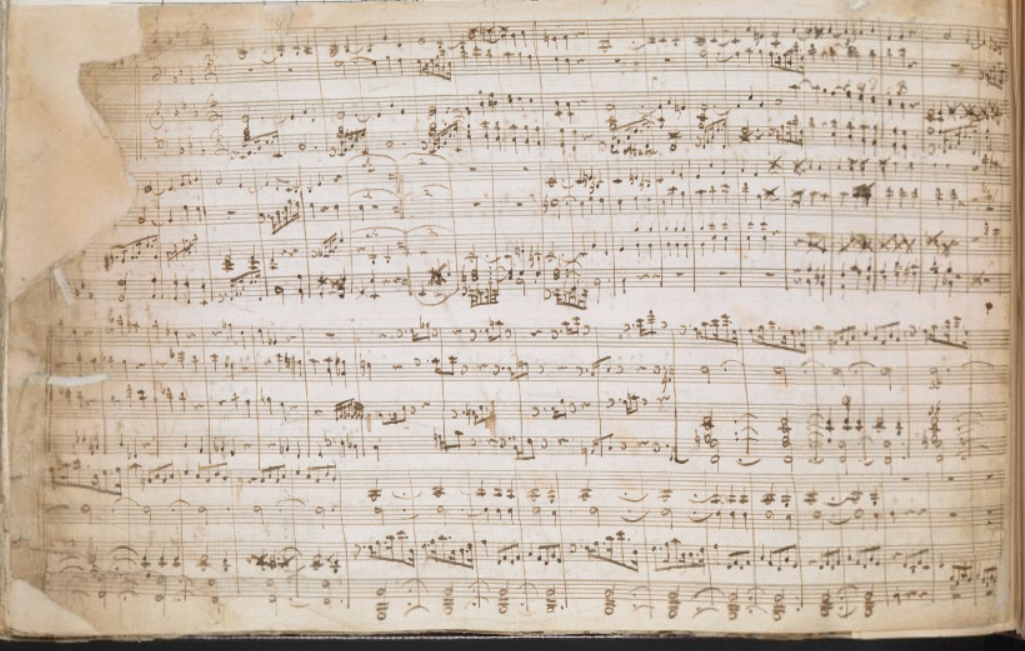
Its a rather lovely piece, perhaps not as lively as the "Allegretto" marker suggests:
... and the Beaux Arts Trio takes even longer:
Rautio plays a copy by Paul McNulty of a grand piano by Conrad Graf dating from 1819. The booklet notes are slim - too much so. But that's the only down side: recording and performanes are excellent.
This disc is available at Amazon here. Streaming below.