
Arthur Catterall: Mozart, Brahms & Franck
A fascinating disc, of real historic significance
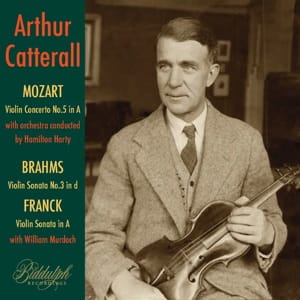
Preston-born Arthur Catterall was leader of the Hallé Orchestra (under Hamilton Hate) and later the BBC Symphony Orchesra (user Boult). He is of the same generation as Marie Hall (who also appears in this series); the Hallé Concerts Archive lies his first solo appearance with the orchestras as with Hans Richter (!) in the Tchikovsky Violin Concerto on December 15, 1904. Alongside the concertos with the Hallé a the leader's solos in Rimsky-Korsakov Shereazade and Richard Stauss' Heldenleben. A full list of his peformances with the Hallé can be found here.
In fact, Hans Richter took Catterall to Bayreuth, to play with the Festival Orchestra. The Hallé connection came early: in 1894, Catterall played to Wilma Neruda, a violinist known for her Mozart. He studied with Willy Hess, leader of the Hallé and a Professor at what was then the Royal Manchester College of Music.
Here are Columbia acoustics - and that should give some idea of the provenance (the Mozart is from April 10, 1924 and was first released on Columbia L1590/1)
While the Mozart is very much of is time, with ralletados that simply would not be countenanced today (thye would be frowned upon as contra-Mozartian), and the orchestra is perhaps not the best, it is Catterall's contribution the is so compelling. The cadenza is fabulous,:any violinist could benefit from hearing this.
The slow movment begins with orchestral violins in really rather slippy-slidey mode. But Catterall himself is beautifully expressive, his tone sweet and slightly wiry in a.good - focused - way. The finale a Rondeau, features magnificent clarity at speed from Catterall, and the sense of purity of line works beautifully. Here's the slow movement:
Biddulph's documntation opts not to describe K 219 as the "Turkish," but how both Cotterall and Harty enjoy this aspect of the finale; it is impossible, surely, not to link this with Mozart's opera Die Entführung aus dem Serail (both were part of he prevalent Zeitgeist of all things "Oriental," which in those days meant Turkey).
This was K 219's first recording, and there some cuts (in the slow movement of six bars, and a small one in the finale).
To complete the disc. pianist Willim Murdoch joins Catterall in sonatas by Brahms (No. 3, D-Minor) and Franck in Columbias from the preceding year, 1923. All of the recordings on this disc precede Catterall's time with the BBC SO (which came in 1929, a year in which he also took up a Professorship at the Royal Academy of Music).
The Brahms is magnificent. The first movement has much lyricism, the second nobility (if Brahms had have known the marking "nobilmente," he would have used it). Murdoch is more associated with Albert Sammons than Cotterall, but the two play here because of contractual reasons. Cattterall and Murdoch play the slow movement as if they had been plying together over; it is unforgettable:
The finale is light as a feather, Murdoch notably pedal-light. It is.a proper Presto, if not as "agitato" as some. Amazingly, some of the depth of tone Murdoch gets from his piano is maintained in the recording, particularly as regards the chordal passages:
There is quite the story about the release of the Franck: it was issued in the States, but with here movements in the wrong order (3, 4, 1) and with one missing entirely; it was withdrawn and the "missing" movement sourced from the UK.
Catterall and Murdoch take the "ben moderato" qualifier to the "Allegretto" first movement to heart; this almost sounds like a slow movement. Yes, there is portamento both upward and downward, but it s artful. Murdoch acquits himself well in the Allegro (it is terrifyingly difficult), ad the recording allows detail to come through:
The slow movement is.dream. Catterall dares to take this meditatively, slowly, linking us to.a remarkably profound space out of which emerges the cadenza-like passages; and with them, a reminder of Caterall's excellence in this mode of utterance (the first movement of the Mozart above).
The approach to the finale has the high tension, but perhaps is not fully successful (again I had to mention my preferred performance here, Stern on CBS); some passages with Catterall and Murdoch feel a tad rushed. And there is a school of thought that says that Franck is syrupy enough without portamento ...
That said, Murdoch's musicality is highly appealing, aad Catterall's prefect attack up high in response to Murdoch's impassioned outburst towards the end make fo exciting listening.
A fascinating disc, of real historic significance. Available from Amazon here.