
Andrew Downes' "A St Luke Passion" (and other choral works)
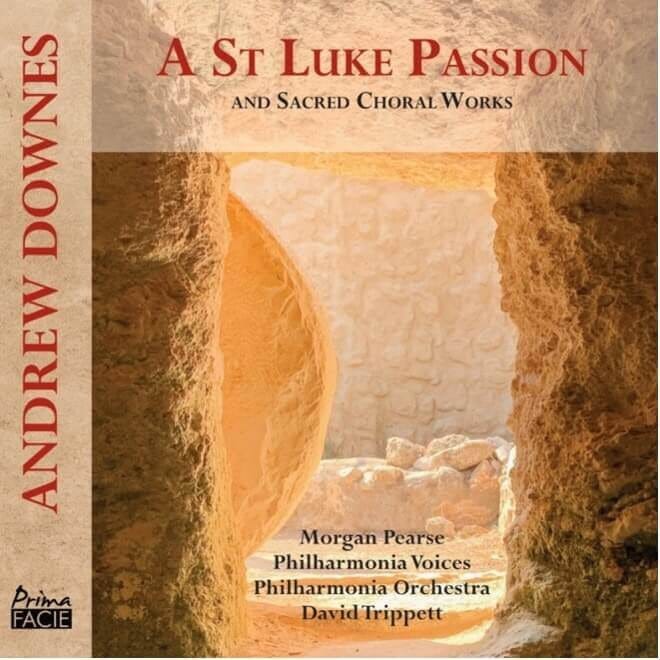
On 27th March 2026, the record label Prima Facie released the premiere recording of Andrew Downes’ A St Luke Passion of 1993 (Op. 50) with the Philharmonia Voices and Orchestra under David Trippett.
This is the first album in a trilogy of recordings of the large-scale choral works of Midlands composer Andrew Downes (1950-2023), who spent his entire life in Birmingham and the rural Midlands. The Marshes of Glynn, Song of the Prairies will be released on August 7; New Dawn will be released on January 8, 2027.
Commissioned by the Wolverhampton Civic Choir in 1993 to be performed alongside Britten’s 1948 Cantata St Nicolas (YouTube playlist of the Steohen Layton performance, as well as A Ceremony of Carols, here)), Downes’ A St Luke Passion is the centre piece of the album which includes several a cappella works.
Here's the promo video, which includes the opening, setting the scene in a sort of dark and yet unmistakably English-Pastoralist way (think Vaughan Williams at his most interesting):
It has been suggested that Downes’ core lyricism aligns him with the Late Romantic English tradition, and as a successor to Howells (his teacher). Think - Elgar and Bantock, one historical step on. Downes comes from a musical family, his father was a horn player in the City of Birmingham Symphony Orchestra, and his uncle a founding member of The Philharmonia. Downes became a countertenor choral scholar at St John’s, Cambridge, later performing Handel opera roles alongside Dietrich Fischer-Dieskau.
The figure of Jesus is sung by excellent baritone Morgan Pearce; the Philharmonia Voices are on top form, their lines referencing chant on occasion while the solo voice is freer, more immediately expressive. While the body text is in English, familiar religious passages are set in Latin Downes' way can be remarkably buoyant: this speaks not of fusty, dust-encrusted pews. but of vibrant belief. The extended Credo of the second half is Downes' finest moment:. And just listen to the choir's final, perfectly controlled diminuendo into noting on the “Amen”:
There is an influence of non-Western musics here as well as what Downes has called the “smooth, timeless quality” of plainsong (with particular reference to the contrapuntal works of Palestrina and Monteverdi, whose freer approach to instrumentation provided inspiration for his St Luke Passion, which is scored for choir, tenor soloist, keyboard, percussion and strings). In the tussle between Pontius Pilate and the crowd, Downes has the chorus and orchestra play in different time signatures simultaneously:
This multi-dimensional effect is straight out of African tribal music where each player has a regular pattern, but in a different time from everyone else”
... Downes explains.
So, while Downes' choral music pays homage to Tudor church music,itbut also reaches out to other cultures (African drumming, Indian classical music, and jazz). Duncan Honeybourne sums this up well in his voice-over to this video:
That said, the a cappella Psalm 23, The Lord is my Shepherd (1997), the first of the Op. 65 Runnymede Millennium Evensong Service, is puee English church music, heartfelt and nicely responsive to the text: a shadow is cast over the setting at the reference to the valley of the shadow of death. The piece segues beautifully into the imaginative setting of The Souls of the Righteous, Op. 31/2 (1984):
Those shadows of the valley seem to be taken and expanded on in In Peace I will Lie Down and Sleep, Op. 31/1 - definitely worth a listen for Paula Downes' pure solo voice:
There is no doubting Downes' harmonic expertise: parts of O Love the Lord, All Ye His Saints (Op. 31/1). The pieces again run together perfectly, as Op. 31 cedes to the 1973 Motet and Mass, O Magnum Mysterium.
Downes' core ability to make one piece sound like the natural outgrowth of the last pays huge dividends in this Motet and Mass (Op. 2, 1973). The Gloria is the longest movement (at 3"17), and certainly the most wide-ranging, the Philharmonia Voices in fine form, male voices 100% secure, upper voices with no trace of strain or unnecessary edge:
I do like the "wavy" lines of the Sanctus; it is as if the music suddenly becomes untethered, while the Agnus Dei carries real emotional weight. It is the Agnus Dei that is Downes' finest moment, though, truly heartfelt:
Five short pieces close the disc. Hannah Cooke is a fine soloist in What Shall I Do to Show Hoe Much I Love Her? (Op. 5, 1973):
Perhaps O Vos Omnes (Op. 23, 1981) is Downes' greatest achievement, positively luminescent (and blessed with the finest of performances here: upper voices have to be 100% steady and offer perfect intonation, as they do here):
The purity of the upper voices really comes through in the Te Deum (Op. 110, 2017, by some way the most recent work on the disc). It stands in contrast to the richness of harmony of the final Ave Maria (Op. 6, 1974):
Summing up, conductor David Trippett is quoted as saying:
Downes is a unique voice that blends deeply choral instincts with a creative eclecticism that sparks and surprises in its imaginative reach. A proud Black Country native, he carried the identity of his home region into his compositions, from local landscapes in the Clent and Malvern Hills to regional poets whose words he set.
The disc is available at Amazon here. Streaming below.