
An Invitation at the Schumanns'
A phenomenal disc; an idea, beautifully realised
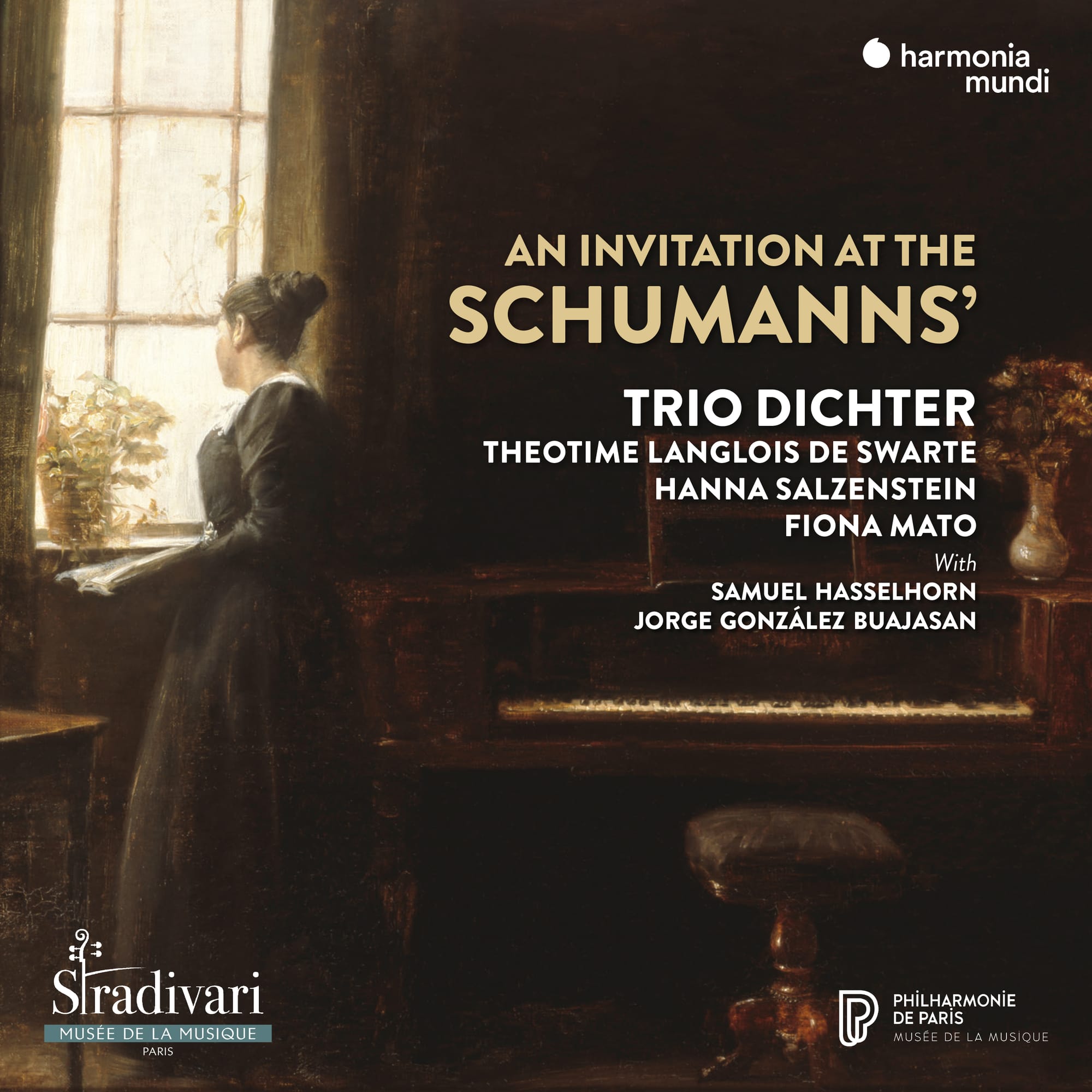
What a lovely idea, beautifully realised.
"An evening at the Schumann's: is very much Robert and Clara; or is that Clara and Robert? We start with Clara, the Andante molto, the first of the three Romances that make up her Op. 22 (list to those beautifully romantic schematic inflections of harmony):
The Trio Dicher plays on phenomenal instruments: Théotime Langlois de Swarte plays on n Alessandro Gagliano violin of 1700; Hanna Salzenstein plays on a 1734 viola made in Venice; and Fiona Mato plays on a Viennese Bösenorferr piano of around 1890.
:The Bösndofer piano is richly, softly toned, perfect against the Alessandro Gagliano violin . The innate lyricism of the music is perfectly conveyed, all the more intimate via the Bösendofer (set agianst, say, a contemporary Steinway!) whether with singer (Samuel Hasselhorn superb in Widmung, the first song of the cycle Myrthen, Robert's Op. 25) or alone in Clara's ‘Nottorno’ (No. 2 of the Op. 6 Soirée musicales), impetuous in its Chopinsque arabesques, and yet harmonically all of Clara.
All of this is prefaratoy to the main event, Robert's Piano Two No. 2 in F-Major, Op. 86 in which we hear the full Trio Dichter. It follows on from the Trio de la cour de Belgique's Schumann Third Trio yesterday. The opening Lenhaft is certainly that. It brings us to the age-old question of why Schumann's chamber woks (particularly the string quiets) lie in a second division somewhat away from the songs? This is magnificent music, and the performance here absolutely lives up to the lively indication for the first movement, while allowing space for lyricism:
The highlight is the slow movement ('Sehr innigem Ausdruck": with very internal expression). It most clearly is of inner expression: the more fragile tone of the Bösendofer underscores this, with de Swarte and Salzenstein in decidedly songful mode:
Good, too that the indication for the finale 'Nicht zu rasch," is so faithfully honoured in his peformance. tension ratchets up because of this (and Schumann's processes, here both harmonic and textural: notice how he can "group" inssuments in similar registers to "colour" those spaces):
A nice idea to include a piano trio arrangement of "Von fremden Ländern und Menschen" for piano trio (from Kinderszenen), hee tenderly rendered, next to one of the Fünf Stücke für Cello und Piano, Op. 102:
Later, we hear the second of Op. 102, Langsam. If you want to hear the full set, go for Rostropovich and Britten ....
Bach and Scarlatti would have been daily fodder for piano practice in those days (as they are now, and rightly so). The Little Prelude in E minor (BWV 938, from Sechs kleine Präludium) is the perfect pice, Mato's perfomace beautifully weighted before Niels Gade's Elegie for violin and piano, a Nordic romantic gem: Gade was big in Leipzig but also principal of the Copenhagen Conservatory. His most famous piece is probably Elvstskud; he is seen as the father of Danish music.
The folkish tone of Brahms' 'Schwesterlein" (from the Deutsche Volkslieder) is a nice contrast, Hasselhorn again in fine voice.A new pianist for (Felix) Mendelssohn's Andante & Allgo assai vivace: Jorge Gonzälez Buajasan (with Mato), a delight, full of Mendelssohn's easy melodic flow. The Andante is perfectly judged , not too slow, but slow enough for every note to "speak", the Allegro full of the legerdemain so important for Mendelssohn.
Nice to hear some Theodore Kirchner (1823-1903). From the 1888 Bünte Blätter, a song without words (Lied ohne Worrte) for piano trio (Trio Dichter), an invitation to explore more Kitchen if ever there was one:
Lovely to hear "Meine Rose," probably the most famous song of Schumann's Op. 90 (Sechs Gedichte und Requiem)\. Hasselhorn is beautifully sensitive, and the dialogue between him and the piano's treble (Mao) is exquisite:
How lovely the Scarlatti Sonata (G-Minor, Kk deest), and for once I don't mind tha it is Romanticised: it fits the tinta of the disc. It seems not at all at odds with the Brahms "Wiegenlied" (Op. 49/4), while a piano trio arangement of "Der Dichter spricht" is the perfect close, Schumann's Kindeszenen taken to extended, crepuscular lengths:
A phenomenal disc; an idea, beautifully realised, all held in perfect sound. A crushable release.
I don't know why this is.a mere £6.79 at Amazon at present (MP3 streaming is £10.99!) but it might be an idea to snap up! Streaming below, except iDagio here.