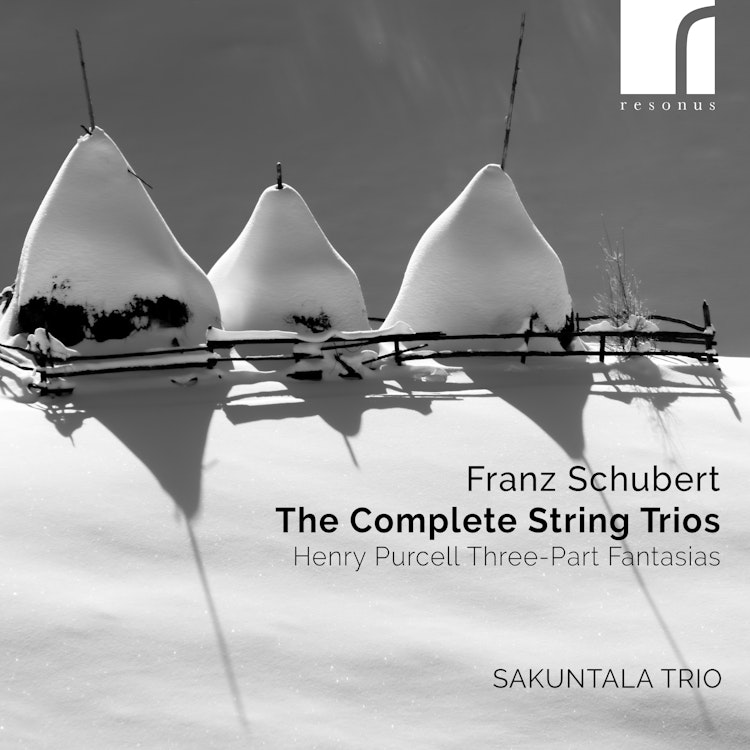
A terrific pairing of Schubert & Purcell (a la Warlock!)
Some real discoveries to be made here
There is a world primmer of "Schubert" here - the completion by Schubert scholar Brian Newbould of the String Trio, D 472. This is also the recording debut of the excellent Sakuntala Trio (Rebecca Chan, violin; Sascha Bota, viola; Brian O'Kane, cello).
The use of gut stings and low/no vibrato runs though the disc, fitting of course for Peer Warlock's range s of three Purcell Three-Part Fantasias (Nos. 1, 3. ad 2, in that order), which pepper the programme. The first, Z 732, seems to hearken back to an earlier age.than Purcell, its counterpoint and slow descending lines speaking of an archaic past. Here's Z 732 (No. 1):
The String Trio, D 471, is perhaps best known for is first movement Allegro, and is often heard as such (only part of the second movement is extant); but here is a complete four-movement structure. Much of the slow movement is Newbould's completion; while German Dances (D 790 No.5 and D 820 No.6 ) and an Allegretto, D 356, complete "D 471". Unsurprisingly, given Newbould's qualifications in this area, it works well, and the Sakuntala Trio makes the most persuasive case imaginable, revealing themselves sa highly skilled execuans in the process.
Newbould's work was done for the Leopold Strrig Trio in 2000. It is intriguing how, here in its delayed pier recording, the opening Allegro seems to emerge naturally from the Purcell/Warlock, Schubert gently "introducing himself" as the harmonies establish themselves. One hears parallels in the linear workings, too. The Sakuntala performance is full of charm, but also there is an underlying high seriousness. Here's the first movement:
The Andante sostenuto completion is eminently convincing, with just a touch of a "join"; but how skilfully Newbould mimics the technique of a contemporary work, the Fourth Symphony, by taking forward elements of his central section into the return of Schubert's "A" section. The resulting ternary structure is most satisfying.
There are massive cotnrasts in the Scherzo and Trio (in less than three minutes!) before a finale with brilliantly delivered counterpoint closes. Rebecca Chan, who as violinist caries he lioness' share, is ever in tune:
Purcell's Fantasia, Z 734 is the perfect "separator"; a stately interlude in one sense, a frozen moment of time in another. the Schubert that follows, the String Trio, D 581, is heard in its second version (which only exists as a set of parts, albeit in Schubert's hand). The first movement includes passages of pure dance; none of the walks Schubert takes his music on go too far deep into the woods, though:
The Andante is full of surprising twists and turns and the perfomance revels in them. This is the most profound music on the disc:
The finale contains music like a chamber version of a county dance, civilised but buoyant, and yet the overall landscape is markedly varied.:
The final Purcell, Z 733, while makes "rather slow," is actually notable acid intil its glacially unfolding final minute or so, offering a reflective close to this fascinating disc.
Some real discoveries to be made here, then; and I look forward very much to hearing more from he Sakuntala Trio.
This disc is available for purchase on Amazon here.