
A staged Messiah: Wild Arts triumphs again
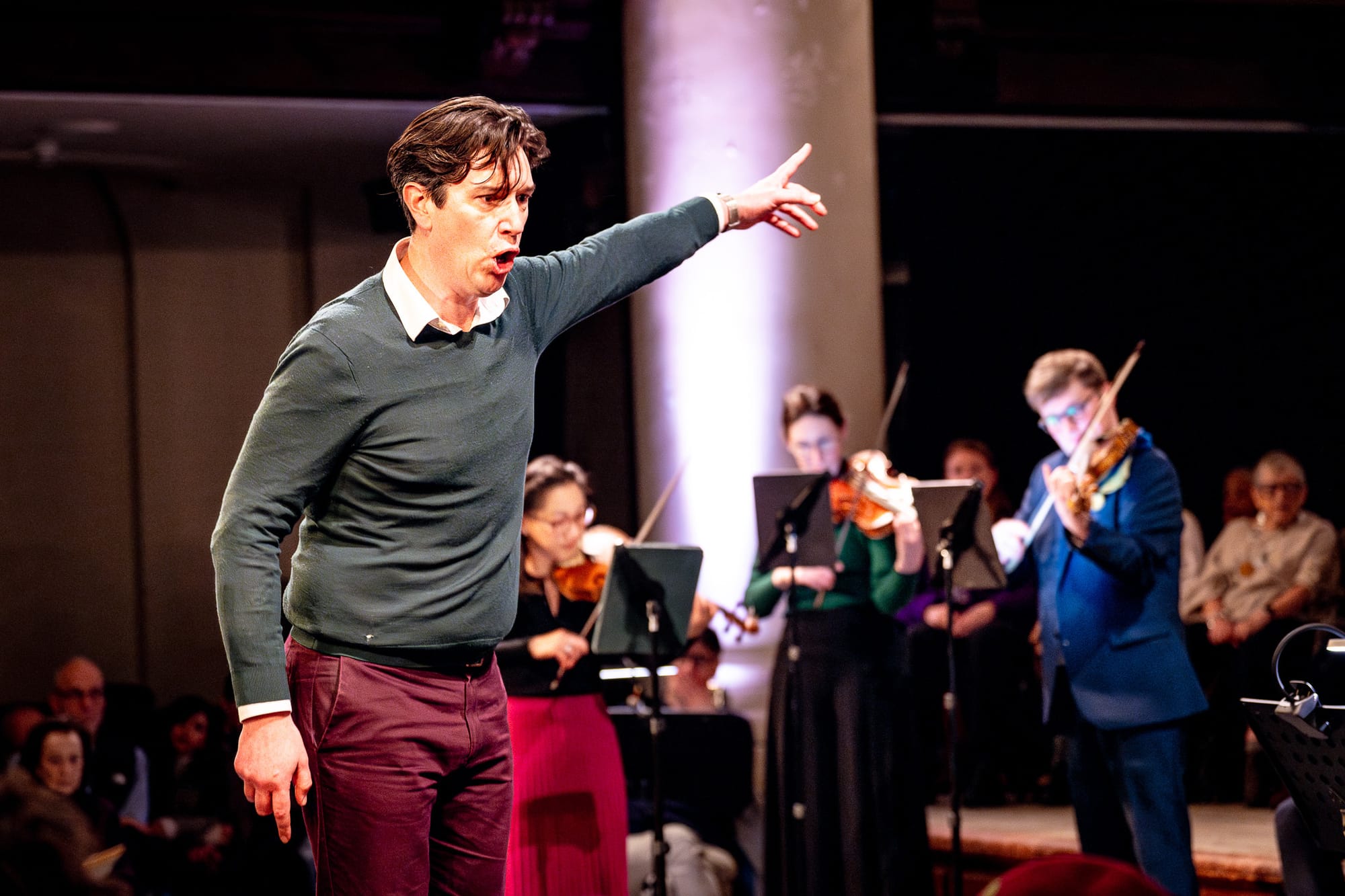
Handel Messiah, HWV 56. Joanna Songi, Sofia Kirwan-Boaz (sopanos); Marha Jones, Kate Symonds-Joy (mezzos); Guy Elliot, Harry Jacques (tenors); Timothy Nelson (baitone); Edward Hwkins (bass); The Wild Arts Ensemble (Sijie Chen, Will McGahon, violins; Hannah Shaw, viola; George Ross, cello; Mairanne Schofield, double-bass; Leo Duarte, Geoff Coates, oboes; Chris Rawley, bassoon; Sam Lewis, Brendan Musk, trumpets; Tom Lee, timpani / Orlando Jopling (director/harpsichord). Tom Morris, director. Smith Square Hall, London, 19.12.2025
Jesus isn't the only one who can create miracles: Wild Arts gives him (Him?) a pretty good run for h(H)is money. They create magic from the smallest ensembles (and budgets, presumably); the paucity of stage objects in this case means a cross takes on huge significance - unsurprisingly, perhaps. With Wild Arts' Donizetti L'elisir d'amore at Thaxted in 2023, I was entranced beyond measure; a Zauberflöte followed the next year. Now, we have Handel's Messiah, staged by Tom Morris.
Staged? Well, a pre-show spoken intro by bass Edward Hawkins explained that a (somewhat vague) reference to an early performance of Messiah might have meant there were dramatised elements; and little else was needed as a spur, clearly. The soloists in ensemble make up the chorus, resulting in a brilliant transparency of texture (and semiquaver melismas that sparkle). The same could be said of the instrumental ensemble, led by the extraordinary violinist Sijie Chen and including wo mobile trumpets (up high either side of the organ in the Third Part).
The idea of a mobile chorus worked beautifully: disparate solo voices physically moving together to crate a vox populi. The words of arias took on whole new meaning as singers reassured each other, hand on a shoulder here and there. Thus Messiah became much more than the sum of its parts; it also became one arc, with arias blending effortlessly into other arias. The use of the full ground floor of the church made this an involving experience; voices were as likely to come from behid you than in front.
Recontexualised like this, Messiah becomes a dynamic, living organism, its vitality reflected at every turn by that of the players and singers. I mention the players as they are the engine of this drama, the one-to--part transparency enabling us to hear the music anew. Perhaps the most remarkable instrumental moment was the “Pifa,” its gentle pastoral rocking suddenly sounding like some ancient bagpipe.
If there is a criticism, it is that several of the choruses, while starting off with exactly the right energy, sagged in the middle. They lost some of their momentum and energy, not in terms of tempo, but in terms of the music's own internal motor (“His Yoke is Easy” bring a case in point).
The soloists were perfectly chosen, voices blending superbly. Each seemed to have the perfect stage presence (perhaps especially alto Kate Symonds-Joy, with a depth of voice to match). Both tenors, Guy Elliot and Henry Jacques, found both strength and agility to their roles (Elliott absolutely mesmeric in the opening “Comfort ye”), while alto Martha Jones sang with laser-like focus. The two sopranos (who rather confusingly look like identical twins in their publicity photos) excelled, light in delivery, profound in meaning, Soprano Joanna Songhi's “I know that my Redeemer liveth” was a highlight, an ugently acted out statement of belief in the face of adversity.
But, maybe it was the way the three parts not only formed an organic whole, but that each had its own overall energy that enabled this to work so well. The energy of the final part was laden with grief, and cast in darkness, “Since by man came death” a sort of Rothko-esque black on black, and standing in total contrast to the blazing light of “the resurrection of the dead” . It is true that the distancing of the trumpet brought with it the occasional ensemble problem, but the effect of that final part was unforgettable, more so than in any of the (many) performances of this work I have heard.
A wonderful achievement. Oratorio and opera were pretty fluid in Handel's time (think of Covent Garden's stagings of oratorio, for example; their Jephtha in 2023 was remarkable), and this Messiah experiment is unforgettable. Wild Arts can be justifiably proud.