
A Glyndebourne triumph: Rossini's Il Turco in Italia
Any review of this Glyndebourne Turco would be incomplete without a mention of Elvis Presley and his sausage.
Rossini Il Turco in Italia. Soloists: Glyndebourne Chorus; London Philharmonic Orchestra / Bertie Baigent. Glyndebourne Festival Opera, 28.5.2026
Production:
Director - Mariame Clément
Revival Director - Ian Rutherford
Designer - Julia Hansen
Revival movement - Anna-Marie Sullivan
Lighting - Bernd Purkrabek
Video design - David Fricker
Cast
Don Geronio - Rodion Pogossov
Donna Fiorilla - Elena Villalón
Selim - Peter Kálmán
Don Narciso - Minghao Liu
Prosdocimo - Matteo Mancini
Zaida - Aytaj Shikhalizada
Albazar - Anie Gou
Girlfriend - Anna-Marie Sullivan
This is a revival of the 2021 staging of Rossini’s Il Turco in Italia. The director is Mariane Clément, whose staging chimes in perfectly with the 2026 season’s theme of meta-theatre (brilliantly introduced by Julian Johnson in his Festival booklet essay, Opera about Opera). There is a brilliance here, a deft hand that suits Rossini’s evergreen comedy perfectly, expertly overseen by Revival Director Ian Rutherford. And as far as meta-theatre is concerned, I can’t wait until Ariadne …
It would have been easy to move in very different directions, darkening the experience: Rossini’s opera focuses on ‘otherness’ - the arrival of a cultural ‘other’ into an established society. As such it is akin to L’Italiana in Algieri, but with the direction reversed: rather than an Italian traveling to ‘strange’ lands, here a Turk, Selim, arrives in Naples. He’s wealthy, too, which helps his chances of success in all sorts of fields. Instead of taking the idea of cultural identities, personal or collective, and their blurring/enrichment/dilution via the insertion of others (highly relevant right now, of course) this production instead sits firmly in the bosom of the central season concept of ‘meta-theatre’: theatre about theatre, in which audience discombobulation is a vital part. So here, instead of the author Don Prodocimo finding inspiration from those around him, he actually creates via his imagination the figures which act out around him. We see a blank page projected on stage - the archetypal writer’s slate and potential block, challenging him to write. As he writes on paper, so we see the plot emerge, sometimes in diagrams of characters with lines between them to show relationships. This enables Clément to play with epochs: the writer is very much of our time, the 21st century, but we find ourselves in various earlier time: a 1950’s delicatessen, for example.
Meta-theatre is now new, not by any means, and plays with ‘voices’ - an author and his characters in this instance. Stories within stories: I am minded of Carolyn Abbate’s book Unsung Voices, which searches for opera’s ‘voice’ and in doing so explores the scene around Lakmé’s ‘Bell Song’ in Delibes’ opera of that name, a telling of a story within an opera that is itself a story. But a whole season that explores all angles of meta-theatre has the potential to be revelatory. And, talking of inter-opera correspondences, the Orientalism (as Turkey would have surely been seen in those days) reaches over (in our terms) and back (in historical terms) to Mozart’s Serail later in the season.
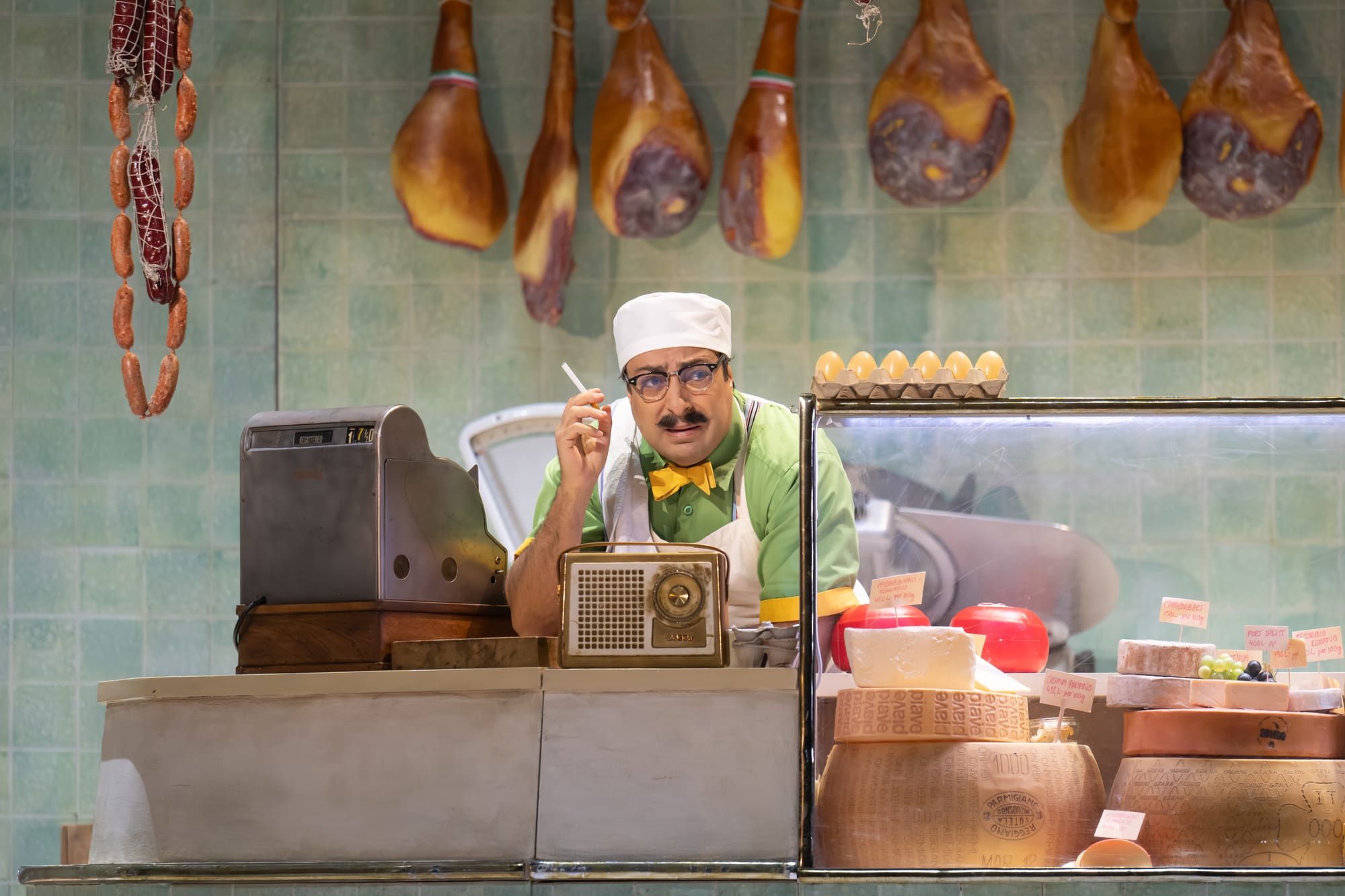
Here in Turco, interaction, intersection and juxtaposition of eras poses great challenges for the staging, and it is deftly managed by Julia Hansen’s designs, which while implying the present day for the writer at home, adds various other scenes - a delicatessen, a garage, the gypsies’ caravans, and so on. The time envelope clearly reaches back to the 1950s. It is virtuoso both in stage manipulation and in how the audience can transfer attention from one era to the other effortlessly. Interactions between characters and the author perhaps mirror the quasi-autonomous life characters take on for authors as part of the creative process, too. All hewn in bright colours, with superb lighting by Bernd Purkrabek.
Here's the official trailer:
The original conductor for the earlier performances was to have been Vincenzo Milletari; Bertie Baigent took over all performances except that on June 26, which will be led by Jack Gonzalez-Harding.The overture set the atmosphere perfectly - it also holds two key brass solos, a long, expressive one for French horn and an agile trumpet later on, both despatched with both ease and accuracy by LPO principals. The drone opening to the chorus ‘Nostra patria è il mondo intero’ was perfectly judged by Baigent, too, leading to the Glyndebourne Festival Chorus in fine fettle (as they were throughout). But there was a lot going on during the overture, as Prosdocimo signs copies of his new book, which while dramatically clever distracts from Rossini’s magic enacted downstairs in the pit.
The orchestral excellence was unflagging, however, as was the superb fortepiano continuo. Baigent’s tempos were light, fleet and yet gave space for melody and, indeed, decorations (Selim’s ‘Che bel Turco! Avviciniamoci’ a case in point - lower voices do need that space, and Peter Kálmán was superb, as he also was throughout, occasional air around his voice notwithstanding).
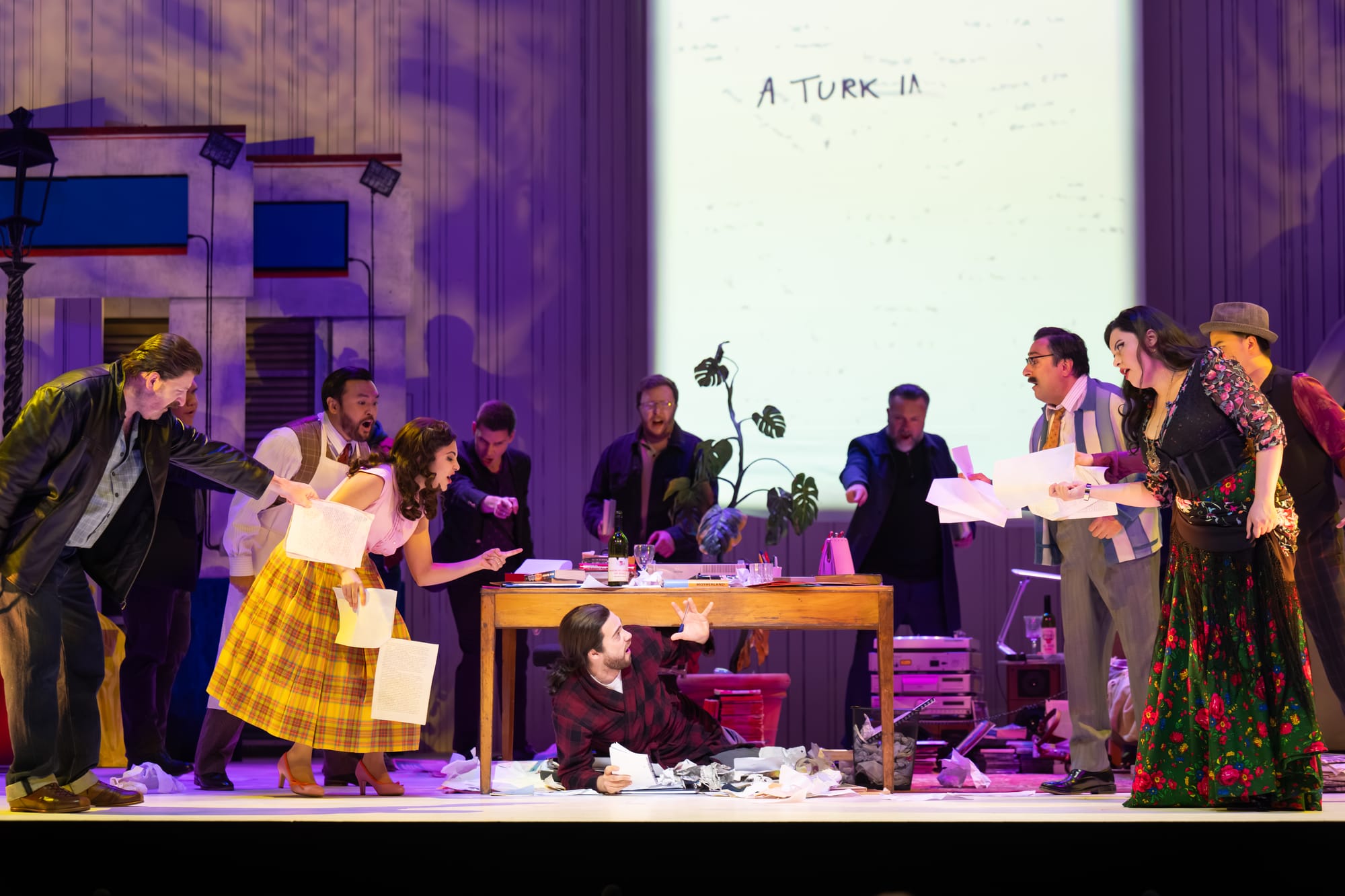
Seen at home, Prosdocimo (and with his silent partner, played by Anne-Marie Sullivan) exists in creative turmoil and chaos, searching for notes (paper!) in the mess of crumpled, discarded ideas under his desk (see photo above). Matteo Mancini takes the role with brilliance, his presence a brilliant mix of authority and authorly misdirection as he explores the plot’s cul-de-sacs and possibilities.
Rodion Pogossov’s Don Geronio is the only cast member taken over from the 2021 cast. He sings and acts with great assurance, a fabulous comedy actor who absolutely held his own. But for all the male singers - and we’re not finished with them, yet - it was two of the ladies who triumphed. The first is as it should be: the leading lady, Fiorilla, Elena Villalón was superb, her ‘Non si da follia maggiore’ eloquent and yet agile, her great act II scena ‘Squallida veste e bruna’ justifiably bringing the house down. But how lovely it is to hear a ‘secondary’ character sung with such confidence and beauty that she attains equal footing in the memory: Aytaj Shikhalizada as Zaida was just phenomenal: her act 1 scene 2 contribution to ‘Nostra patria è il mondo’ alongside the strong Albazar of Anie Gou was the first of several moments when she shone. It is always wonderful when the smaller roles excel, and I look forward to hearing more from this singer. Shikhalizada arrives fresh from singing Grimgerde, one of the Valkyries, in an all-star Walküre at Salzburg (Lise Davidsen, Brünnhilde - whom I hear tonight at Wigmore Hall and which report will appear here next week - Christopher Maltman, WotanBrindley Sherratt, Hunding).
Any review of this Glyndebourne Turco would be incomplete without a mention of Elvis Presley and his sausage. It’s not the first time an Elvis quiff has graced the role of Narciso (think Moshe Leiser and Patrice Caurier,’s RBO staging), but how it worked. Minghao Liu loved every moment of his act 2 scena, and so did the audience (his post-performance bow was absolutely in character, too).
This is magical. Any gripes are micro-gripes, with an orchestra delivering preternatural accuracy 99% of the time at least. Glyndebourne’s season this year is a procession of great operas: L’Orfeo is next in line.