
1851: Schumann & Moscheles Sonatas from Steven Isserlis & Connie Shih
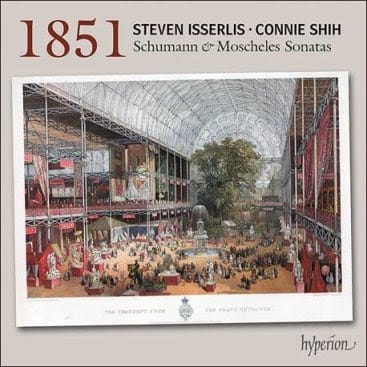
Released on 30 January 2026, Hyperion's beautiful new recording is inspired by a single year, 1851, concentrating on two major chamber works: 1851 is the year he piano make Érard won an award at the Great Exhibition in London. Residing in Birmingham, the piano is vital to this recording: Érard’s new action was hailed as a marvel by Berlioz (and admired by Queen Victoria at the Great Exhibition).
Both sonatas presented here (Schumann and Moscheles) were written in 1851, as were all four of the smaller pieces. It's also the year the Érard piano in this recoding was made. The Moscheles Sonata is, other neatly, dedicated to Schumann.
At the centre are two major works: Schumann’s Violin Sonata No. 2 in D minor, Op. 121 (in Steven Isserlis’s own cello version); and Moscheles’s Sonata for Cello and Piano in E major, (bizarrely, also Op. 121). The disc also includes Ferdinand David’s Romanze in F major, Op. 28 No. 4, and Gounod’s famous Ave Maria, performed together with The Gesualdo Six. NB that's Fedinand David (1810-73); a later Classical Explorer post will introduce the music of Johann Nepomuk David (1895-1977)
Steven Isserlis has released the following about the project:
This album is unusual, I know, in its concentration on one year; but when I realised that Schumann’s magnificent 2nd violin sonata (which I’d previously arranged for cello) and Moscheles’ wonderfully loveable sonata (dedicated to Schumann) were both written in 1851, the year in which the beautiful Erard piano in Birmingham was made, it seemed to be a sign! Remembering the lovely experience of recording Chopin and Schubert a few years ago, with Dénes Várjon on that piano, I just couldn’t resist. Connie also dived into the project with great enthusiasm, falling in love with the Erard; we hope that the album conveys our love for the music, the instrument and also for the personalities and intricately intertwined life-stories and musical relationships of the composers represented here.
Schumann’s Second Violin Sonata references the chorale “Gelobet seist du, Jesu Christ”; some have speculated this may reflect Schumann’s grief for his friend Mendelssohn, who had died, tragically young, just four years earlier (Mendelssohn had brought in the same chorale at the emotional climax, the finale, of his Second Piano Trio. Here's the famous Stern/Rose/Istomin CBS performance, with score:
0:00: Allegro energico e con fuoco 10:24 - Andante espressivo 17:34 - Scherzo. Allegro molto quasi presto 21:23 - Finale. Allegro appassionato
Isserlis is beautifully expressive in the first movement of the Schumann sonata that launches the album; Connie Shih is very much an equal, and plays with beautiful freedom. The Érard allows for perfect balance between the two (and boasts a lovely sweet treble, to boot). Amazingly, Isserlis' articulation is everywhere clear (the lower pitch could easily muddy the more rapid passages); most impressive, though, is the sheer sweep of the performance:
A muscular Scherzo cedes to the slow movement ("Leise, einfach"), again referencing that chorale.
The finale is cleanly kinetic; it has all of the movement ("Bewegt") Schumann asks for. I love the sheer radiance the players achieve on the very final chord, the Érard's sound full and sonorous, Isserlis' cello positively elated:
Here's the violin and piano original, a live performance by Gidon Kremer and Martha Argerich from Japan:
Ferdinand David's Fünf Salonstücke (Five Salon Pieces), Op. 28 was again originally for violin and piano and No. 4, a Romanze, is heard here in another Isserlis arrangement. Unfortunately, the only YouTube I could find of the violin original isn't really up to scratch; worth pointing out the Nocturne, No. 1, is equally lovely (Megumi Shimane and Toshiki Usui make a fine fist of it on the disc, From Viotii to Mendelssohn). Here's Isserlis/Shih, giving the piece a nice sense of movement (so it' doesn't over-sweeten):
The shock coms with the Moscheles, cast on a large canvas (27 minutes all told). Hyperion is a particularly fine label for Moscheles thanks to its Romantic Piano Concerto series; nice to have this as supplemennt, although to call the piece such is to do it a disservice. Moscheles was, of course, a.major piano virtuoso, so no surpass both parts are challenging. But melodically, the first moment is beautiful, The music unfolds, reflects on itself, with an optimism that belies Moscheles' challenging circumstances a the time of composition.
T
Arguably the first movement does run out of steam a tad; but the Scherzo is a sort of slightly heavy Mendlssohn, full of felicitous touches. It's also about as emotive as Moscheles gets, before cleaning the air with swirling, heady piano writing. It is the "Ballade" of the this Sonata that is most touching, however, "In böhmischer Weise," looking back to Moscheles' Czech roots:
Shish's articulation is a joy in this multi-faceted movement, part dumka, part tone-poem; the finale is the perfect complement, grand in design and ambition, structurally sound, and how the players take to heart he "ma non troppo" qualifier to the Allego vivace so that everything registers:
Two pieces, in the manner of encores: Schumann's Op. 127/1, the first of the Lieder und Gesänge held within that opus: " "Sängers Tost," arrangzd by Isserlis again, the music now intimate, deeply melancholic:
Finally, with a nice touch of portamento, Ave Maria, the Bach/Gounod "Méditation"are Bach's C-Major Prelude, BWV 846, in which Isserlis and Shih are joined, eventually, by the Gesualdo Six, who offer a sort of cloud of sound around Isserlis:
The disc is available fom Amazon here. iDagio here. remaining streaming below: